
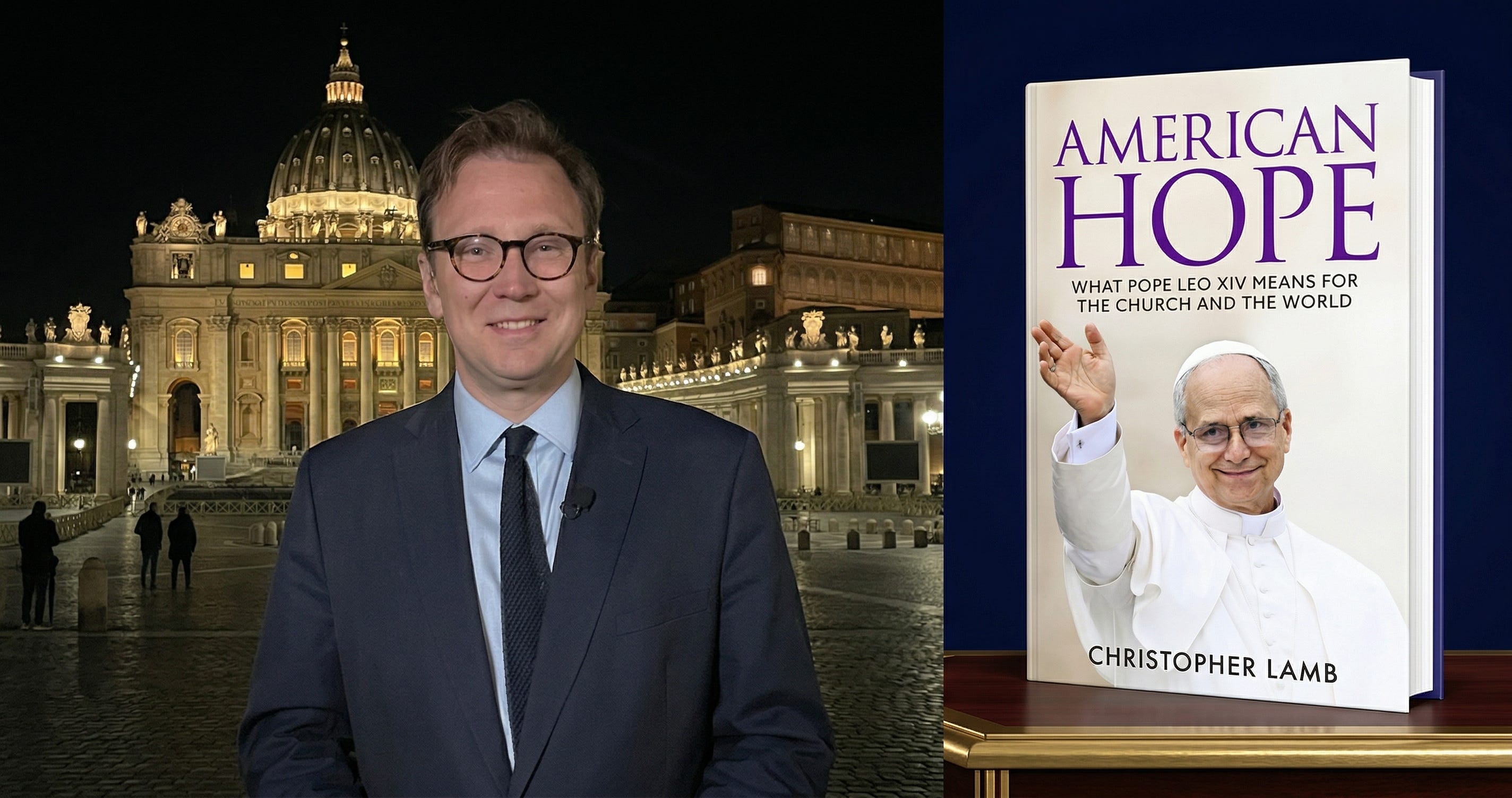
“A Lion Who Knows When to Roar” — Christopher Lamb’s Revelatory Portrait of Pope Leo XIV
Christopher Lamb spent two decades covering the Vatican. His account of Leo’s first year draws on interviews with cardinals, diplomats, and members of the pope's inner circle.
Dear friends —
Before you read today’s essay, one important note:
Anyone who purchases a yearly subscription to Letters from Leo or donates $80 or more from this post will receive a brand-new copy of Christopher Lamb’s American Hope: What Pope Leo XIV Means for the Church and the World.
This offer is available through Thursday, April 2 at 11:59 PM PT.
If you’ve been considering joining our community, this is the moment — and this is the book. I’ll explain why below.
On Tuesday night, CNN’s Christopher Lamb stood at Castel Gandolfo as Pope Leo XIV walked to his car after an evening of quiet reflection at the papal residence outside Rome. Lamb asked the pope about President Trump and the war in the Middle East.
Leo paused, then offered a message that aired on Anderson Cooper 360 within hours: “Hopefully, he is looking for an off-ramp. Hopefully, he is looking for a way to decrease the amount of violence, of bombing, which would be a significant contribution to removing the hatred that’s being created and that’s increasing constantly in the Middle East and elsewhere.”
That scene — a veteran Vatican correspondent catching the pope in a candid moment outside an ancient hilltop palace, extracting a message intended for the most powerful man on earth — captures exactly why Christopher Lamb is the right person to write one of the definitive first accounts of this papacy.
American Hope, published last week by Headline Press, is the result of two decades of Vatican reporting, extensive access to the Vatican and Pope Leo, and a deep understanding of what the election of the first American pope means for both the Church and the world.
I have always found Lamb to be one of the most intrepid Vatican reporters working today, and I trust his work through and through. That trust is rewarded on every page of this book.
Lamb was sitting on a temporary CNN broadcasting set in St. Peter’s Square on May 8, 2025, his back to the basilica, when smoke billowed from the Sistine Chapel chimney. White smoke.
“The first American pope has been elected!” he announced live on air, and the prologue of American Hope places the reader right there beside him — amid tens of thousands of people gathered in the square, the stunned commentators, and the electric uncertainty of a conclave that had lasted little more than twenty-four hours.
The book that follows is structured around five essential themes of Pope Leo’s young pontificate: his extraordinary capacity for listening, his role as a spiritual counterweight to the Trump administration, his efforts to unify a deeply polarized Church, his quiet but determined approach to reform, and his vision for the Church’s finances and institutional credibility.
Lamb’s reporting draws on interviews with cardinals, senior Vatican officials, diplomats, and members of Leo’s inner circle, producing a portrait of a pope that feels both intimate and authoritative.
Lamb’s portrait of Leo’s temperament is especially revealing.
“Beneath what might seem a meek exterior lies a steely determination,” Lamb writes. “Leo is a lion who knows when to roar, and the moment he decides something, it’s final.”
This is a pope shaped by the ancient rule of St. Augustine, by decades of missionary work among communities experiencing extreme poverty in Peru, and by his time leading one of the Vatican’s most powerful offices — the department responsible for appointing and disciplining bishops around the world.
Lamb traces how each of these experiences forged a leader who prefers incremental reforms that become “codified in the Church’s law and culture, and irreversible.”
The chapter on Leo as a “spiritual counterweight” to the MAGA movement is the book’s most urgent contribution. Lamb documents the sharp contrasts between the pope and the president with granular specificity: Trump dismisses climate change while Leo insists the Christian faith demands environmental stewardship. The administration arrests and deports immigrants; Leo calls for their welcoming and integration.
Lamb also confirms what I first reported in Newsweek last year: that Leo, then Cardinal Prevost, helped draft Pope Francis’s forceful letter to the American bishops denouncing mass deportation and warning that nationalist ideology risks making “the will of the strongest” the sole criterion of truth.
That detail alone reframes the first months of Leo’s papacy — this was not a pope reacting to the Trump administration in real time but one who had been preparing his moral response for months before the white smoke rose.
And when Trump attacks journalists, Leo defends the freedom of the press by citing Hannah Arendt’s The Origins of Totalitarianism. Lamb situates this tension within a deeper argument about moral leadership.
“Leo is the only American in the world today who matches Donald Trump’s status in terms of global recognition,” he writes. That framing — two Americans, two radically different visions of what the country and the world should be — gives the book an almost novelistic dramatic structure.
The reporting on Leo’s family is revelatory. Lamb details how the pope’s eldest brother, Louis Prevost, is a vocal MAGA supporter who posted inflammatory pro-Trump content on social media and was welcomed at the White House by Trump and Vice President Vance.
“We’re still very close, even though one is far on one end politically; we’re in different places,” Leo said. The pope, in his own family, models exactly the unity he preaches for the Church: you can disagree and stay united. Love can reach across the divide.
What makes American Hope exceptional is Lamb’s refusal to flatten Leo into a caricature.
Leo chose his papal name because the Church’s social teaching tradition — pioneered by Leo XIII in the late nineteenth century — can offer an antidote to “another industrial revolution” driven by artificial intelligence.
He restored the tradition of using the Castel Gandolfo residence, signaling to priests everywhere that rest and renewal are essential. And his personal trainer at a gym near the Vatican had no idea his client was a cardinal until he saw him on the balcony of St. Peter’s.
These details, woven throughout the book, reveal a man who is fully human, deeply private, and profoundly serious about the long-term trajectory of the institution he leads.
Lamb closes the book by looking forward to the generation of young Catholics who see in Leo a figure of authenticity in a world saturated with performance. He quotes Leo’s inaugural message from the balcony: “La pace sia con tutti voi!” Peace be with you all.
At a moment when the pope is begging world leaders to stop the killing, when American bombs are falling on Iran, and when Catholic voices for peace are more necessary than they have been in a generation, that message carries an urgency Lamb captures with precision and moral clarity.
Buy this book. Read it cover to cover. Give it to the person in your life who wants to understand why this pope matters.
And if you want a free copy, join our community as a yearly subscriber or make a one-time donation of $80 or more before Thursday, April 2, at 11:59 PM PT.
At Letters from Leo, we stand with every Catholic and person of goodwill who believes that moral leadership still exists in this world — that a pope from Chicago who spent his life among the poor in Peru can speak with an authority that no amount of political power can manufacture.
Christopher Lamb’s book captures why this papacy matters, and our community exists to ensure that the message reaches as far as it can.
In an era when cruelty is marketed as strength and indifference is dressed up as realism, we remain rooted in a faith that insists on the dignity of every human life — born and unborn, documented and undocumented, American and Iranian.
This is the fastest-growing Catholic community in the country because people are hungry for something deeper than rage and propaganda. They want truth grounded in the Gospel, courage that doesn’t flinch, and a community that holds together when everything else fractures.
If you believe this movement matters — Catholics and people of goodwill standing for human dignity against the forces of division and war — I am asking you to join us.
If you’d like to invest in our mission, here are three ways you can help this Holy Week:
Subscribe as a paid member to receive exclusive posts about the life and formation of Pope Leo and help sustain this newsletter.
Donate with a one-time gift to fuel this project’s mission.
Share this post (and Letters from Leo) with a friend who might enjoy it.
Paid subscribers have access to the ongoing biographical series on Pope Leo’s life and formation, our investigative series on Jeffrey Epstein and Steve Bannon’s attempt to take down Pope Francis, and the best of our full archive.
Letters from Leo is open to anyone who wants to be informed and inspired by our pope — and to turn that inspiration into action that leaves America and the world more just, less cold, and more alive with hope.
Whether you give $0, $1, or $1,000, your presence here matters — no matter your faith or your politics.
Thank you for reading. I’ll see you on the road.


Blessings and God's grace
In 12- step language, to be a friend among friends and a worker among workers does not mean I value myself less than others; it means I value YOU more. It does not mean that my self-esteem decreases; it means that my esteem for YOU increases. We are interconnected, and in many ways interdependent. Pope Leo understands this. He models this humility and awareness. His personality is a great balance between those two poles, and his faith is real and palpable. We desperately need this modeling in the current world of narcissists and people who think their wealth makes them "above the law" I am looking forward to reading the book!