
“A Miracle of Compassion” — Pope Leo XIV Spends America’s 250th Birthday With the Migrants of Lampedusa
Leo XIV wore blue vestments stitched with waves and preached the Good Samaritan to an entire continent. Before Mass began, I got to wish the first American pope a happy Fourth of July.

Thank you for reading! Letters from Leo is a reader-supported movement of Catholics and people of goodwill standing for human dignity in the United States and around the globe. To invest in this mission, please consider becoming a free or paid subscriber.
LAMPEDUSA — Pope Leo XIV celebrated Mass this morning on a treeless strip of Mediterranean rock that lies closer to Africa than to the Italian mainland, wearing vestments accented in blue.
While the United States marked the 250th anniversary of the Declaration of Independence with parades, cookouts, and fireworks, history’s first American pope spent the Fourth of July on Lampedusa, the tiny Sicilian island that serves as Europe’s front door for migrants crossing from North Africa. Tens of thousands of others never reached it alive.
I was there, one face among the islanders and the newest arrivals who gathered for the 10:30 liturgy beneath the image of Our Lady of Portosalvo — Our Lady of Safe Harbor, the island’s patroness. The statue survived the Second World War bombs that leveled her sanctuary here. Today she stood beside Pope Leo XIV as he celebrated Mass for the migrants who cross her sea.
This essay will attempt to do two things. It will report what Leo XIV said and did on one of the most symbolically charged days of his young papacy — and then it will try to put into words what an American feels celebrating holy Mass on a migrant island with the first American pope on the 250th birthday of our country.
Before the liturgy began, I had the chance to briefly greet the pope. I told him what I would tell any fellow American on this day: hello, Holy Father, and happy Fourth of July. He answered in English, gracious and audibly delighted: “Thank you!”

I will carry that half-second exchange for the rest of my life. Our nation’s founders would have no idea what to do with this, and I love that. More on it below — but first, the news.
A morning at the door of Europe
The pope’s day began early. After landing just before 9 a.m., Leo drove first to the island’s cemetery, where a section of the graves holds people who drowned trying to reach this shore. He laid a wreath of yellow and white flowers on tombs marked by crosses carpentered from the splintered wood of shipwrecked boats, and he paused over the grave of a child named Joussef.
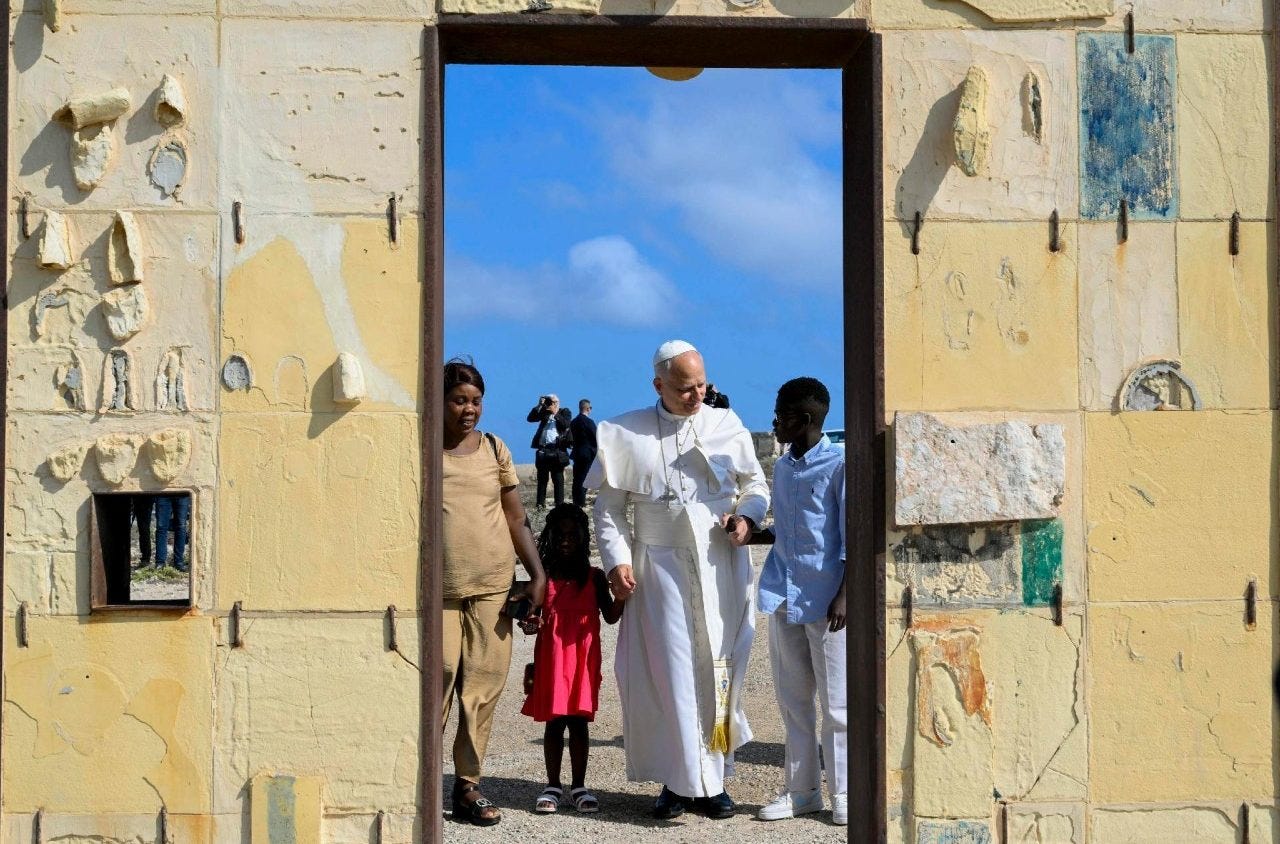
At the Porta d’Europa — the “Door of Europe” monument that stares out at the sea — a ten-year-old boy handed the pope a letter and a ball.

The boy’s name is Leo. He landed on Lampedusa alone a decade ago, after his mother perished in the crossing. “They tell me I stopped crying only when someone gave me a ball made of paper,” he wrote to the pope who shares his name. “From that day the ball has stayed in my heart, and I have never stopped playing. I hope with all my heart that this ball I am giving you can reach another child and make him as happy as it made me.”

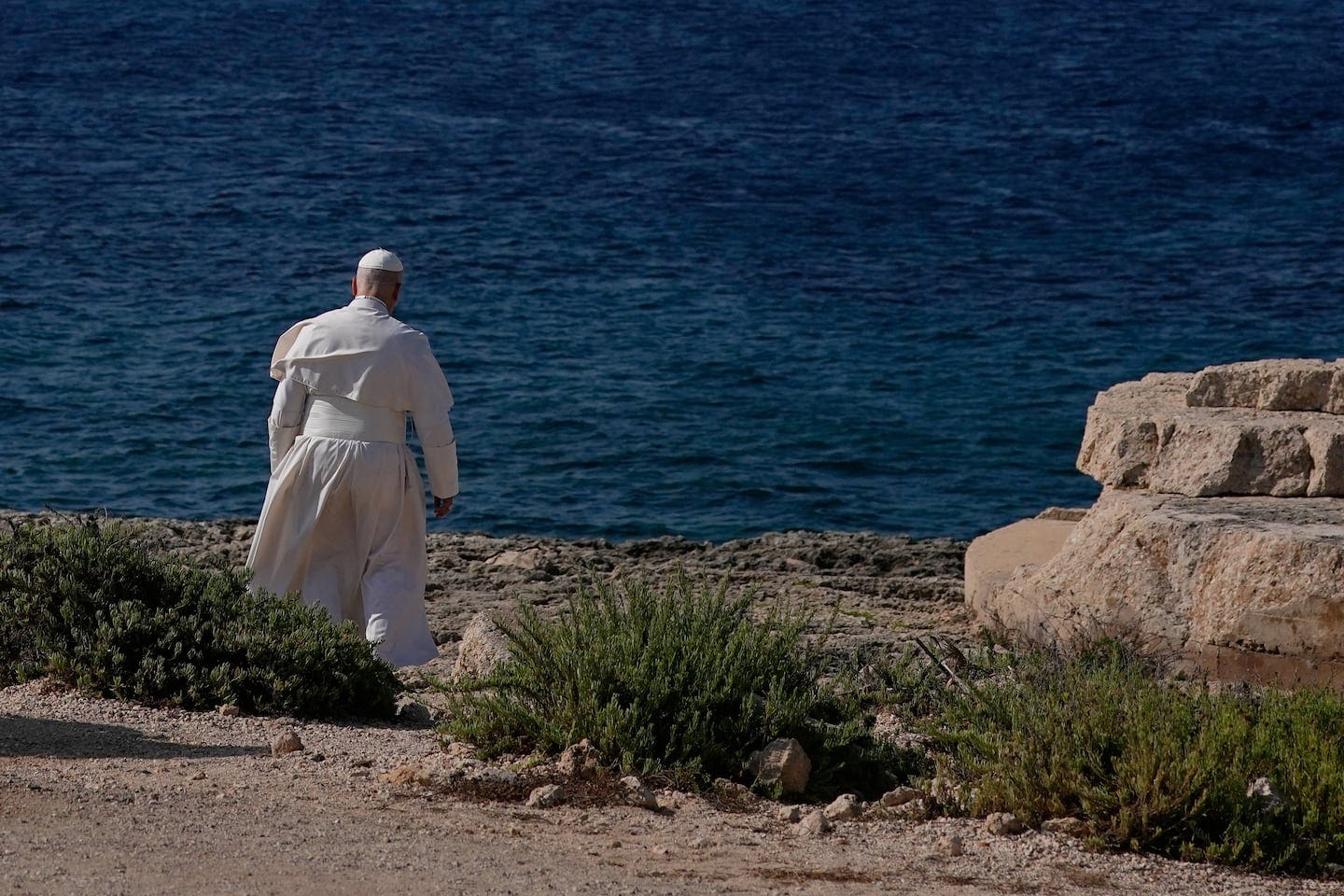
The pope then moved to the Favaloro Pier, where the rescue boats unload the living. He greeted a group of migrants, blessed a plaque dedicating the dock to Pope Francis, and walked out alone onto the jetty rocks, where the wind pulled the zucchetto from his head as he stood looking at the water.
Francis stood in nearly the same place almost exactly thirteen years earlier, on the first journey of his papacy, and denounced “the globalization of indifference.”
Leo’s itinerary today traced his predecessor’s footsteps almost stop for stop — a deliberate signal that the Church’s arms remain open at Europe’s southern door, whoever occupies the Chair of Peter.

Then came the Mass, celebrated on the same sports field where Francis preached in 2013. In his reply to the mayor’s welcome, Leo insisted he had not come to give speeches but to celebrate the Eucharist, “the supreme sign of Christ’s presence among us.” “This is a place where gestures speak louder than words,” he said. “But for gestures to be human, they need a heart.”
Having disclaimed speechmaking, he proceeded to deliver one of the longest homilies of his pontificate. He thanked the people of Lampedusa for the “miracle of compassion” they have shown the strangers who reach their beaches, and he turned the parable of the Good Samaritan loose on an entire continent.
“Here you have seen not just one, but thousands of human beings fallen into the hands of robbers who have taken everything from them, beat them brutally and walked away, leaving them half-dead,” he preached.
The obligation to respond, he insisted, comes before politics. “Indeed, before any intellectual consideration or ideological conviction, the encounter with those who lie before us, stripped of everything, calls us to be close to them.”
“It is time to recognize and affirm that religious affiliation must never become a reason for discrimination, as if faith had boundaries rather than being a universal call to salvation,” he continued. “Where there were walls of separation, Christ broke them down. There is no love of God without love of neighbor, and there is no neighbor if I do not draw near. To pause, to be moved, to bend down, to weep before another’s pain — as Jesus did — means entering into the dynamic of love, the very movement in which God has revealed himself.”
He spoke of the drowned as though they had filled the empty seats. Those who never finished the crossing, he said, make their presence felt among us, challenging us no less than the survivors who land in need of attention and aid. The International Organization for Migration has recorded more than 35,000 migrants missing in the Mediterranean since 2014, and the real toll runs higher, because many shipwrecks are never recorded at all.
“Those who have lost their lives in the Mediterranean Sea are victims both of decisions that were made and of decisions that were not made,” he said, before naming them one by one:
“Indifference to the common good and corruption in their countries of origin; a global economic system that generates poverty and exclusion; fear that fuels prejudice and contempt; the belief that such problems do not concern us; the criminal calculations of those who profit from the suffering of others; the slow and difficult transition from mere emergency management to the development of comprehensive and shared policies.”
Preaching from what he called “this far-flung corner of Europe on the Mediterranean Sea,” Leo urged the continent’s leaders to address migration in a comprehensive way — immediate relief joined to long-term strategies to welcome, protect, promote, and integrate those who arrive, while developing their home countries so that no one is forced to migrate.
“Only mercy can respond, with new beginnings, to the depths of the human heart and to the horrors of war,” the pope said. “We have entered a millennium in which we must give spiritual, cultural, legal, political and economic expression to the civilization of love. May the enormity of the suffering we witness help us grasp the radical nature of this call.”
Washington was meant to hear every word. Leo has clashed with the Trump administration for months over a mass deportation campaign that has struck hardest in his native Chicago.
On Friday, the U.S. bishops released his letter to the American people for the 250th anniversary — I covered it in full yesterday — in which the pope wrote that defending human life includes “welcoming, protecting and assisting immigrants, whose hopes, sacrifices and contribution have formed part of the history of this country from its very beginning.”

To receive them with compassion and generosity, he added, “is not only an act of charity, but also a recognition of the dignity that belongs to every human person.”
Three weeks ago he carried the same message to the Canary Islands, Europe’s other drowning ground, where he declared that “all of us are migrants” and warned human traffickers they would answer before God.
And when federal agents detained a religious sister walking to Sunday Mass in Texas this week, the collision between American immigration enforcement and the Catholic Church stopped being an abstraction for millions of American parishioners.
The theology of water
Through the entire Mass, my mind kept circling one thing: water.
Catholic liturgy assigns its colors by season — purple for Advent and Lent, white and gold for Christmas, Easter, and the great feasts, red for Pentecost and the martyrs, rose on two Sundays a year, green for Ordinary Time. Blue sits almost entirely outside that palette, permitted only in a handful of places for feasts of the Virgin Mary.
Yet there stood the pope at the altar in a blue-accented mitre and vestments stitched with waves, under the gaze of Our Lady of Safe Harbor. Nobody in that congregation needed the symbolism explained. Today was about water.

Water holds a strange double place in our faith. At baptism we are plunged into a death — Saint Paul says we are buried with Christ beneath the surface — and what rises from the font is a new creation. The Church has always understood that you cannot get to the resurrection without going under.
The sea surrounding this island carries both meanings in the physical world. Thirst — for clean water, for food, for safety, for a life worth living — drove hundreds of thousands of people onto smugglers’ boats pointed at this rock. Thousands of them never made it. The longing that pushed them onto the water is the same longing God planted in every human heart, and it deserved better than the bottom of the Mediterranean.
And still water redeems. We thirst all day long, often without noticing, and every glass answers a need none of us did anything to earn. I knew it myself at the Mass, thirsting under the hot Lampedusa sun in a navy suit and tie. Christ told the Samaritan woman at the well about a living water that ends thirst for good. Surrounded by the sea and dressed in its color, the pope offered that water this morning to a congregation of survivors.
Near the homily’s end, he turned to the image of the Madonna beside the altar and recalled that Saint Augustine loved to describe human life as a voyage across a stormy sea, and its destiny as a safe harbor. In God, he told the islanders, we all have a safe port — and every Christian community is called to be its reflection on earth.
Two hundred and fifty years
Today was one of the most fascinating days of my life.
The founders whose signatures we celebrate tonight built a republic that deeply distrusted Catholics, and my own ancestors could scarcely have pictured the scene: an American Catholic greeting a pope born in our homeland, on an island in the Mediterranean, wishing him a happy Fourth of July — and hearing a delighted “Thank you!” in English.
And yet, as Pope Leo reminded us from that altar, we have much to live up to. The truths of 1776 do not stop at the water’s edge. They belong to the child buried beneath a cross of boat wood, to a ten-year-old with a paper ball, to Sister Letty in Texas, and to every person the sea has taken while they chased the freedom and prosperity we set off fireworks for tonight.
All day, the Door of Europe kept sending my mind back to a door of our own. One of my favorite vistas in the United States opens from the Brooklyn Bridge as you cross into Manhattan. Look left to right and you can see three things — Ellis Island, the Statue of Liberty, and the World Trade Center. The full arc of American history runs across that view: entry, then liberty, then destruction, and finally redemption in the rebuilt tower — all of it on the water, where this day taught me to look.
Ellis Island was our Lampedusa. Twelve million people came through that harbor thirsting for the same things that push boats toward this one, and the statue that greeted them still lifts her lamp, in Emma Lazarus’s words, beside “the golden door.” Lampedusa’s door and ours open onto the same water.
Tonight I will sit with that image in prayer, remember every one of you, and — as long as God gives me breath — work beside you to make sure this country remains, for every one of its inhabitants and for everyone still crossing the water toward it, a land of dreams.
At Letters from Leo, we stand with the people of Lampedusa, with the survivors who filled the pews this morning, and with every Catholic and person of goodwill who believes that human dignity carries no passport and that no child of God belongs at the bottom of the sea.
In an era when governments on two continents treat the migrant as a problem to be managed, this community stays rooted in a faith that refuses to look away from the one lying stripped and half-dead on the road.
People are hungry for courage, for truth, and for love made visible in action — and that hunger is why the fastest-growing Catholic community in the country keeps growing.
If you believe this movement matters — Catholics and people of goodwill standing for the dignity of migrants against the machinery of indifference — I am asking you to join us.
If you’d like to invest in our mission, here are three ways you can help on this Independence Day:
Subscribe as a paid member to receive exclusive posts about the life and formation of Pope Leo and help sustain this movement.
Donate with a one-time gift to fuel this project’s mission.
Share this post (and Letters from Leo) with a friend who might enjoy it.
Paid subscribers receive the full biographical series on Pope Leo’s life and formation, exclusive investigations like the Epstein-Bannon files, the weekly Sunday scripture reflections, and Pope Leo XIV Takes On Silicon Valley.
Whether you give $0, $5, $50, $500, $1,000, or more, your presence here matters — no matter your faith or your politics.
Reporting from Lampedusa: to you and to those you love, a happy and blessed Independence Day to the United States of America.
Thank you for reading. I’ll see you on the road.


Thank you. This article broke my heart, yet made me sing. Pope Leo is the person we need for this time.....
Love ❤️ is the answer