


Thank you for reading! Letters from Leo is a reader-supported publication and the fastest-growing Catholic community in the country. To receive new posts and support this movement, consider becoming a free or paid subscriber.
A reminder: to receive a free copy of American Pope, the new book by NPR’s Daniel Burke and Scott Detrow, you must buy a yearly subscription or donate $80 or more through my review itself by Thursday, Oct. 8.
On Monday night, at Pier Sixty on the Hudson River, Commonweal gave its Centennial Award to Father John Jenkins, C.S.C., who led the University of Notre Dame from 2005 to 2024. I had the honor of being in the room.
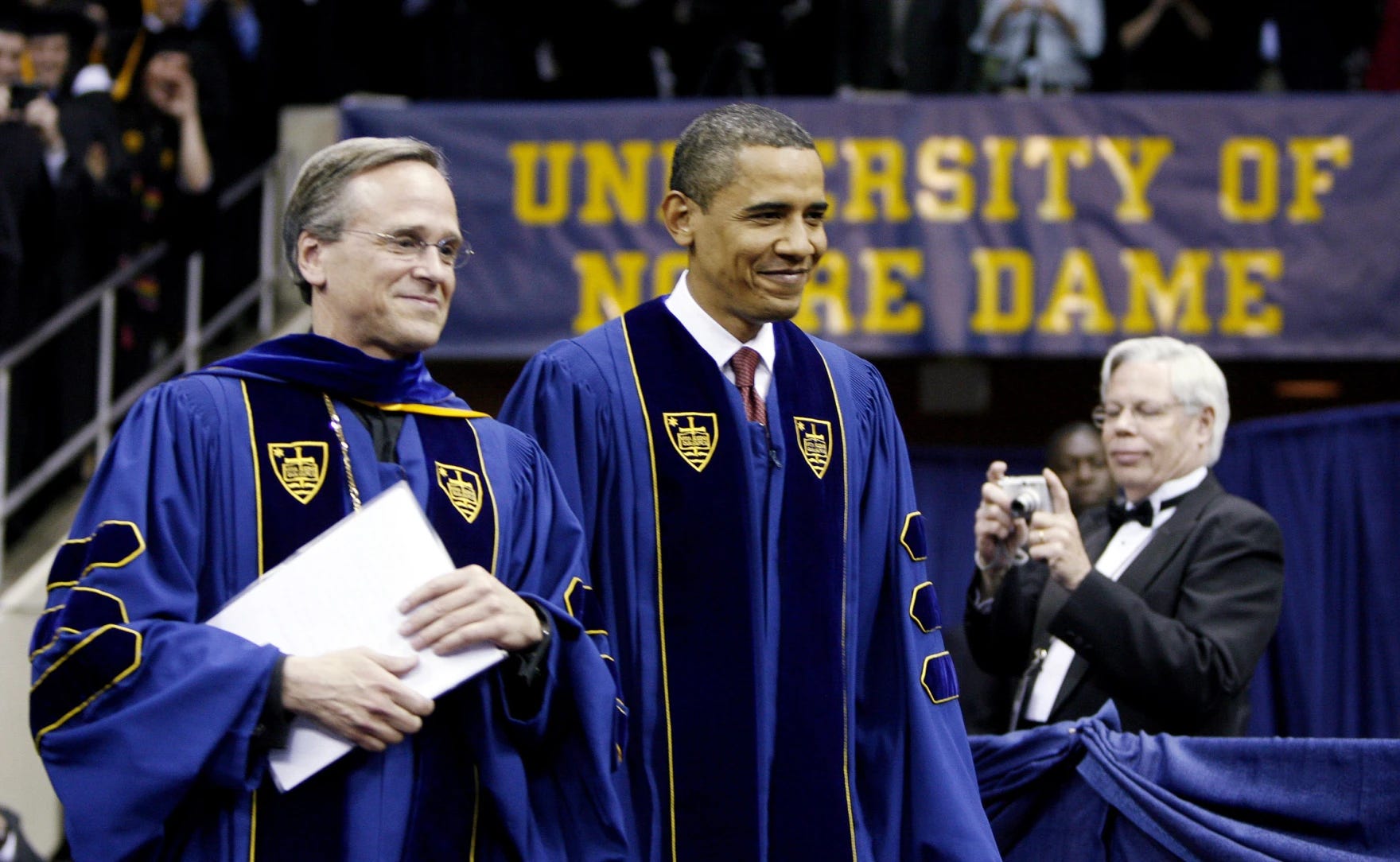
Jenkins has been on my mind for weeks. Last month I went back to the spring of 2009, when he invited a newly inaugurated Barack Obama to deliver Notre Dame’s commencement address and accept an honorary degree.
The backlash came fast. Dozens of American bishops objected publicly, and Bishop John D’Arcy of Fort Wayne-South Bend, whose diocese includes the campus, refused to attend. Mary Ann Glendon, the former U.S. ambassador to the Holy See, turned down Notre Dame’s Laetare Medal rather than appear alongside the president.
Jenkins held firm. Obama rewarded his nerve with a magnificent speech.
Obama told the graduates that a group of Catholic churches in Chicago had funded the Developing Communities Project, the South Side organization that hired him as a young community organizer in the 1980s. (I told that story at length when I reported that Obama wants to meet Pope Leo XIV.)
He remembered Cardinal Joseph Bernardin speaking at one of the first organizing meetings he attended, a man he called “kind and good and wise,” always “congenial and gentle in his persuasion.”
Near the end came the line people still quote: “Open hearts. Open minds. Fair-minded words.”
Lost in most retellings is what Jenkins said before Obama ever reached the lectern. I cut a clip of it last month, and it remains the part of that afternoon I find most moving.
Jenkins told the crowd plainly that Notre Dame opposed the president’s policies on abortion and embryonic stem cell research. Then he praised the man anyway.
“President Obama is not someone who stops talking to those who differ with him,” he said. “If we want to extend courtesy, respect and love — and enter into dialogue — then surely we can start by acknowledging what is honorable in others.”
He rooted that conviction in Gaudium et Spes, the Second Vatican Council’s charge to extend respect and love “to those who think or act differently than we do in social, political and even religious matters.”
Four years later, after the 2012 election, he pressed the point again in the Wall Street Journal. Romney against Obama looks almost gentle now, though plenty of us found it bitter at the time.
In “Persuasion as the Cure for Incivility,” published in January 2013, Jenkins argued that the answer to our bitterness was the old work of changing minds. “If we earnestly try to persuade, civility takes care of itself,” he wrote, because you cannot persuade someone you have refused to hear.
Monday’s speech carried that instinct to a new subject. As far as I can tell, nobody has written about it yet.
Jenkins began with George Shuster, the Notre Dame graduate and early Commonweal editor who in 1925 mocked Catholic colleges for offering little beyond excellence in football.
Notre Dame eventually brought its critic home.
A mark of strong leadership, Jenkins said, is “having the humility and confidence to bring trenchant but responsible critics into the conversation.”
“Catholicism, it’s been observed, has a genius for institutions,” he continued. He traced that genius from the parish system and the first universities at Bologna, Paris and Oxford to St. Joseph’s Hospital in Omaha, where his father practiced medicine, met his mother (a nurse there), and later died with his wife and son at his bedside.
Americans’ confidence in institutions sits at a historic low, he acknowledged, and the Church still bears the wound of the abuse crisis. He warned against the temptation that grows out of both, which he likened to the old Manichaean contempt for the body: the belief that God stands aloof from institutions and meets us only as autonomous individuals.
His answer was the Incarnation.
Human institutions are “messy, fallible and sinful,” Jenkins said, and grace works through them anyway, drawing us closer to God and one another. With loneliness spreading and artificial intelligence promising to replace the shared work that binds people together, he urged Catholics to “lean in to our genius for institutions.”
He closed with Flannery O’Connor, a Commonweal contributor: “The life you save may be your own.”
Jack Brennan, chairman emeritus of Vanguard and a former chair of Notre Dame’s board, introduced him with two stories. In their first phone call nearly twenty years ago, Jenkins identified himself simply as “John Jenkins. I work at Notre Dame.”
The second story took place at Madison Square Garden.
Before a Notre Dame game, a man near their group suffered a heart attack, and Jenkins left the dinner to stay with the man’s family for a couple of hours while everyone else walked over to the game. One of Brennan’s guests, a man of a different faith, turned to him and said, “He really is a priest first, isn’t he?”
He is. Catholics have long sung the words of Psalm 110 at ordinations: “You are a priest forever in the line of Melchizedek.” Jenkins holds an Oxford doctorate in philosophy and spent years on the Commission on Presidential Debates, all while running a great university. That night at the Garden, the priesthood came first, and in everything I have seen of him, it always has.
He has made mistakes. In September 2020 he attended the Rose Garden ceremony for Amy Coney Barrett without a mask and shook hands with other guests. Within days he apologized to his campus (“I failed to lead by example”) and soon tested positive for COVID-19. The lapse was real. Set beside nineteen years of service to Notre Dame and to the Church in America, it is small.
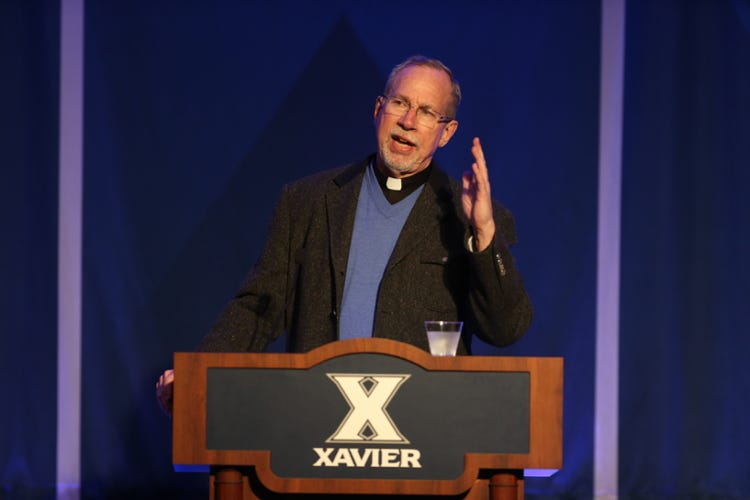
I first learned this vision of a Catholic institution at Xavier University in Cincinnati, under the great Father Michael Graham, S.J. The Jesuits there handed us a line from Jerónimo Nadal, one of the early Jesuits closest to St. Ignatius: “We are not monks. The world is our house.”
Some Catholics still prefer the cloister.
Rod Dreher’s The Benedict Option urged believers to retreat into resilient enclaves and wait out a hostile culture. That road was never Notre Dame’s or Commonweal’s, and it is not ours. Our pope is an Augustinian, a son of the saint who wrote about two cities tangled together until the end of time.
Alex Haley liked to say, “Find the good and praise it.”
Catholic institutions at their best do exactly that, and they spit out what is bad with love. Father Jenkins has spent his life finding the good in a world he never feared, in a president who disagreed with him and in the family of a stranger stricken at Madison Square Garden.
That is what a priest looks like, and I can think of no better model for what Catholic institutions in this country ought to be.
At Letters from Leo, we stand with Father Jenkins and with every Catholic who believes the Church belongs in the public square, listening to those who disagree with us and bearing witness to what we believe.
In an age of contempt, when too many leaders treat opponents as enemies and tear down what generations built, we hold to a faith that finds the good in others and builds things that outlast us.
This is the fastest-growing Catholic community in the country because people are hungry for a Church unafraid of the world, a Church that runs hospitals and universities yet still makes time to sit with a stranger’s family in a crisis.
If you believe this movement matters — Catholics and people of goodwill standing for human dignity and the common good — I am asking you to join us.
If you’d like to invest in our mission, here are three ways you can help:
Subscribe as a paid member to receive exclusive posts about the life and formation of Pope Leo and help sustain this newsletter.
Donate with a one-time gift to fuel this project’s mission.
Share this post (and Letters from Leo) with a friend who might enjoy it.
Paid subscribers receive our ongoing series on Pope Leo’s Life & Formation, including his years as an Augustinian friar, along with the Sunday Scripture Reflection Series and our exclusive investigations.
Whether you give $0, $5, $50, $500, $1,000, or more, your presence here matters — no matter your faith or your politics.
Thank you for reading. I’ll see you on the road.

It was nice to see President Obama at Notre Dame. Through his mother he is Irish ☘️. He will be out campaigning for democratic candidates in a fight for democracy.I will pray for Pope Leo and our nation.
Thank you for introducing me to Fr. Jenkins. I agree with his views that we in the Church must be in the world if we have any chance at making it a better place.