
“A True Shepherd” — Pope Leo XIV Honors the Priest Israel Killed in Southern Lebanon
The Maronite priest killed by Israeli tank fire in Lebanon was laid to rest as the pope eulogized him at the Vatican — and a widening war creeps closer to American soil.
Thank you for reading! Letters from Leo is a reader-supported publication. To receive exclusive posts and support my work, consider becoming a paid subscriber.
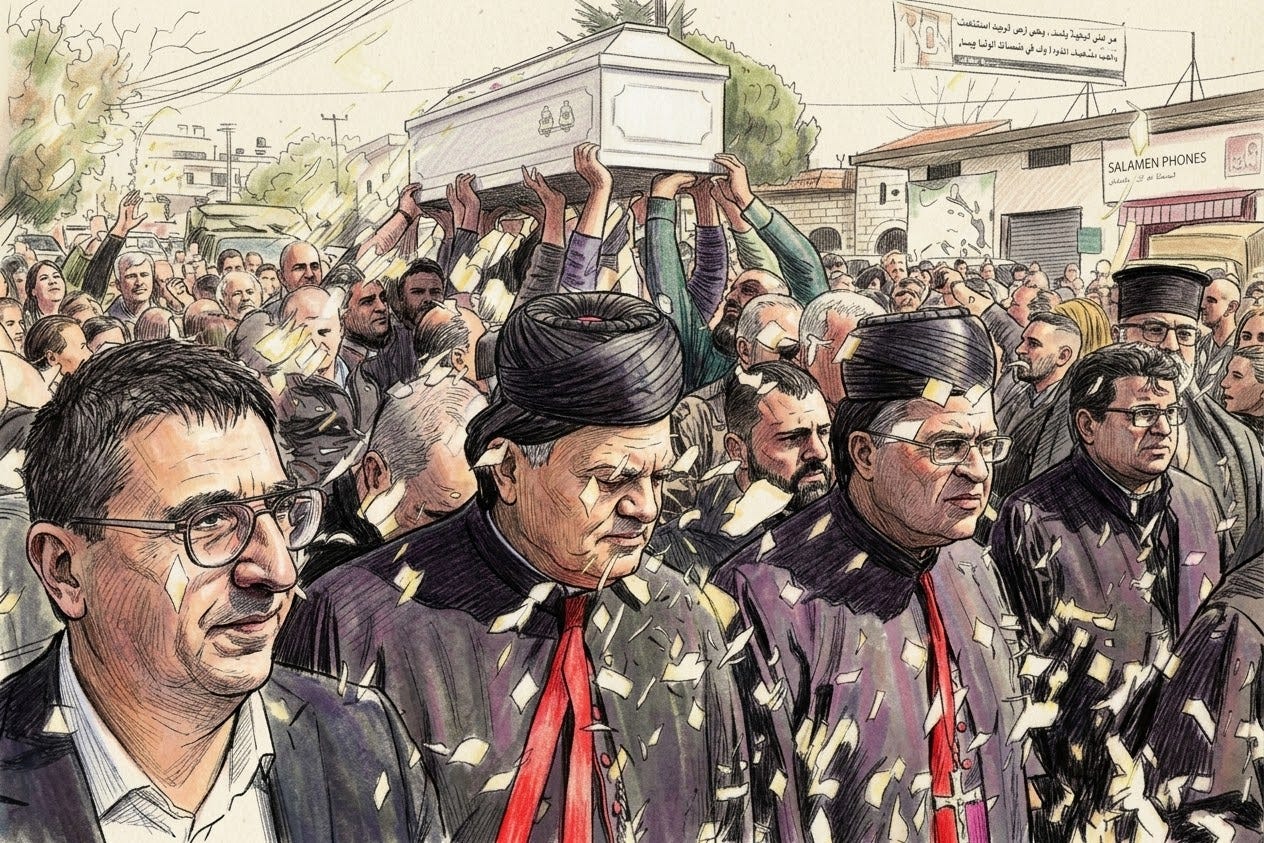
On Wednesday morning in the village of Qlayaa, in the mountains of southern Lebanon, hundreds of mourners carried the coffin of Father Pierre al-Rahi through the streets. Women wept. Men chanted “Samidoun” — “We resist.”
Lebanon’s army commander in chief, General Rodolphe Haykal, flew in by helicopter.
The apostolic nuncio, Archbishop Paolo Borgia, stood alongside the president of Caritas Lebanon and dozens of priests who had traveled from across the country to honor a man they refused to let the world forget.
Father Pierre was a Maronite Catholic priest — the parish shepherd of Qlayaa, a Christian village of eight thousand people just miles from the Israeli border. His surname, al-Rahi, means “shepherd” in Arabic. He lived up to it until the very end.
On Monday, as I wrote here at Letters from Leo, an Israeli Merkava tank shelled a home in Qlayaa.
Father Pierre heard that parishioners had been wounded in the strike and ran to the scene with a group of young volunteers and Red Cross paramedics. While they were tending to the injured, the tank fired a second time. Father Pierre was hit. He was rushed to a local hospital, where he died from his wounds.
Days before his death, Father Pierre had told reporters why he and other clergy in southern Lebanon had refused Israeli evacuation orders. His words were plain: “We carry nothing but the weapons of peace, goodness, love, prayer, and more prayer.” He added: “We are only defending our land. None of us carry weapons.”
That was the priest they buried today.
A Martyrdom the World Cannot Ignore
Cardinal Béchara Bourtos Raï, Lebanon’s most senior Catholic cleric and the patriarch of the Maronite Church, called Father Pierre’s death a martyrdom. The patriarch described it as a “deep wound in the heart of the Church,” inflicted by what he termed “the barbaric war raging on Lebanese soil.”
Cardinal Raï’s language was deliberate. In the Catholic tradition, martyrdom carries theological weight that transcends politics.
A martyr does not simply die in a conflict. A martyr is killed because of what they represent — the presence of the Church among the suffering, the refusal to abandon the vulnerable, the insistence that love can hold ground where armies advance.
Father Pierre ran toward a bombed house to drag wounded neighbors from the rubble. The tank fired again. That sequence of events is not an accident of war. It is the cost of witness.
And the Church, from the patriarch’s residence in Bkerke to the Vatican, is naming it as such.
Pope Leo XIV Responds
At the close of his Wednesday general audience in St. Peter’s Square, Pope Leo XIV turned his attention to Father Pierre’s funeral, calling the slain priest “a true shepherd who always remained beside his people, with the love and sacrifice of Jesus the Good Shepherd.”
The pope’s choice of words mattered. He reached for the deepest image in the Catholic pastoral vocabulary — Christ as the Good Shepherd who lays down his life for his flock.
Pope Leo was not offering polite condolences. He was conferring a religious identity on Father Pierre’s death, framing it within a tradition of sacrificial love that stretches from Calvary to a shelled house in southern Lebanon.
“As soon as the priest heard that some parishioners had been wounded by a bombardment, he ran to help them without hesitation,” the pope continued. Then, lifting his gaze beyond Lebanon:
“Let us continue to pray for peace in Iran and throughout the Middle East, especially for the many civilian victims, including many innocent children.”
Earlier in the same audience, during his catechesis on the Second Vatican Council’s Lumen Gentium, the pope had offered a statement that now reads as a moral frame for everything that followed.
“The Church can never turn inwards on herself,” Pope Leo said, “but is open to everyone and is for everyone.” He called the Church “a sign placed in the very heart of humanity, a reminder and prophecy of that unity and peace to which God the Father calls all his children.”
Father Pierre lived that teaching. While Israeli forces ordered civilians to evacuate and the machinery of war closed in around Qlayaa, he stayed.
He fed his parishioners. He sheltered them. He prayed with them. When they were bombed, he ran to save them. The Church he embodied was one that could not turn inward — because to turn inward would mean abandoning the people in front of him.
A War Without Borders
Father Pierre’s death did not happen in isolation. The U.S.-Israeli military campaign against Iran, launched on February 28, has metastasized into the largest regional conflagration the Middle East has seen in decades.
The war now engulfs Iran, Lebanon, and much of the Gulf. Tehran has retaliated with missile and drone strikes against all six Gulf Cooperation Council states. Half a million Lebanese civilians have been displaced. Hezbollah has resumed hostilities with Israel just fifteen months after the November 2024 ceasefire collapsed.
The consequences are not confined to the region. Counterterrorism experts warn that the killing of Iran’s supreme leader and the resulting power vacuum have created ideal conditions for blowback — both from Iran-backed proxy networks and from groups like ISIS and al-Qaeda exploiting the chaos.
An early March shooting in Austin, Texas, has already raised alarms about lone-actor radicalization tied to the conflict. The war that killed Father Pierre is not a distant event. Its tremors are arriving on American soil.
“May the Lord grant that the blood he shed may be a seed of peace for beloved Lebanon,” Pope Leo said on Wednesday, borrowing the ancient Christian formula that links martyrdom to renewal. The people of Qlayaa, chanting “Samidoun” as they bore their priest’s coffin through the streets, seemed to believe the same thing — that staying, resisting, refusing to be erased is itself an act of faith.
In the Church there is, and there must be, a place for everyone. That is what Pope Leo preached on Wednesday morning. Father Pierre al-Rahi, the shepherd of Qlayaa, died proving it.
At Letters from Leo, we stand with Cardinal Raï, with Pope Leo, and with the Christians of southern Lebanon who are burying their priest today because he refused to abandon his people while tanks advanced on their village.
We stand with the half-million Lebanese civilians displaced by a war that grows wider by the day — and with every person of goodwill who believes that the weapons of peace Father Pierre carried into that bombed house are worth more than the shell that killed him.
This community exists because people are hungry for moral clarity in a world drowning in cynicism and violence. As this war spreads across the Middle East and its consequences reach American shores, the hunger for a Church that refuses to turn inward has never been more urgent.
If you believe this movement matters — Catholics and people of goodwill standing for human dignity against the machinery of war — I am asking you to join us.
If you’d like to invest in our mission, here are three ways you can help this Lenten season:
Subscribe as a paid member to receive exclusive posts about the life and formation of Pope Leo and help sustain this newsletter.
Donate with a one-time gift to fuel this project’s mission.
Share this post (and Letters from Leo) with a friend who might enjoy it.
Paid members get full access to our biographical series on Pope Leo’s life and formation, the Epstein-Bannon investigation, and our Lenten Reflection Series — the work that sustains this community and holds power accountable.
Whether you give $0, $5, $50, or $500, your presence here matters — no matter your faith or your politics.
Thank you for reading. I’ll see you on the road.


We need more true shepherds in this world and fewer people who treat war as some sort of video game with no actual blood to dirty their own hands.
Just like Portaferry Priest Fr. Hugh Mullan, who was murdered and martyred in 1971 by the British army while ministering to his people in Ballymurphy, this brave Lebanese Priest was murdered and martyred by the Israeli army while ministering to his beleaguered people ❤️🔥