
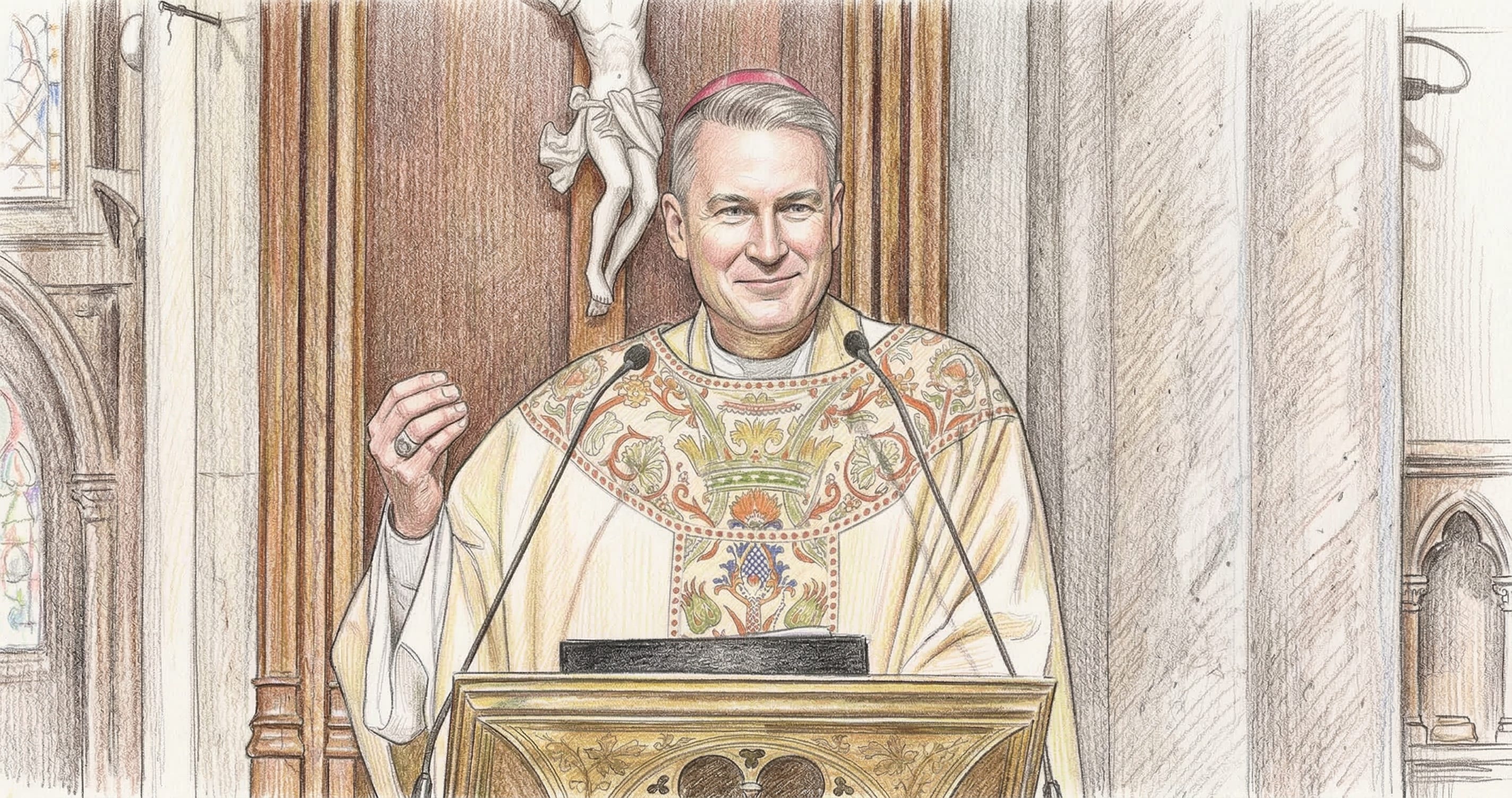
Amid Trump-Vance ICE Raids, Hicks Defends Immigrants at NYC St. Patrick’s Day Mass
In his first St. Patrick’s Day Mass, Pope Leo XIV’s most important American appointment quoted Hamilton, told the story of an Irish farmer who died to save a priest, then turned to today’s immigrants.
Thank you for reading! Letters from Leo is a reader-supported publication. To receive new posts and support my work, consider becoming a free or paid subscriber.
March Madness is here. I’m running the first-ever Letters from Leo NCAA Tournament Bracket Pool. $26 entry fee. $500 to the winner — $750 if you pick a Catholic school to win it all. $1,000 if you pick Villanova. Sign up here before 11:45 AM ET Thursday.
St. Patrick’s Cathedral was standing room only on Tuesday morning. Dignitaries, Ancient Order of Hibernians members, and thousands of ordinary New Yorkers packed into the pews for the traditional Mass that kicks off the 265th annual St. Patrick’s Day Parade.
But this year was different. For the first time, the man at the altar was Archbishop Ronald A. Hicks — Pope Leo XIV’s most consequential American appointment to date.
Hicks, 58, was installed as the eleventh Archbishop of New York just six weeks ago. A native of Chicago’s south suburbs, he grew up fourteen blocks from the future pope. He served for years as vicar general under Cardinal Blase Cupich, the progressive leader who has become Pope Leo’s closest American ally.
He spent five years in El Salvador running Nuestros Pequeños Hermanos, a charity serving orphaned and abandoned children across Latin America. The experience left a mark. Hicks is fluent in Spanish, and when he stood before the congregation at his February installation, he opened by singing in Spanish — a hymn almost every Mass-going Latino knows.
His episcopal motto is “Paz y Bien” — Peace and Good, the greeting of St. Francis of Assisi. He is the first Archbishop of New York ever to choose a Spanish motto.
Hicks didn’t flinch. The Washington Post called him a “Mini-Me” of Pope Leo — a description that captures both the biographical parallels and the theological alignment between the two men.
On Tuesday, Hicks used his first St. Patrick’s Day homily to make a case that the day’s green beer and bagpipes crowd doesn’t always hear: that honoring the Irish past requires reckoning with the immigrant present.
Cast Your Nets Wider
Hicks opened with a tribute to the Irish immigrants who built Catholic New York. “Many Irish immigrants left everything, cast their nets far from home when they journeyed to the shores of the United States of America,” he told the cathedral. “They came seeking a better life. Many of them arrived with strong faith and families and a lot of hope.”
He didn’t sanitize the history. Irish immigrants were “not always welcomed warmly,” he said. They faced suspicion, discrimination, hardship. What carried them through was their faith and their devotion to family and Church.
They built parishes, schools, neighborhoods, entire communities. They shaped the Archdiocese of New York and the Catholic Church across the country. “And as the Broadway musical Hamilton reminds us,” Hicks said, drawing laughter, “immigrants get the job done.”
The line got applause. But the homily’s real force came in what followed.
At the centerpiece of his remarks, Hicks told a story from the Irish Penal Times — when practicing the Catholic faith was a crime. Soldiers arrived to arrest a priest. An elderly farmer stepped forward and proposed they switch clothes.
The priest refused. The farmer insisted, “I have lived a long and good life. Our community does not need another old farmer. But we need you. We need the Mass. We need the Eucharist.”
The farmer was arrested and killed. The priest survived. The faith endured.
Hicks let the story breathe. Then he turned to the present.
Will We Remember Our Own Story?
“This feast invites us to look at the present,” Hicks said. “Just as Irish immigrants once came to this country seeking hope and opportunity, today many immigrants come to our nation leaving everything behind, seeking a better life for themselves and their families.”
In an era when ICE agents haunt church parking lots and Catholic shelters face political threats, those words carried particular weight inside St. Patrick’s Cathedral. Worth noting: Pete Hegseth’s pastor, Doug Wilson, has said publicly that Catholic parades and processions — the very kind of celebration Hicks was leading — should be banned as “public displays of idolatry” in his vision of a Christian America.
Hicks was speaking to a city where immigrants from Latin America, West Africa, and Central Asia fill the same pews that Irish and Italian Catholics once occupied. He was speaking as a man who lived among the poor of El Salvador, who chose a Spanish motto for one of the most powerful Catholic positions in the English-speaking world.
“As followers of Jesus Christ, we are called not to see them as strangers, but as brothers and sisters, welcoming them with respect and walking together in faith,” Hicks continued.
Then came the three questions that gave the homily its moral center: “Will we remember our own story? Will we welcome others as brothers and sisters? Will we cast our nets wider just as Christ asked us to do?”
The questions were directed at every Irish American in the cathedral — and, by extension, at every American Catholic who has ever invoked their immigrant ancestors while looking the other way as today’s immigrants face cruelty at the border and fear in their parishes.
A New Kind of Archbishop for New York
Hicks is a different kind of leader for an archdiocese than those who have advanced in recent decades.
The contrast with Bishop Robert Barron, for example, was hard to miss.
The day after Mamdani took office in January, Barron attacked the new mayor on social media for using the phrase “warmth of collectivism” in his inaugural address, warning of mass death and tyranny.
Hicks took a different approach. He got to know Mamdani personally — phone calls, breakfast, a one-on-one meeting.
After the St. Patrick’s Day Mass, Hicks told Fox News he was “glad that he, and so many people, were here today.” Mamdani, for his part, called it “truly a joy” to sit with the archbishop and celebrate the fact that both are beginning their leadership journeys in New York at the same time.
His appointment was Pope Leo’s clearest signal yet about the direction of the American Church: missionary, multilingual, rooted in the preferential option for the poor. The pope chose a man formed not in the corridors of Roman power but in the orphanages of Central America.
Cupich’s influence is evident. The Chicago cardinal has spent years building a bench of pastorally minded bishops who take Catholic social teaching on immigration, poverty, and peace as seriously as the Church’s teachings on life. Hicks is the most prominent product of that effort.
And the fact that Pope Leo — himself a Chicagoan who spent decades in Peru — reached back to his own backyard for this appointment tells you everything about his vision for the Church in America.
St. Patrick’s Day is always a celebration of the past. Hicks made clear, in his very first parade Mass, that it must also be a reckoning with the present and a commitment to the future.
The faith that Irish immigrants carried through centuries of persecution survived because ordinary people — farmers, mothers, priests — chose sacrifice over comfort. The question Hicks posed on Tuesday was whether today’s American Catholics are willing to make that same choice for the immigrants in their midst right now.
The answer, if you follow the Gospel that Hicks preached, is obvious.
At Letters from Leo, we stand with Archbishop Hicks and the millions of American Catholics who believe that honoring our immigrant heritage means welcoming today’s immigrants with the same courage and faith that carried the Irish through famine, persecution, and prejudice to build the greatest Catholic city in the Western Hemisphere.
In an era when cruelty toward immigrants has become a political weapon and fear has crept into parish life itself, we remain rooted in a faith that sees every stranger as Christ in disguise.
This is the fastest-growing Catholic community in the country because people are hungry for something deeper than rage and nativism.
They want a Church that means what it preaches — and right now, as Archbishop Hicks reminded us from the same altar where generations of Irish Americans have prayed, that hunger has never been more urgent.
If you believe this movement matters — Catholics and people of goodwill standing for human dignity against the politics of fear — I am asking you to join us.
If you’d like to invest in our mission, here are three ways you can help this Lenten season:
Subscribe as a paid member to receive exclusive posts about the life and formation of Pope Leo and help sustain this newsletter.
Donate with a one-time gift to fuel this project’s mission.
Share this post (and Letters from Leo) with a friend who might enjoy it.
Paid subscribers have access to the multi-part biographical series on Pope Leo’s Life and Formation, The Epstein-Bannon Investigation, and our Lenten Reflection Series.
Whether you give $0, $1, or $1,000, your presence here matters — no matter your faith or your politics.
Thank you for reading. I’ll see you on the road.


It is also worth noting ing that “Paz y bien” is the motto of Franciscans. (Peace and all good) He stated on his radio show that he chose it in honor of St. Francis and the good Franciscans do in the world, sort of like our beloved previous Holy Father chose the name Francis, to honor the poor. He started the last few Sunday masses by doing the song of the cross in Spanish. I like him!
What an uplifting read!!!