
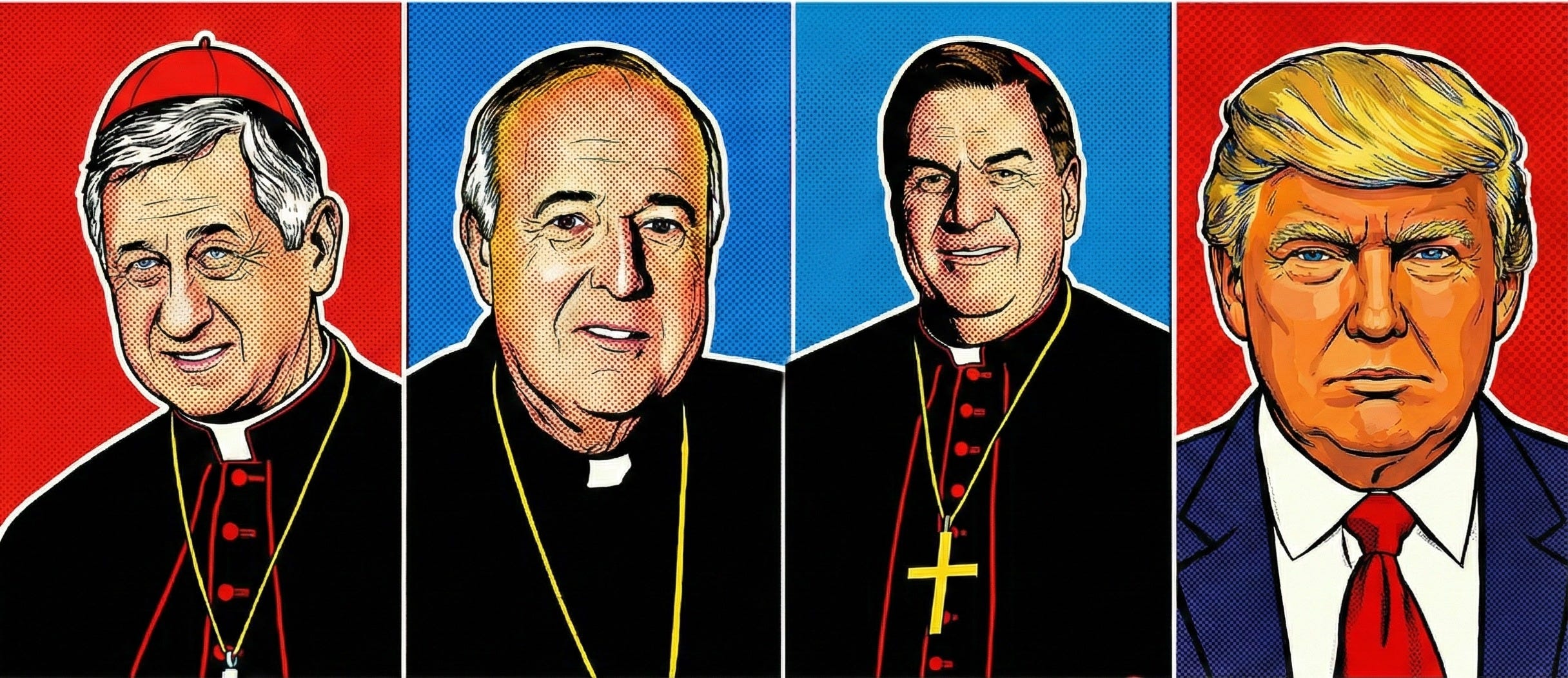
Backed by Pope Leo, U.S. Cardinals Rebuke Trump’s Greenland Gambit
As Trump pushes to annex Greenland, three top American cardinals — Cupich of Chicago, McElroy of Washington, and Tobin of Newark — have issued a rare joint statement denouncing a “zeal for war.”
Dear friends —
Today’s story spotlights an extraordinary moment: three American cardinals stepping into the global arena to denounce President Trump’s escalating push to annex Greenland.
Backed by Pope Leo XIV’s powerful warning against “the zeal for war,” Cardinals Cupich, McElroy, and Tobin are raising their voices in defense of peace, sovereignty, and the Gospel. Their statement marks the most forceful challenge yet from the U.S. hierarchy to Trump’s foreign agenda — and it lands at a moment when America’s moral leadership is hanging by a thread.
Why now? And why Greenland? As you’ll see, this is about more than Arctic maps. It’s about what kind of nation we are — and whether the Church in this country is finally ready to confront the brutal logic of power that Pope Leo has spent months warning against.
Thanks to your support, Letters from Leo can trace these turning points others miss.
We’re the only outlet in the world with the depth to connect Pope Leo XIV’s moral vision to the shifting ground of American politics — because I’ve spent the past fifteen years deeply embedded in both the life of the Catholic Church and the machinery of U.S. political power.
If you’re already a paid subscriber, thank you. If not, I invite you to join us.
And as always: if you need help with your subscription, just reply to this email.
In an extraordinary move, the United States’s three top cardinals publicly challenged President Donald Trump, imploring his administration to step back from foreign policy strategies that threaten world peace.
Their Jan. 19 statement comes amid a looming crisis over Greenland, where the White House has been sharply ratcheting up rhetoric about acquiring the Arctic territory.
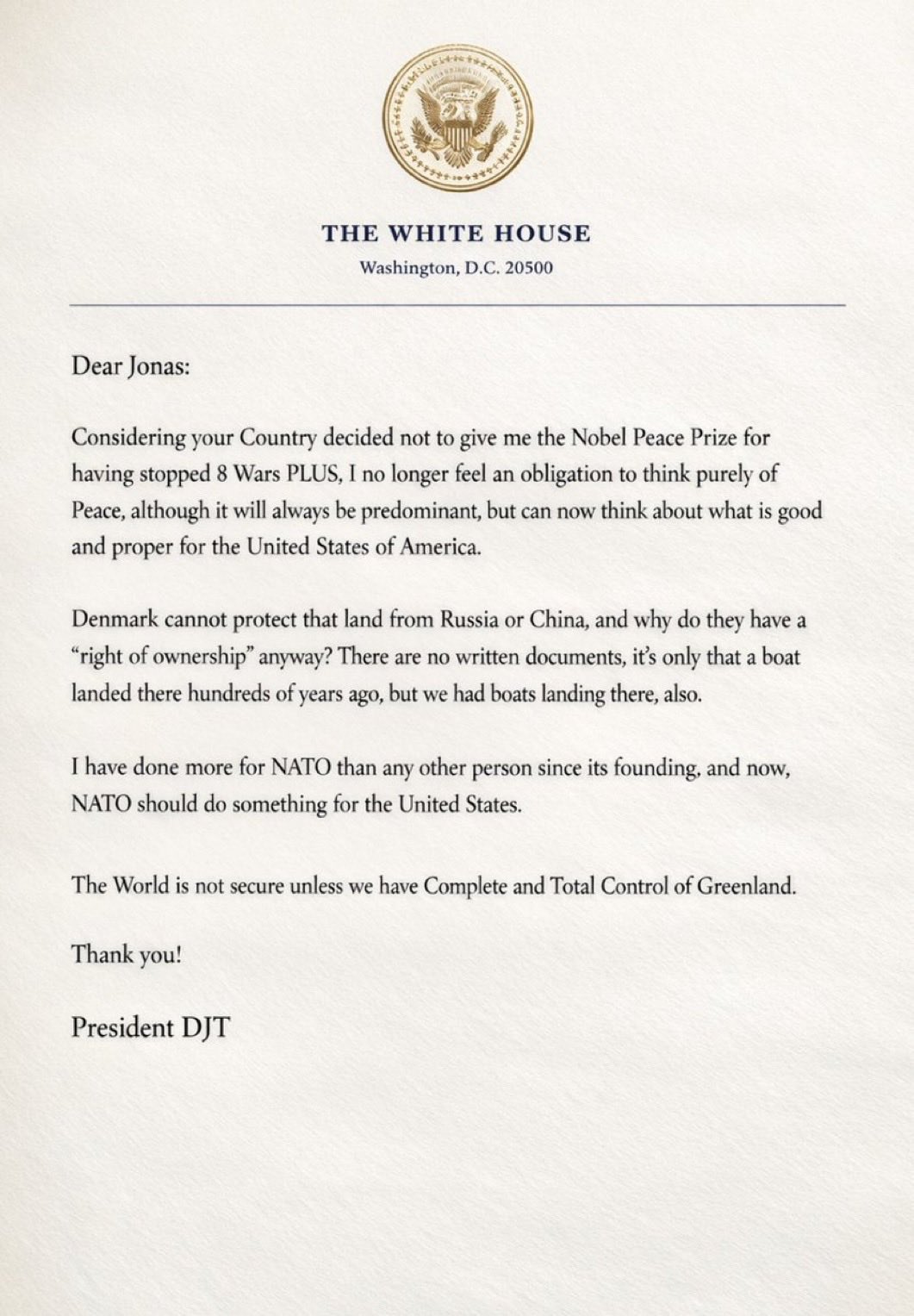
Trump insists the U.S. “needs Greenland” as a strategic asset. Over the weekend, he sent Denmark’s prime minister, Jonas Gahr Støre an extraordinary text message, where he wrote that after being snubbed for the Nobel Peace Prize, he no longer felt the need to think “purely of peace.”
“Considering your Country decided not to give me the Nobel Peace Prize for having stopped 8 Wars PLUS, I no longer feel an obligation to think purely of Peace,” he wrote, adding that the US needed “complete and total control” of Greenland.
Trump’s threats to take the island have Greenlanders and American allies in uproar. In Nuuk, the tiny capital, thousands marched through the snow chanting “Greenland is not for sale!” in defiance of Trump’s takeover threats.
European NATO partners have likewise bristled: France, Germany, the U.K. and others rushed troops to Greenland in a dramatic show of support for Denmark, warning that any U.S. seizure would spell the end of NATO.
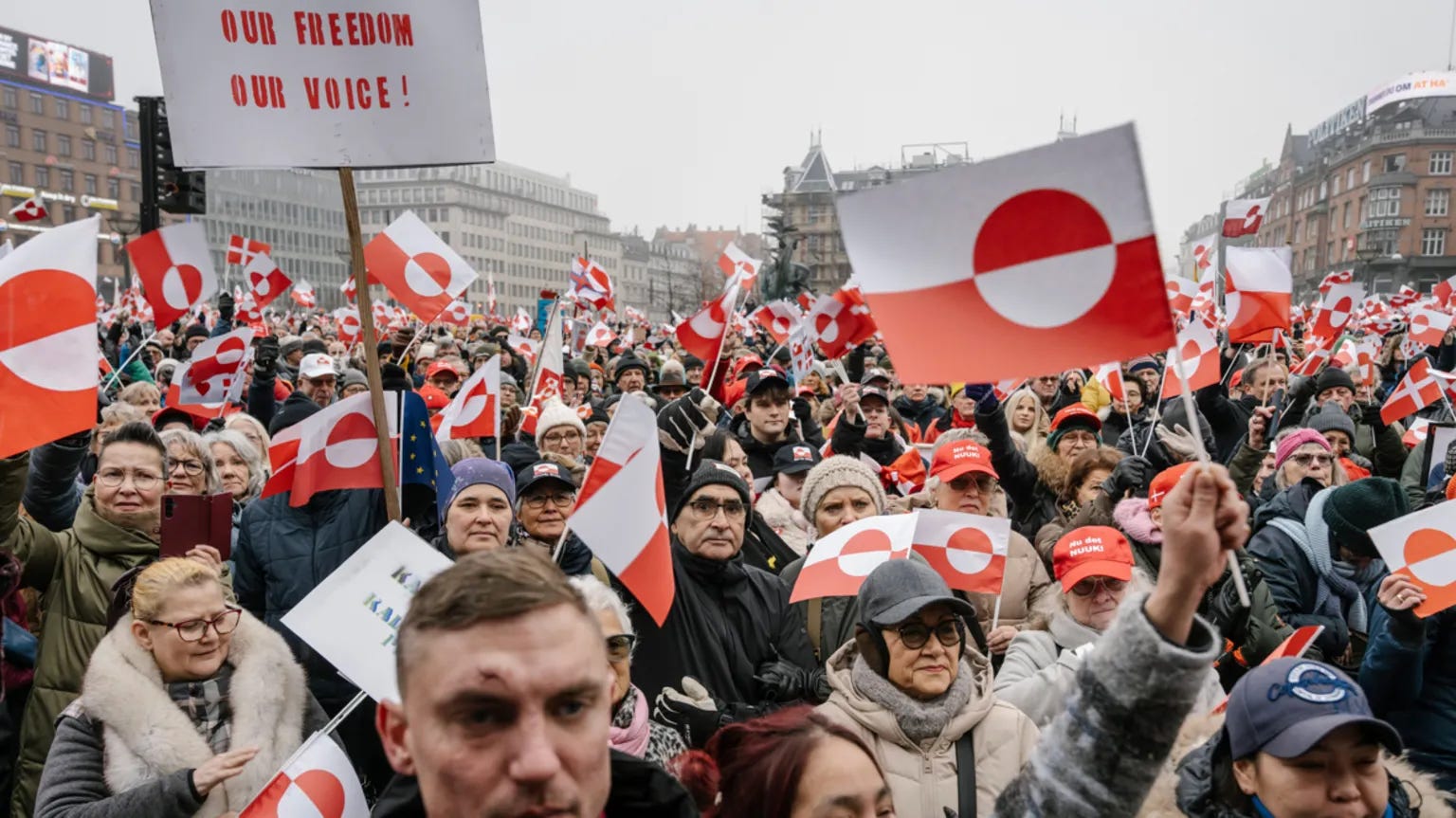
At issue is the moral principle of national self-determination. Greenland is a self-governing part of the Kingdom of Denmark, and both Danes and Greenlanders have firmly declared the island isn’t for sale.
Trump, however, has voiced open contempt for their refusal, telling reporters that America will take Greenland “whether they likes it or not.”
He argues U.S. control is necessary to preempt Chinese or Russian ambitions in the Arctic, pointing to the lightning-fast U.S. invasion of Venezuela earlier this month as proof of American resolve.
In a high-stakes meeting on Jan. 14, Trump bluntly told Denmark’s officials, “You found that out last week with Venezuela.” Such rhetoric has sent anxiety soaring across the North Atlantic.
“It’s not the time to gamble with our right to self-determination, when another country is talking about taking us over,” Greenland’s Prime Minister Jens-Frederik Nielsen said.
The cardinals’ statement pointedly upholds that view. In their statement, they condemned the trend of might-over-right in global affairs, echoing Pope Leo XIV’s concern that “war is back in vogue” and that force is replacing dialogue.
“The events in Venezuela, Ukraine and Greenland have raised basic questions about the use of military force and the meaning of peace,” the U.S. prelates wrote. They noted that American policy is at a moral crossroads:
“The sovereign rights of nations to self-determination appear all too fragile in a world of ever greater conflagrations.”
In stark terms, they renounced “war as an instrument for narrow national interests,” insisting military action must be only a last resort in extreme cases. Instead, they call for a foreign policy anchored in “the right to human life, religious liberty, and the enhancement of human dignity” — priorities far removed from any resource grab or nationalist aggression.
Pope Leo’s Challenge and the Cardinals’ Response
This unified Catholic rebuke did not emerge in a vacuum. Pope Leo XIV — history’s first American pope — has been steadily encouraging the U.S. Church to speak out against what he sees as the moral failures of Trumpism.
Just ten days earlier, on Jan. 9, Pope Leo delivered a “State of the World” address to diplomats in Rome that now serves as the charter for the cardinals’ stance.
In that speech, Leo warned that the post-WWII principle forbidding territorial conquest has been “completely undermined.”
“Peace is no longer sought as a gift. Instead, peace is sought through weapons as a condition for asserting one’s own dominion,” the pope lamented. He decried a “zeal for war” spreading in our time — language the American cardinals explicitly embraced in their statement.
Recent events gave Leo’s words urgent concreteness.
On Jan. 3, just days before that speech, U.S. forces launched a surprise attack in South America, capturing Venezuelan President Nicolás Maduro and his wife in a nighttime raid.
Trump triumphantly proclaimed the ouster of Maduro as a win for freedom — even boasting that the U.S. would “run Venezuela” going forward.
That drew an immediate and firm intervention from Pope Leo XIV.
After his Sunday Angelus prayer on Jan. 4, Leo surprised observers by pointedly asserting that “Venezuela must remain an independent country.”
He stressed that “the welfare of the Venezuelan people must take precedence over any other consideration,” urging respect for human rights and Venezuela’s autonomy.
In Leo’s view, the beloved Venezuelan nation should not become a pawn in great-power games — a direct counter to any U.S. pretensions of installing a puppet regime. Leo’s plea that Venezuela’s sovereignty be guaranteed and its people’s needs put first was widely seen as a moral rejection of Trump’s self-anointed role as “liberator” of that country
Not surprisingly, the Trump administration tried to spin the pope’s stance. The U.S. ambassador to the Holy See — a Trump-appointed Catholic activist — publicly misrepresented Leo’s remarks, implying the pope condoned the military action.
That prompted swift pushback. Letters from Leo was the first publication to expose the distortion, and the Vatican made clear that Leo XIV stood by his principle: no nation gets to unilaterally “run” another.
All this set the stage for the U.S. cardinals’ intervention. Cardinals Blase Cupich, Robert McElroy, and Joseph Tobin have now amplified Pope Leo’s moral framing on American soil — effectively echoing his message that “might makes right” has no place in a just world order.
Each cardinal brought a distinct voice to the joint statement. “As pastors entrusted with the teaching of our people, we cannot stand by while decisions are made that condemn millions to lives trapped permanently at the edge of existence,” said Cardinal Cupich, invoking Leo’s clear direction as a guide.
McElroy, for his part, warned that a narrowly selfish vision of national interest – one that “excludes the moral imperative of solidarity among nations and the dignity of the human person” — inflicts “immense suffering” and “catastrophic” damage to any just peace.
And Cardinal Tobin, fresh from a gathering of the world’s cardinals in Rome last week, said Pope Leo’s global perspective compelled him to speak up.
“Recent events, including participation in last week’s consistory in Rome with Pope Leo and brother cardinals from across the world, convince me of the need to underscore the vision of Pope Leo for just and peaceful relations among nations,” Tobin observed. “Otherwise, escalating threats and armed conflict risk destroying international relations and plunging the world into incalculable suffering.”
It is remarkable for American churchmen of this rank to collectively confront a sitting U.S. president’s agenda. By all accounts, this is the most direct rebuke U.S. cardinals have leveled at the White House in decades. Pope Leo XIV’s influence is unmistakable here. Since his election, Leo has consistently challenged Catholics to expand their “pro-life” ethics to every human life — from unborn children to impoverished families, refugees, and victims of war.
In pushing back on Trump’s Greenland and Venezuela moves, the cardinals are aligning with Leo’s expansive vision of the Gospel. They are effectively saying that nationalism and domination have no moral high ground, and that true patriotism must be measured by America’s commitment to peace and humanity’s common good.
In their own words, “Pope Leo has given us the prism through which to raise [our national debate] to a much higher level.” They vowed to “preach, teach, and advocate” in the coming months to make that moral vision a reality.
As the United States navigates showdowns from Caracas to Copenhagen, the Catholic Church’s voice — emboldened by an American pope — has entered the fray with unusual clarity. Cardinals Cupich, McElroy, and Tobin are answering Pope Leo’s call for a more courageous episcopacy, one willing to challenge political leaders in defense of peace.
Their message, boiled down, is that America’s soul is on the line in how it wields its power.
Will we choose the path of might, or the path of right? The fact that these Church leaders spoke out together, citing the Gospel and the pope, underscores the gravity of that question.
And it throws down a gauntlet: in 2026, with the world’s eyes on America, moral leadership must matter as much as military might. The “zeal for war” can and must be turned back — starting with a resounding “no” to treating any people or nation as something to be bought, bullied, or thrown away.
Last year, something unexpected happened. The Advent Reflection Series became one of the most widely read and shared parts of Letters from Leo.
Many of you wrote to say those reflections helped steady your hearts during a difficult year — one marked by division, anxiety, and genuine moral uncertainty.
Because of that response, I’ve decided to make these Mass reflections a permanent part of this work in 2026.
These Sunday reflections will be available to all paid subscribers as a small but sincere way of saying thank you for making Letters from Leo possible.
Here is this week’s reflection.
Paid subscribers will also have access to the Q&A mailbag opening this week, where you can ask me anything about American politics, Catholicism, Donald Trump, Pope Leo, JD Vance — or my own faith, biography, and life.
Letters from Leo is open to anyone who wants to be informed and inspired by our pope — and to turn that inspiration into action that leaves America and the world more just, less cold, and more alive with hope.
If you’d like to invest in our mission during this new year, here are three ways you can help:
Subscribe as a paid member to receive exclusive posts about the life and formation of Pope Leo and help sustain this newsletter.
Donate with a one-time gift to fuel this project’s mission.
Share this post (and Letters from Leo) with a friend who might enjoy it.
Whether you give $0, $1, or $1,000, your presence here matters — no matter your faith or your politics.
Thank you for reading. I’ll see you on the road.


This is such good news. Pope Leo is the moral leader the world so desperately needs today. I love him so much. Thank you for keeping us informed. 🙏
What can we the readers do to bring awareness to the reality that the Pope's views and suggestions are NOT trickling down to the local level. Nothing. Zip. Nada. I attend Mass within the Diocese of Venice in SW Florida. Without substack I would not know about the Pope's views or the actions of a handful of brave priests and cardinals. The local churches must do better.