
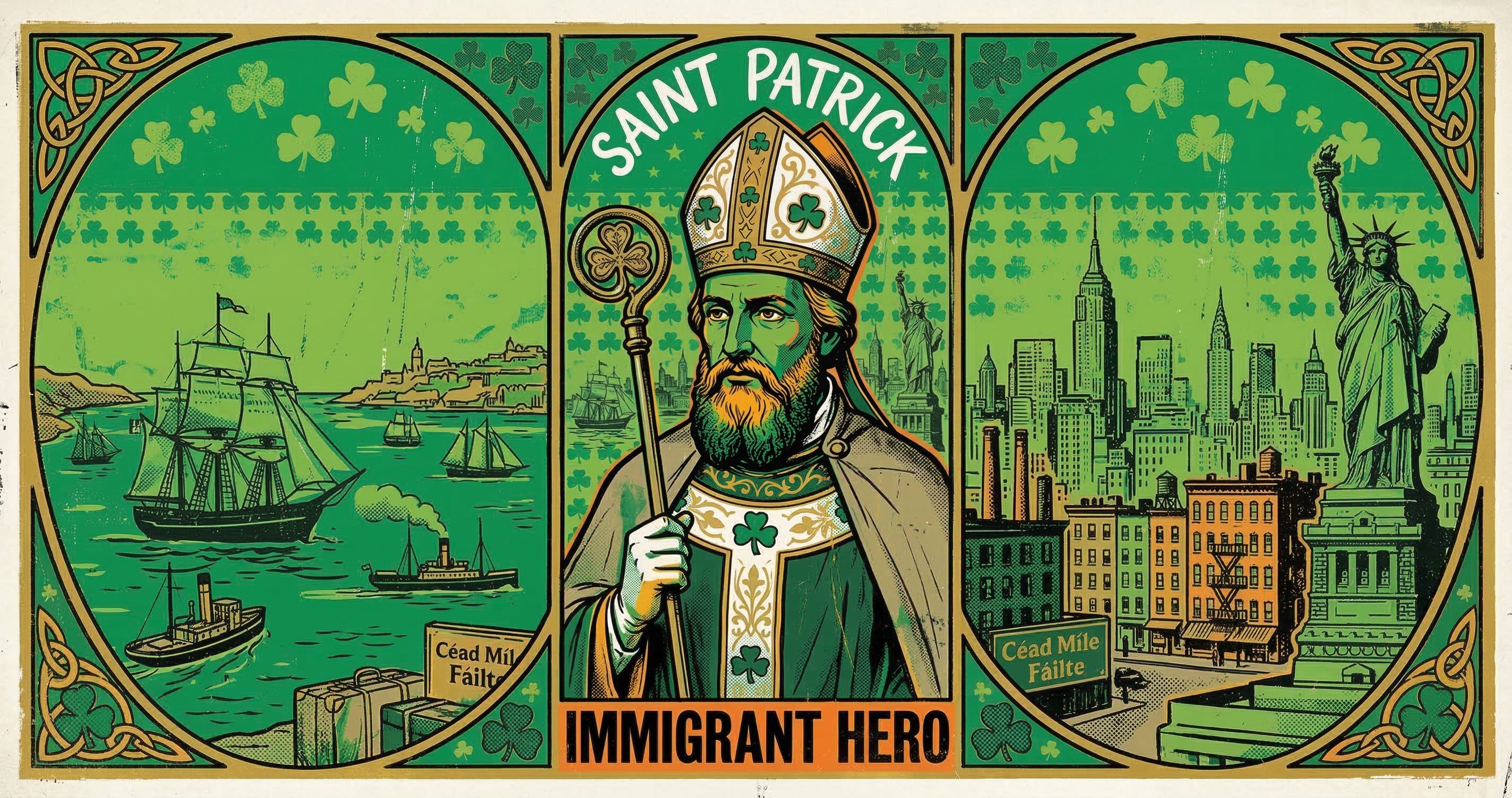
Before He Was a Saint, Patrick Was an Immigrant
Cardinal Tobin reminds Americans what St. Patrick's Day actually means — and who the "new Irish" are in 2026.
Thank you for reading! Letters from Leo is a reader-supported publication. To receive new posts and support my work, consider becoming a free or paid subscriber.
March Madness is here. Paid subscribers: I’m running the first-ever Letters from Leo NCAA Tournament Bracket Pool. $26 entry fee. $500 to the winner — $750 if you pick a Catholic school to win it all. $1,000 if you pick Villanova. Sign up here before 11:45 AM ET Thursday.
On this St. Patrick’s Day, Cardinal Joseph Tobin of Newark recorded a short reflection for the United States Conference of Catholic Bishops that opened with a line worth sitting with. “Before he was a saint,” Tobin said, “St. Patrick was an immigrant.”
Americans tend to flatten Patrick into a mascot. He becomes green beer, a parade float, a reason to wear shamrocks and eat corned beef. Tobin’s reflection cuts through all of that.
The real Patrick was a sixteen-year-old boy ripped from his home in Roman Britain, dragged across the Irish Sea, and forced into slavery as a shepherd in a country whose language he did not speak. He spent six years alone on the hillsides before escaping. And then — in the part of the story that should stun us every time we hear it — he went back.
Patrick returned to the land that had enslaved him. He returned not with an army or a grievance but with the Gospel. He chose to love the people who had stolen his youth. That decision reshaped the entire civilization of medieval Europe.
Tobin drew the connection that matters most in 2026. His own grandparents and great-grandparents came to America from Ireland, and he described the old custom of holding wakes for the departing emigrants before they ever boarded a ship.
Their families mourned them as if they had died, because the Atlantic crossing meant they would almost certainly never see each other again. The first slums in New York were built for the Irish. Ralph Waldo Emerson once observed that he had never met a gray-haired Irishman — because so many of them, weakened by famine and poverty, died young.
The cardinal then made the turn that every American celebrating today should hear.
He asked us to “recognize the new Irish among us, who left their homes because of persecution, because of poverty, and came to this new land with hope.”
This should not be a controversial statement. The entire mythology of St. Patrick’s Day — the pride, the flags, the ancestral memory of survival — rests on the fact that Irish Catholics were once the despised immigrants of this country.
They were the ones accused of stealing jobs, importing a dangerous foreign religion, breeding too quickly, drinking too much, and refusing to assimilate. “No Irish Need Apply” was not a slogan from ancient history. It was a living reality in American cities within the lifetimes of people our grandparents knew.
What happened to the Irish in America is now happening to families from Guatemala, Honduras, Haiti, Venezuela, and a dozen other countries where poverty and violence have made staying impossible. The faces and the languages have changed. The underlying human experience has not.
A mother in Tegucigalpa packing a bag for her child carries the same weight as a mother in County Cork loading her son onto a coffin ship in 1847. Both women know the same fear. Hope drives them equally. And the love behind both decisions — the willingness to lose everything so a child might have a chance — is indistinguishable.
The Trump administration does not see it that way. The current White House has built its political identity on the premise that today’s immigrants are fundamentally different from yesterday’s — more dangerous, less deserving, incapable of contributing to the American project.
ICE agents have conducted raids near Catholic churches. Families have been separated at the border with the clinical efficiency of a bureaucracy that has stopped seeing human beings. Rhetoric about “invasion” and “poison” has replaced any serious conversation about the men and women who risk everything to reach this country.
Patrick’s story dismantles that entire framework. He was the ultimate outsider — a foreigner, a slave, a person with no legal standing in the society that held him captive. The only thing he possessed was faith.
When he returned to Ireland as a free man, he did not demand reparations or build walls. Instead he walked from village to village, baptizing and teaching, transforming a pagan island into one of the great centers of Christian civilization.
The Book of Kells, the monastery system that preserved Western learning through the Dark Ages, the missionary tradition that sent Irish monks across Europe — all of it traces back to a teenage immigrant who chose mercy over bitterness.
Cardinal Tobin also invoked Mother Cabrini, the Italian immigrant nun who was once voted the woman with the greatest impact on New York City, simply because of her tireless care for migrants.
He spoke of the nameless saints who came out of immigrant communities — “people who suffered but remained faithful to their own dignity and to their faith.” Their perseverance, he said, “allowed them to pass on the faith to generations like my own family.”
That is the inheritance at stake. When we celebrate St. Patrick’s Day, we are celebrating a tradition that exists only because immigrants survived hostility and held on to what mattered. The faith that fills Catholic parishes across America on any given Sunday morning arrived on boats carrying people who were told they did not belong here.
In the middle of Galway Cathedral, there is a mosaic dedicated to John F. Kennedy — an American president honored in an Irish house of worship because the bond between these two countries runs that deep. The Irish did not just come to America. They became America, and Ireland never forgot it.
If St. Patrick were alive today and tried to enter the United States from a country ravaged by poverty and violence, he would be exactly the kind of person this administration targets for deportation. A young man with no documents, no connections, no wealth — only a burning conviction that God had called him somewhere.
The patron saint of the green beer crowd would be sleeping on the floor of a detention center in south Texas.
Tobin’s invitation stands as a challenge and a grace.
Welcome the new Irish among us. See in their faces the same courage that built the parishes, the schools, the hospitals, and the unions that turned Irish Catholic immigrants into the American middle class.
The story of St. Patrick is the story of every person who crosses a border with nothing but hope and faith. To celebrate one while deporting the other is a contradiction that no amount of green dye in the Chicago River can wash away.
At Letters from Leo, we stand with Cardinal Tobin and the millions of Catholics — and countless others of goodwill — who refuse to let St. Patrick’s Day become a hollow celebration divorced from its own meaning.
The story of the Irish in America is an immigrant story. To honor that story while turning our backs on today’s immigrants is a betrayal of the very faith Patrick carried across the sea.
This is the fastest-growing Catholic community in the country because people are hungry for moral clarity in an era that rewards cruelty and amnesia. They want a faith that remembers where it came from.
If you believe this movement matters — Catholics and people of goodwill standing for human dignity against the forces of nativism and fear — I am asking you to join us.
If you’d like to invest in our mission, here are three ways you can help this Lenten season:
Subscribe as a paid member to receive exclusive posts about the life and formation of Pope Leo and help sustain this newsletter.
Donate with a one-time gift to fuel this project’s mission.
Share this post (and Letters from Leo) with a friend who might enjoy it.
Paid subscribers get access to our ongoing biographical series on Pope Leo’s life and formation, exclusive investigations, including the Epstein-Bannon investigation, and our Lenten Reflection Series.
Whether you give $0, $1, or $1,000, your presence here matters — no matter your faith or your politics.
Thank you for reading. I’ll see you on the road.


My ask of Saint Patrick today is that he come and drive all the snakes out of Washington DC.😎
Great article! I wish more people would see the connection between St. Patrick and the immigrants. I admit I had not seen it until I read the article. Kudos to Cardinal Tobin!