
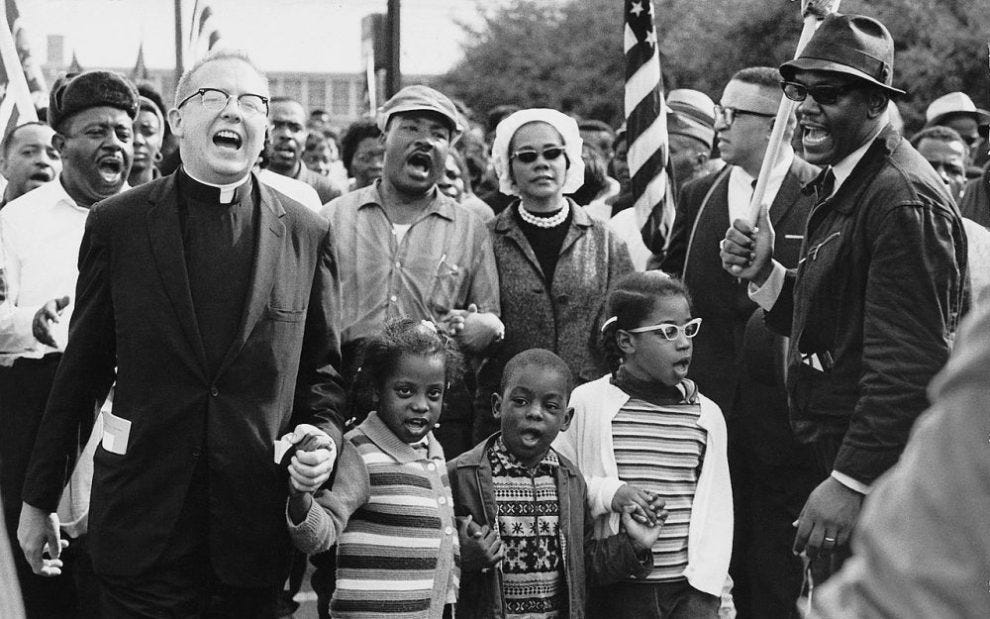
Black Lives Matter Is a Deeply Christian Claim
Growing up in a Tennessee parish once threatened by the Ku Klux Klan shaped my understanding of faith, race, and Christian moral responsibility.
Thank you for reading! Letters from Leo is a reader-supported publication. If you find value in my work, please consider becoming a paid subscriber or making a one-time donation.
Several years ago, I received an email from a woman who had seen me on Fox News discussing faith and race.
I had said on-air that “black lives matter” is a deeply Christian claim.
She wrote that while she appreciated much of what I said, she thought my stance contradicted Jesus’s teachings that all lives matter. Her question gave me pause — and an opening for an important dialogue.
I answered by sharing a lesson I learned in high school. During a church retreat on the Beatitudes, I remember grumbling to my youth minister, Bob Carney, that it felt unfair Jesus only named certain groups as “blessed.”
Blessed are the poor, the meek, the persecuted — shouldn’t everyone be blessed? Bob’s reply stays with me to this day. Yes, God loves everyone, but Jesus has a preferential love for those who are marginalized, excluded, and suffering injustice.
He singles out the downtrodden not to deny others’ worth, but to underline the worth of those whom the world treats as worthless.
In Jesus, God turns the world upside down so that the last become first. In a society where black lives, immigrant lives, and refugee lives are too often pushed to last place, proclaiming that black lives matter is not a negation of anyone else’s dignity — it’s a necessary affirmation of those whom our sinful world consistently undervalues.
I’m convinced that if Jesus Christ walked the earth today, he most certainly would say “black lives matter.” After all, he was the one who taught, “Blessed are the poor” and “Blessed are those who mourn,” naming the very people who most needed to hear that blessing.
My conviction on this point isn’t just theoretical. I grew up Catholic in the American South, in a diocese with a proud history of fighting for African Americans’ dignity during the Civil Rights era.
That history set the foundation for my faith. Years before public schools desegregated in Tennessee, Nashville’s Catholic bishop, William L. Adrian, quietly ordered the Catholic schools to integrate in 1954.
And when many white clergy in Alabama urged Dr. Martin Luther King Jr. to slow down his campaign for equality, one of them was a Southern Catholic prelate named Joseph Durick. Dr. King’s famous “Letter from Birmingham Jail” was addressed to Durick and those other moderates, calling their caution a form of complicity.
To his great credit, Bishop Durick had a conversion of heart. He took King’s words to heart and soon stepped to the forefront of white Southern clergy advocating for integration. Durick became a champion of racial justice — he even joined in memorial services for the girls killed in the 16th Street Baptist Church bombing and led prayers after Dr. King’s assassination.
By the end of the 1960s, he was marching with striking black sanitation workers in Memphis and insisting that the Church belong on the frontlines of the civil rights struggle.
This is part of my Catholic inheritance: imperfect men and women of the Church striving, repenting, and taking prophetic stands for justice.

That legacy also taught me that racism is not just a social sin — it’s a grave offense against God. The Catholic Church has made that clear in our teachings.
The U.S. bishops’ historic pastoral letter Brothers and Sisters to Us declared that “racism is a sin: a sin that divides the human family… and violates the fundamental human dignity” of those targeted.
To proclaim that black lives matter, then, is to stand with the Church in affirming the God-given worth of our black brothers and sisters and to denounce the sin that seeks to silence or destroy that worth.
I also carry personal memories from my hometown parish, St. Rose of Lima in Murfreesboro, Tennessee — a community that itself endured the hatred of white supremacists.
I learned as a child how in 1929 the Ku Klux Klan marched in our city to protest the building of St. Rose of Lima Catholic Church. The KKK burned crosses and paraded in hoods, trying to intimidate Catholics — in part because the Catholic Church welcomed Black worshippers and immigrants.
That was long before I was born, but its shadow lingered.
Decades later, when I was growing up, I heard the stories from older parishioners. I realized that to some extremists, even our little Catholic parish was seen as an enemy — a threat to their hateful vision of a segregated society.
Yet the church stood its ground. The gospel carried on. Those experiences impressed on me that being Catholic in the South meant choosing inclusion over exclusion, and knowing what it’s like to be treated as “other.” It forged in me a solidarity with anyone targeted by bigotry.
Because of that formative experience, Black Lives Matter isn’t a political slogan to me; it’s a truth aligned with my faith.
When I say those words, I’m echoing lessons taught by the black priests, nuns, and laypeople who nurtured me in the faith of Jesus Christ.
In our parish and my diocese, Black Catholics were among my mentors and heroes — people who showed me what it means to live joyfully in a Church that hasn’t always fully appreciated them. They wove the struggle for racial justice into the fabric of my religious upbringing.
I owe them a debt of gratitude. They showed me that the Catholic faith demands a love as bold and specific as Christ’s love — a love that “rejoices in the truth” that each person is cherished by God.
So, to my email correspondent – and to anyone who wonders how a Christian can say “black lives matter” without implying other lives don’t — I would say this: Our Lord told us that the Good Shepherd leaves the ninety-nine to find the one.
He told us God cares especially for the prodigal son, the lost sheep, the wounded traveler on the roadside. Right now, in our country, it’s black men, women, and children who too often lie wounded by the roadside of history, knocked down by systemic racism or personal prejudice.
To declare their lives matter is to act exactly like that Good Shepherd. It is to love as Jesus loves — with a preferential care for the ones in danger of being forgotten.
Far from rejecting Jesus’s teaching, the phrase “black lives matter” fulfills it. It’s a modern echo of the Beatitudes’ promise that the last shall be first in the kingdom of God. And as Christians, we should rejoice to make that echo heard loud and clear.
Last year, something unexpected happened. The Advent Reflection Series became one of the most widely read and shared parts of Letters from Leo.
Many of you wrote to say those reflections helped steady your hearts during a difficult year — one marked by division, anxiety, and genuine moral uncertainty.
Because of that response, I’ve decided to make these Mass reflections a permanent part of this work in 2026.
These Sunday reflections will be available to all paid subscribers as a small but sincere way of saying thank you for making Letters from Leo possible.
Here is this week’s reflection.
Paid subscribers will also have access to the Q&A mailbag opening this week, where you can ask me anything about American politics, Catholicism, Donald Trump, Pope Leo, JD Vance — or my own faith, biography, and life.
Letters from Leo is open to anyone who wants to be informed and inspired by our pope — and to turn that inspiration into action that leaves America and the world more just, less cold, and more alive with hope.
If you’d like to invest in our mission during this new year, here are three ways you can help:
Subscribe as a paid member to receive exclusive posts about the life and formation of Pope Leo and help sustain this newsletter.
Donate with a one-time gift to fuel this project’s mission.
Share this post (and Letters from Leo) with a friend who might enjoy it.
Whether you give $0, $1, or $1,000, your presence here matters — no matter your faith or your politics.
Thank you for reading. I’ll see you on the road.


The Arc of the Moral universe is long and bends towards justice. I hope faith, and the courage to pray for my African American, brothers and sisters. My prayers also got to Pope Leo, and the Catholic community. Thank you for your letters to Pope.
This is impactful Chris. Your story needs to be shared. I grew up in St Louis, which has always been very racist even though it’s the Midwest. The cardinals desegregated all the Catholic Churches and schools after WWII. Failure to comply was automatic excommunication. I went to an all girls desegregated Catholic high school. I was in high school during the 60s-70. We had peace masses in the gym one a month in support of civil rights and against the war in Vietnam. The lessons I learned from the priests, nuns and classmates are still with me today. All people are equal and need to be treated with respect and dignity.