
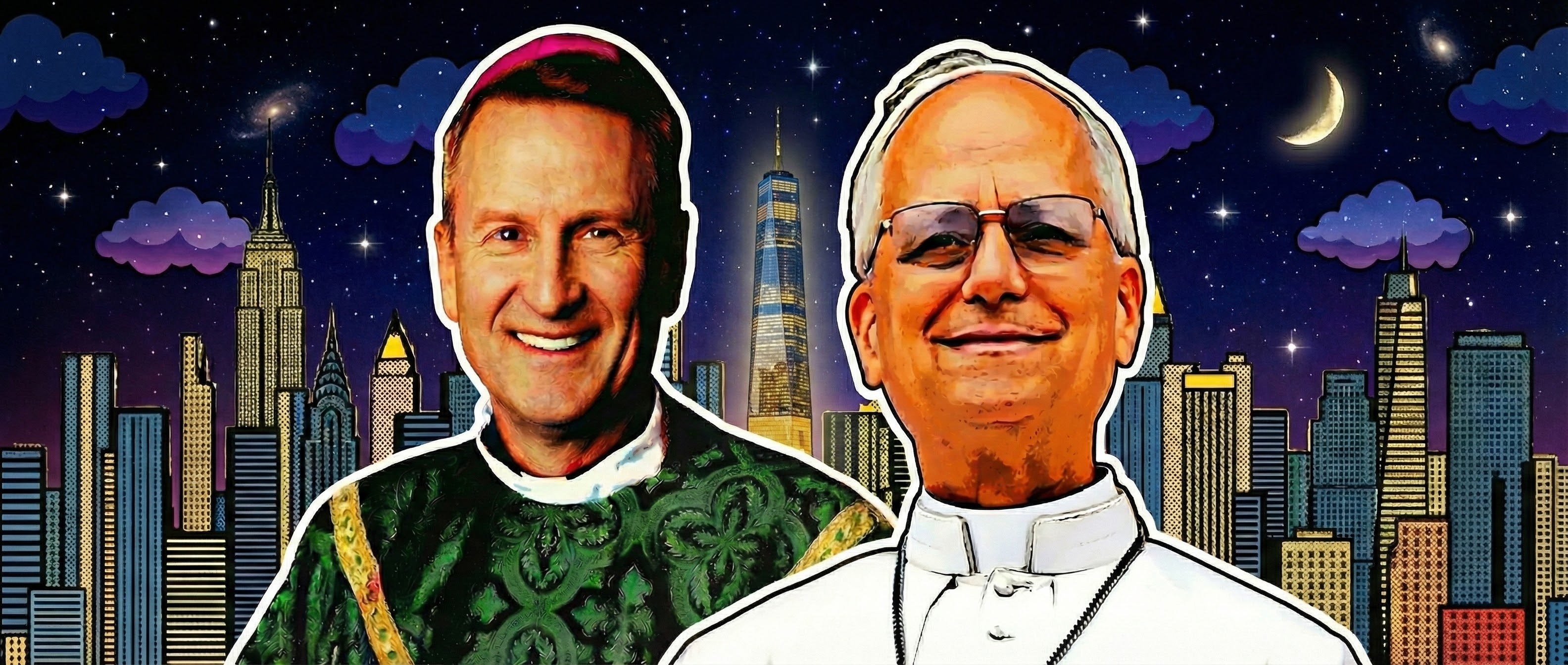
Leo’s Chicago “Trifecta”: Cupich Protégé Tapped to Lead New York
Pope Leo XIV is set to appoint Bishop Ronald A. Hicks — a protégé of Chicago’s progressive Cardinal Blase Cupich — as the 11th Archbishop of New York, succeeding Cardinal Timothy Dolan.
Thank you for reading! Letters from Leo is a reader-supported publication. If you find value in my work, please consider becoming a paid subscriber or making a one-time donation.
Four independent sources with direct knowledge tell Letters from Leo that Pope Leo XIV is naming Bishop Ron Hicks of Joliet, Illinois as the next Archbishop of New York, with an official Vatican announcement expected as soon as this week.
Archbishop Hicks’s installation will come in early 2026.
The selection of Hicks, 58, decisively undercuts the hopes of some traditionalists who thought Leo might chart a new course in New York. Instead, it cements the influence of Chicago in American Catholic leadership.
As one source put it bluntly in a comment to Letters from Leo:
“This is a Chicago priest, advocated by Cardinal Cupich, appointed by a Chicago pope. It’s a perfect trifecta.”
That “trifecta” refers to the central role of Cardinal Blase Cupich, the Archbishop of Chicago and a close ally of Pope Leo, in Hicks’s ascent.
Cupich mentored Hicks for years and actively advocated for him in Rome. Now Hicks — who once served as Cupich’s vicar general — will take the helm in New York, America’s largest diocese.
The move confirms that Leo XIV has no intention of sidelining Cupich’s contingent; on the contrary, he’s elevating it.
The Archdiocese of New York, long a stronghold of more conservative churchmanship under Cardinal Dolan, will now be led by a bishop formed squarely in the Pope Francis-Pope Leo mold. It’s a dramatic generational changing of the guard.
The timing of the appointment appears carefully coordinated. Cardinal Dolan turned 75 this year (February 6) and duly submitted his resignation, as required by Church law.
In recent days, the Archdiocese of New York quietly moved to resolve a major shadow over Dolan’s tenure: a massive clergy sex-abuse settlement.
Just last week, the archdiocese agreed to enter mediation to compensate roughly 1,300 survivors of child sexual abuse by priests and church personnel.
To fund that settlement, church officials are finalizing the sale of a $490 million Midtown Manhattan property — a building that forms part of the iconic Lotte New York Palace hotel complex.
The Vatican often likes such grim business to be settled before a new bishop steps in, and indeed Dolan’s team is clearing the deck.
With the deal in motion, Pope Leo’s acceptance of Dolan’s retirement and the naming of a successor could proceed without further delay.
Sources say the formal announcement was originally planned for Thursday, though it might be brought forward or briefly held if leaks keep emerging.
I reached out to the New York Archdiocese for confirmation; as expected, officials declined to comment, since no appointment is official until the Holy See itself says so.
For New York’s 2.5 million Catholics, Bishop Hicks represents a notable shift in tone and priorities.
I wouldn’t necessarily call Bishop Hicks a progressive, but I can assure you he’s more progressive than Cardinal Dolan.
Hicks is largely seen as a pastor in the Pope Francis vein — focused on the peripheries and less on the culture-war battles. In Joliet, he gained a reputation for humility, accessibility, and even a certain openness to diverse liturgical expressions.
Traditionalist faithful should take heart though: Hicks has been far more accommodating to Latin Mass communities than many U.S. bishops.
His diocese applied Pope Francis’s Traditionis custodes restrictions “prudently and non-disruptively,” allowing local Traditional Latin Mass groups to continue their worship life without drastic interference.
That’s in stark contrast to the clampdowns seen in some other dioceses.
In other words, Hicks is no firebrand ideologue — he’s a pastoral workhorse who by all accounts listens more than he lectures.
That alone marks a change from Cardinal Dolan’s approach. Dolan, 75, has been a towering figure in the U.S. Church for over a decade, known for his gregarious personality and media savvy, but also criticized at times for political entanglements.
Earlier this year, Dolan drew heavy fire after he praised far-right agitator Charlie Kirk as “a modern-day Saint Paul.”
Even a group of nuns publicly rebuked the cardinal’s remark.
Nuns Rebuke Cardinal Dolan’s “St. Paul” Praise for Charlie Kirk
After Dolan’s Fox News canonization of Kirk, nuns clap back: “These prejudicial words do not reflect the qualities of a saint.”
Bishop Hicks, by contrast, is unlikely to be feting culture warriors or making headlines on cable news. His style aligns more with Pope Leo’s vision of a Church close to the poor and marginalized, and cautious of cozying up to secular power.
It’s noteworthy that Hicks comes from the Bernardin lineage of the Chicago Church. He was ordained a priest in 1994 by the late Cardinal Joseph Bernardin, the legendary archbishop who championed the “consistent ethic of life” and shaped a generation of more progressive Catholic leadership.
For decades after Bernardin’s death, that legacy was often eclipsed as a different style of American Catholicism (embodied by figures like Dolan) took center stage.
Now, in a twist of providence, a priest formed under Bernardin’s influence will inherit the very seat (New York) that in recent years became a symbol of the opposite camp.
In a real sense, Bernardin’s vision is coming to St. Patrick’s Cathedral — via Bishop Hicks.
Meanwhile, Hicks’s debt to Cardinal Cupich is unmistakable.
At Hicks’s installation as Bishop of Joliet, Ill., he publicly turned to Cupich and said:
“Thank you for your extraordinary leadership to the Church. Thank you for your trust and confidence in me… I want you to know how much I’ve learned directly from you.”
Those words were a heartfelt tribute from a protégé to his mentor, in front of a packed Congo at his new cathedral.
Hicks has been one of Cupich’s protégés from day one. Cupich made him vicar general of Chicago in 2015 and then auxiliary bishop three years later.
In 2020, when the Joliet diocese needed a new leader, Cupich’s recommendation helped Hicks land the job.
Now, in Pope Leo, Cupich has a friend on the Chair of Peter — and that friend just handed Cupich’s guy the most high-profile American see.
If anyone wondered whether Cardinal Cupich’s star would fade under Pope Leo XIV, the answer from this appointment is a resounding “no.”
On the contrary, Leo is leaning on Cupich’s circle to steer the U.S. Church’s future.
To be clear, Bishop Ron Hicks is very much his own man with a diverse résumé beyond the Cupich orbit.
A native of the south suburbs of Chicago, Hicks studied at Loyola University and Mundelein Seminary, and earned a doctorate in ministry.
Early in his priesthood, he spent five years in El Salvador running an orphanage for abandoned children — an experience he says changed his life and deepened his faith.
He speaks fluent Spanish.
Back in Chicago, he rose through the ranks: seminary dean of formation, then the late Cardinal Francis George (Cupich’s predecessor) sent him to the prestigious North American College in Rome for further training.
When Cupich arrived, he recognized Hicks’s talent for administration and tapped him for the top aide role. Hicks’s background in pastoral ministry, education, and Latin American mission work gives him a well-rounded perspective.
He’s also currently the chairman of the U.S. bishops’ Committee on Clergy, Consecrated Life and Vocations, a national leadership role where he’s earned respect for tackling the clergy shortage and seminary reforms.
One question some observers have asked is how did Hicks emerge as the pick for New York?
The answer, multiple sources say, is Pope Leo XIV’s personal involvement. Leo (formerly Cardinal Robert Prevost of Chicago) has known of Hicks for years through Cupich, but the two last spoke directly in August 2024.
Then-Cardinal Prevost visited Illinois in August 2024 to give a talk at a local parish, and Bishop Hicks was in the audience.
Hicks later recounted that he “walked away saying, ‘I learned something tonight. I learned something about our faith. I learned something about our Church’” from Prevost’s lecture.
The two men chatted for about twenty minutes afterward. Hicks was struck by Prevost’s humility: “He takes more time to listen than to talk,” Hicks told WGN News of Chicago.
He also praised Prevost (who would be elected Pope Leo just weeks later) for not backing away from tough issues and for “leading with the heart of a shepherd.”
That warm encounter made an impression on Leo as well.
It didn’t hurt that the two share a Chicago heritage — Hicks even noted with a laugh that he and Leo “played in the same parks, went swimming in the same pools, liked the same pizza places” growing up.
The only divergence: Hicks is a die-hard Chicago Cubs fan, a trait his dad instilled.
“Stay Catholic and stay a Cubs fan,” his father told the kids. Pope Leo, on the other hand, is a White Sox man — but we won’t hold that against him.
The appointment of Ron Hicks to New York is a bold statement about Pope Leo XIV’s priorities.
It signals that continuity and “sustained influence” are the order of the day — continuity with Pope Francis’s focus on a more inclusive, compassionate Church, and sustained influence for the pastoral-progressive camp within the U.S. hierarchy.
By placing a Cupich protégé in New York, Leo is effectively saying he trusts the Chicago model of episcopal leadership: collaborative, oriented toward social justice and liturgical reverence, and not afraid of engaging the modern world.
Hicks is known for promoting Eucharistic adoration and vibrant liturgies in Joliet, in line with Leo’s push for a Church that “returns to the source” (the sacraments) to renew itself.
He’s also seen as someone who can unify rather than divide — a crucial skill as New York’s Catholics are a mosaic of liberals, conservatives, immigrants, and every group in between.
By contrast, had Pope Leo chosen a more hardline or culture-warrior bishop for New York (as some conservatives had lobbied for), it would have signaled a course-correction or appeasement of the right.
That’s not what happened. Leo doubled down on the vision that got him elected: a Church that stands firmly with the marginalized (immigrants, the poor, abuse survivors) and that resists the politicization of faith.
The Hicks appointment also underscores that Cardinal Cupich remains squarely in the pope’s good graces. Far from being sidelined, Cupich is effectively one of the lead architects behind the new leadership of the premier American diocese.
For Catholics in the pews, what changes might this herald? We can expect a more low-key media presence from the archbishop’s office. Hicks is not the TV natural that Dolan is, though he’s personable in smaller settings.
We might see renewed emphasis on listening sessions, outreach to abuse survivors, and attention to immigrant communities.
Hicks’s fluent Spanish and Central America experience bode well for a diocese with huge Latino and immigrant populations. He is also likely to continue Pope Leo’s and Cupich’s priority of keeping the Church out of partisan showdowns — don’t expect Hicks to deny Communion to politicians or wade into election endorsements.
However, we could see him quietly advance Pope Leo’s teachings on social and economic justice in the local context, perhaps bolstering Catholic charities and schools in underserved areas of New York City.
Internally, New York’s clergy will be getting a boss who is known for being approachable and “down to earth.”
One Illinois priest who worked with Hicks told Letters from Leo that Hicks is “the kind of guy who remembers your kids’ names and asks how you’re doing really doing.”
If he brings that approach to a sometimes impersonal New York chancery, it could improve morale. Still, Hicks will have enormous challenges: the archdiocese is navigating bankruptcy-like financial strains due to the abuse settlements, and church attendance in the Northeast is in long-term decline.
He’ll need all the administrative savvy he honed as vicar general to tackle budget cuts, parish consolidations, and the ongoing fallout of scandal.
Pope Leo’s confidence in Hicks suggests that Rome believes this Midwest bishop has the skills and steady hand for the task. He will need to be both a healer and a reformer.
In the coming days, as this appointment becomes official, many observers will frame it as “Leo XIV replacing a conservative with a moderate in New York.”
That’s true enough, but it actually understates the significance.
On a deeper level, this is about Pope Leo shaping the future of the U.S. Church in his and his immediate predecessor’s image.
New York’s archbishop traditionally holds outsized influence — often becoming a cardinal, often serving as a national spokesman for Catholicism. By choosing Hicks, Leo is effectively choosing Cupich’s vision over US conservatives’ for that influential role.
It’s a choice for continuity with the Francis-Leo agenda, and a bet that a pastorally-minded bishop can bridge divides in a polarized church.
In sum, Pope Leo’s appointment of Ron Hicks to New York is a defining moment in this nascent pontificate. It shows Leo’s willingness to defy the expectations of one faction and follow the counsel of those he trusts (Cupich and others) in choosing shepherds for his flock.
It’s also a reminder that the Holy Spirit (and perhaps some Chicago common sense) is guiding the Church in a direction of continuity rather than whiplash change.
Some traditionalists may grumble, but they will also find in Hicks a more liturgically friendly leader than they assumed.
Progressives, on the other hand, will likely cheer this as a victory for the “field hospital” Church that Pope Francis championed.
Most of all, the faithful in New York can look forward to a bishop who listens — one who, like Leo XIV, believes in taking time to hear people’s stories before he speaks.
As Pope Leo has often reminded us, “The Church cannot remain silent before injustice. You stand with me, and I stand with you.”
By picking Ron Hicks, Leo is sending New York a bishop who will stand with his people, and who will continue the work of building a Church that is more just, less cold, and more alive with hope.
Letters from Leo exists to spotlight moments like this. We were the first English-language outlet in the world to confirm this story, originally broken in the Spanish-language press. And we didn’t just echo it — we confirmed what was right and corrected what was wrong.
But this isn’t about scoops or competition. It’s about helping you see, clearly and urgently, the Church Pope Leo is building — in the United States and across the world.
And using that clarity to help you do the work — every day — to make this world a bit more just, a bit less cold.
Since November 30, all paid subscribers have been receiving the Letters from Leo Advent Reflection Series — a daily companion to prepare for the coming of Christ at Christmas, and to reckon with what His arrival demands in a nation veering toward fascism.
This Upside-Down Kingdom Outlasts Every Empire
Christmas isn’t comfort for the powerful — it’s God siding with the poor, the forgotten, and the cast aside.
It’s not too late to sign up by becoming a paid subscriber and catching the remaining reflections. The series runs through Christmas Day.
If you want to support this mission during this Advent season, here’s how you can help:
Subscribe as a paid member to receive exclusive posts about the life and formation of Pope Leo and help sustain this newsletter.
Donate with a one-time gift to fuel this project’s mission.
Share this post (and Letters from Leo) with a friend who might enjoy it.
Whether you give $0, $1, or $1,000, your presence here matters — no matter your faith or your politics.
Thank you for reading. I’ll see you on the road.


Sounds great.
I’m a fan of both the Pope and Cardinal, so, I trust this assignment.
This all sounds very positive! Thankful for God’s guidance in blessing the Church with Pope Francis and now Pope Leo XIV. 🙏🏻🤍