
Can We Trust in Hope?
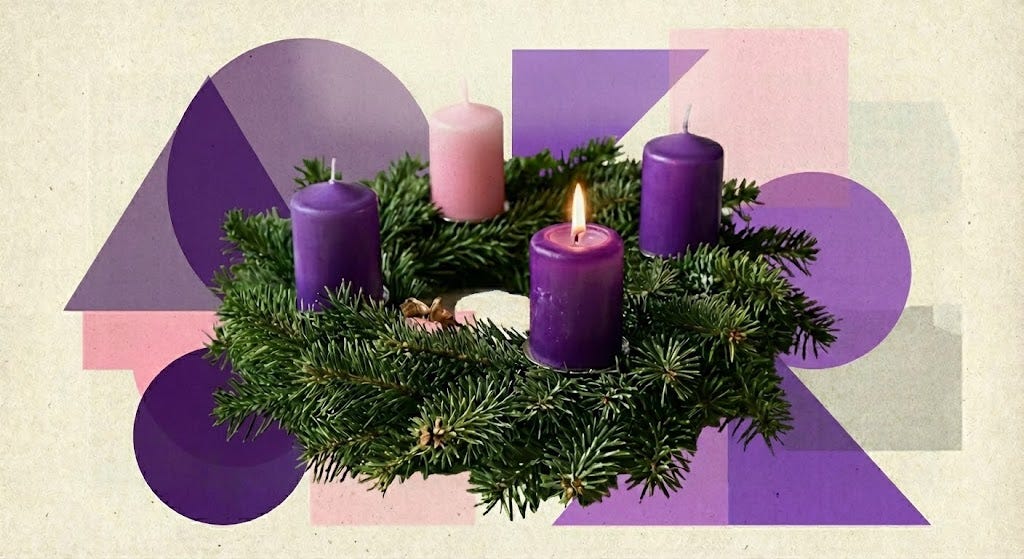
On the first Sunday of Avent, we explore the true meaning of hope — and whether or not it's a reliable tool to guide our lives.
Starting today, Letters from Leo offers daily Advent reflections each morning through Christmas exclusively for paid subscribers, exploring what it means to follow Jesus in American civic and political life. I hope you’ll journey with me as we welcome the light of Christ into every corner of our lives this season.
“It is the hour now for you to awake from sleep. For our salvation is nearer now than when we first believed.” (Romans 13:11)
Today, on the first Sunday of Advent, the Church begins a new liturgical year: a journey that commemorates Jesus’s first coming even as it points toward his ultimate return. Advent holds this double vision: we look back to Christ’s birth in Bethlehem and ahead to his coming in glory. That perspective fills the season with urgent expectation.
Expectation is a thoroughly human experience and flows through the entirety of our lives. We wait for a child to be born. We wait for a friend to visit. We wait to hear the outcome of a job interview. We wait to meet the man or woman whom we will marry.
Humans are alive as long as we wait and as long as we hope.
In this sacred season in which we prepare for Christmas, each one of us can ask: what am I waiting for? What, at this moment of my life, does my heart long for?
So too can our families, our communities and our nation ask similar questions: what are we waiting for together? What unites our aspirations and bring us together?
As highlighted in today’s first reading from the prophet Isaiah, in the time before Jesus’s birth, the expectation of the Messiah was very strong in Israel. The people expected a hero who would at last set the people free from every form of moral and political slavery. They expected someone who would “beat spears and swords into plowshares and pruning hooks” and end the scandal of war.
This was the dream and the promise that God put in Isaiah’s heart. God is always faithful to his promises, but he often surprises us in the way he fulfills them.
Christian hope reminds us that so much remains unseen and thus unknown, and thus uncertain. Hope does not merely project our present beliefs into the future, it acknowledges that despite all we do see, so much remains unseen — in the present as well as in the future.
When we walk in faith but that faith wavers, and we cannot be sure we are on the right path, all we can do is hope. Hope is the attitude of heart that is most humble because its very presence tells us that in this life, there is more than meets the eye. Perhaps we’ve unintentionally been living without hope.
Perhaps that explains the success of a political campaign built on this oft-neglected theological virtue. No matter one’s political allegiance, it is striking how eagerly vast portions of the country desire to hope, their fervent wish to be moved by something new and expansive, the confidence that such hope is not false at all, but active and inspiring.
The question posed to us is this: Can I really trust in hope?
Before we can answer that question, we need to understand what hope is, and we do that best by understanding what hope is not. Hope is not mere optimism. It is not thinking that everything will be “okay” because it always is and because good people—wherever they are—will do the right thing.
Hope is not cheerful. It is not wishful thinking. It is not the refusal to see the somber realities ahead and instead to see a world without those obstacles. Hope is not the denial of an awful reality; it is staring it in the face and hoping––that there is good in life even if it cannot be seen right now.
So what is hope in positive terms?
Hope has eyes.
Hope sees the world differently and gives us new ground upon which to stand. It “gives us the courage to place ourselves on the side of good even in seemingly hopeless situations,” Pope Benedict XVI writes.
Hope is not blind; rather, it changes how we see. It does this not by averting our eyes from a difficult reality, but by drawing our eyes to it so that something different can reveal itself.
Upon healing the man born blind Jesus tells his opponents, “If you were blind, you would not be guilty. But now that you say, ‘We see,’ your guilt remains.” As long as we believe that what we see is in fact all there is to see, we lose what is most vital: our openness to all that remains hidden.
We lose sight of the fact that we all have major blind spots. Hope gives us eyes to see what is otherwise unseen. “In a short time the world will no longer see me,” Jesus tells his followers, “but you will see that I live, and you will live also.”
Hope arises through suffering.
Hope emerges most brightly in deprivation and darkness because it offers us a vision that is not limited to what is immediately at hand. Hope is the star of Bethlehem, most visible on the darkest day of the year.
Pope Benedict XVI calls this hope “great”:
“Certainly, in our many different sufferings and trials we always need the lesser and greater hopes too—a kind visit, the healing of internal and external wounds, a favorable resolution of a crisis, and so on.
In our lesser trials these kinds of hope may even be sufficient. But in truly great trials, I need the certitude of that true, great hope.” He even proclaims that our very capacity to suffer “depends on the type and extent of the hope that we bear within us and build upon.” Hope allows us to find meaning in our suffering, to see that although God does not will our suffering, God is fully committed to creating good from it.
Hope is a way of living with others.
“The saints were able to make the great journey of human existence in the way that Christ had done before them, because they were brimming with great hope,” Benedict XVI exhorts us. In hope, “the dark door of time, of the future, has been thrown open. The one who has hope lives differently; the one who hopes has been granted the gift of a new life.”
Hope moves our feet. It is dynamic. It is not meant to be a mere idea; it is meant to be lived and it is meant to be given.
Benedict XVI puts it this way:
“Human life is a journey. Towards what destination? How do we find the way? Life is like a voyage on the sea of history, often dark and stormy, a voyage in which we watch for the stars that indicate the route. The true stars of our life are the people who have lived good lives. They are lights of hope. Certainly, Jesus Christ is the true light, the sun that has risen above all the shadows of history. But to reach him we also need lights close by—people who shine with his light and so guide us along our way.”
Whether we are see it or not, hope is alive.
It is alive in anyone who has suffered intense loss and kept moving, who has stepped forward to love another with no promise of a return, who has doubted the existence of God and yet prayed anyway, and who has endured suffering for the sake of another and actually found great strength in doing so.
As we prepare for the arrival of Emmanuel in our world — the star of Hope — in just a few short weeks, let us pray that we be given the grace to see the spectacular gift of the life redeemed with new eyes — the Eyes of Hope.


I think I need to read Pope Benedict XVI because he explains what hope is very well. Thank you Chris.
Thank you for reminding me what Hope is