
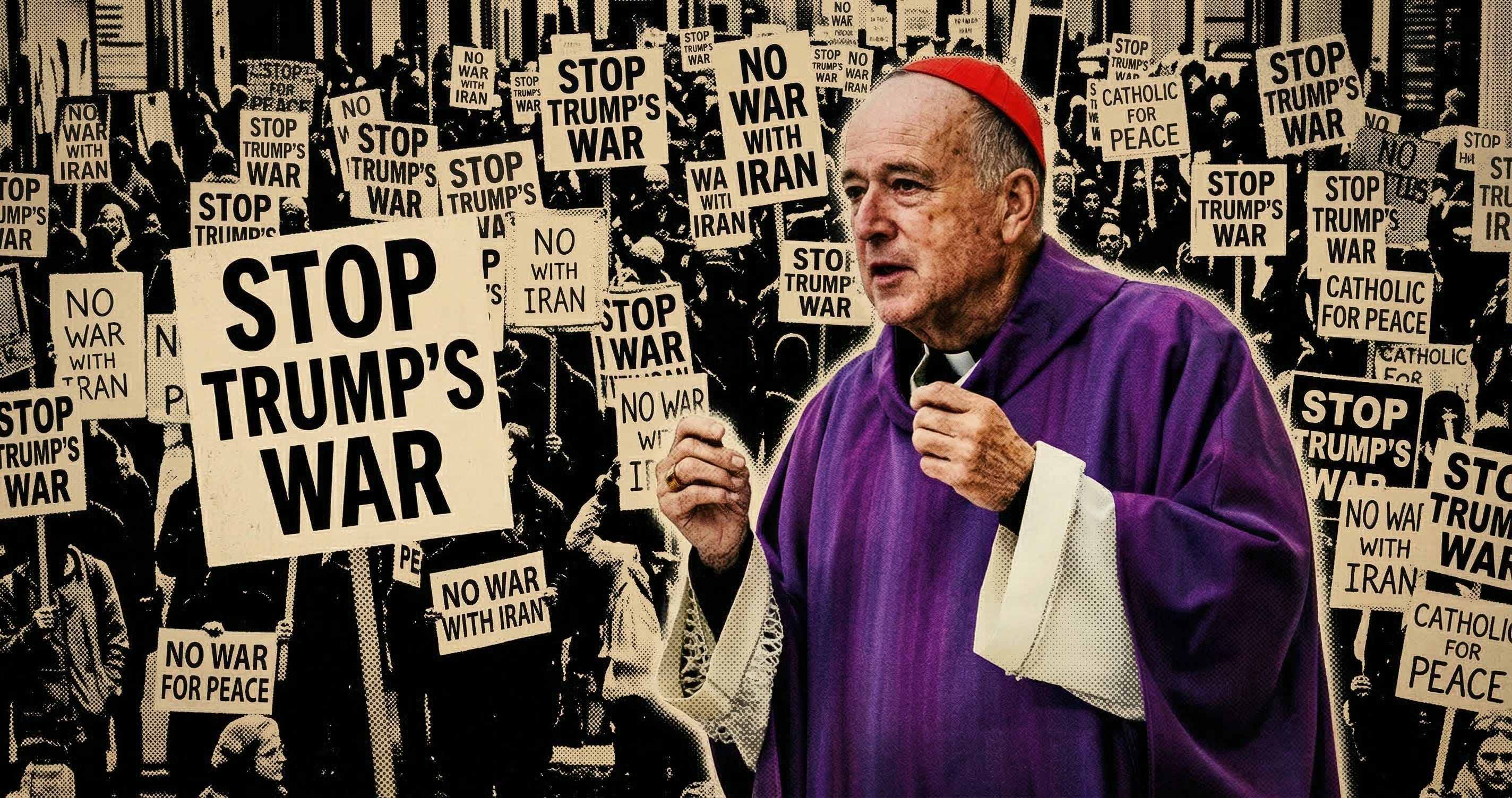
Cardinal McElroy Declares the War in Iran “Not Morally Legitimate” — And He's Not Alone
From Chicago to Arkansas, American bishops are unifying under Pope Leo XIV to challenge the moral foundations of the U.S.-Israeli campaign in Iran.
Dear friends —
Today’s essay covers a remarkable moment in the life of the American Catholic Church. Cardinal Robert McElroy of Washington has declared the war in Iran “not morally legitimate” under Catholic just war doctrine — and he is far from alone.
From Chicago to Arkansas to the offices of the USCCB itself, bishops across the country are unifying under Pope Leo XIV’s persistent calls for peace to challenge the moral foundations of this war.
Cardinal Cupich issued a blistering statement titled “A Call to Conscience,” calling the White House’s viral war video “sickening.”
Archbishop Coakley, the president of the bishops’ conference, warned of a “tragedy of immense proportions” on the very first day of the bombing. Pope Leo himself has called for peace on four separate occasions in the past eight days.
Thanks to your support, Letters from Leo can trace these turning points in real time — connecting the moral voice of the American bishops to the broader vision of the first American pope.
We’re the only outlet in the world with the depth to connect Pope Leo XIV’s moral vision to the shifting ground of American politics — because I’ve spent the past fifteen years deeply embedded in both the life of the Catholic Church and the machinery of U.S. political power.
If you’re already a paid subscriber, thank you. If not, I invite you to join us.
If you’d like to invest in our mission, here are three ways you can help:
Subscribe as a paid member to receive exclusive posts about the life and formation of Pope Leo and help sustain this newsletter.
Donate with a one-time gift to fuel this project’s mission.
Share this post (and Letters from Leo) with a friend who might enjoy it.
Paid subscribers have access to the biographical series on Pope Leo’s life and formation, the Epstein-Bannon investigation, and the Lenten Reflection Series, plus the Q&A mailbag where you can ask me anything about American politics, Catholicism, Donald Trump, Pope Leo, JD Vance — or my own faith, biography, and life.
Whether you give $0, $1, or $1,000, your presence here matters — no matter your faith or your politics.
And as always: if you need help with your subscription, just reply to this email.
Thank you for reading. I’ll see you on the road.
On Sunday, Cardinal Robert McElroy of Washington sat down with his archdiocesan newspaper and said what few American Church leaders have been willing to say plainly: the United States’ war in Iran is “not morally legitimate.”
The cardinal did not mince words. Applying the Catholic Church’s centuries-old just war tradition — the moral framework that has governed Christian thinking about armed conflict since Augustine — McElroy concluded that the U.S.-Israeli campaign in Iran fails on three separate counts.
The war lacks a just cause because America was not responding to an existing or imminent attack. The criterion of right intention is unmet because the administration has offered no coherent explanation for why this war was necessary.
And the principle of proportionality collapses under scrutiny, because the benefits of this conflict are unknowable while the harms — an unstable Middle East, oil supply shocks, immense civilian casualties — are already materializing.
McElroy invoked Pope Benedict XVI’s rejection of preventive war, warning that if such a doctrine were accepted, “all limits to the cause for going to war would be put in extreme jeopardy.”
The cardinal’s statement is important on its own. But what makes this moment genuinely remarkable is that McElroy is far from alone.
A Growing Chorus
Two days before McElroy’s interview, Cardinal Blase Cupich of Chicago issued a blistering statement titled “A Call to Conscience” that targeted something beyond the war itself — the moral rot of treating it as entertainment.
Cupich had watched the official White House social media account post a video splicing footage of actual airstrikes on Iran with clips from action movies, cartoons, and television shows, all captioned “Justice the American way.”
His response was withering. “A real war with real death and real suffering being treated like it’s a video game — it’s sickening,” Cupich wrote.
The cardinal warned that Americans are losing something essential when the destruction of human life becomes content for a social media feed. “We lose our humanity when we are thrilled by the destructive power of our military,” he continued. “War now has become a spectator sport.”
Cupich’s moral clarity landed in the public square like a thunderclap. Combined with McElroy’s systematic dismantling of the war’s moral legitimacy, the two cardinals closest to Pope Leo XIV in the United States have now staked out unmistakable positions. They believe this war is wrong — and they are saying so publicly, forcefully, and without hedging.
The courage extends well beyond the cardinals’ offices.
Archbishop Paul Coakley, the president of the U.S. Conference of Catholic Bishops, released a statement on March 1 — the very first day of the bombing campaign — warning of “the possibility of a tragedy of immense proportions.” He united the voice of the American bishops’ conference with Pope Leo’s own appeal for dialogue, calling on Catholics and all people of goodwill to pray for “diplomacy to regain its proper role.”
In Arkansas, Bishop Anthony Taylor issued his own assessment, concluding that the “necessary conditions do not appear to be met in the present conflict” under just war doctrine. In Tyler, Texas, Bishop Kelly called on leaders to choose dialogue over violence and urged Catholics to pray for effective disarmament.
From coast to coast, in dioceses large and small, Catholic bishops are finding their voice on war. The pattern is unmistakable.
Unifying Under Leo
What we are witnessing bears a striking resemblance to the way American bishops unified under Pope Leo’s leadership on immigration earlier this year.
When ICE agents began targeting Catholic parishes and shelters, the bishops responded with a moral clarity that surprised many observers. Cardinals Cupich, McElroy, and Tobin issued a historic joint statement in January declaring that they “renounce war as an instrument for narrow national interests.”
Bishop Alberto Rojas of San Bernardino exercised his canonical authority to protect his flock from immigration enforcement.
The immigration fight revealed something many had doubted: the American bishops, under the moral leadership of the first American pope, could find shared conviction on contested political questions when Catholic teaching demanded it.
The war in Iran is producing the same dynamic — perhaps even more powerfully, because the just war tradition leaves arguably less room for ambiguity than the Church’s teaching on immigration.
A war that fails the tests of just cause, right intention, and proportionality is simply unjust. Full stop.
And behind all of this stands Pope Leo XIV himself.
In the past week alone, the pope has called for peace on at least four separate occasions. On March 1, in his Angelus address, he appealed to all parties to “assume the moral responsibility of halting the spiral of violence.”
On March 3, at Castel Gandolfo, he told journalists to “seek solutions without weapons.” On March 5, he released a video message praying that leaders would “abandon projects of death” and “halt the arms race.”
And on March 8, at the Angelus again, he prayed that “the roar of bombs may cease” and warned of the conflict spreading to Lebanon and beyond.
Four appeals for peace in seven days. The pope has been careful to avoid polemics — his tone has been pastoral, measured, prayerful. But the consistency of his message is itself a kind of moral thunderclap. When the pope speaks about peace four times in one week, his bishops hear it. And in March 2026, they are responding.
The Silence That Still Speaks
Of course, the chorus is incomplete.
Some American bishops, sadly and unsurprisingly, remain silent. Bishop Robert Barron of Winona-Rochester — who has built a massive media platform and never lacks for words when the subject is culture war politics or YouTube apologetics — has offered nothing.
Not a single statement on the war, not a word of just war reflection, not one sentence of pastoral guidance for the Catholics in his diocese who are watching their country bomb a nation of 88 million people.
He did, however, find time on Monday to tweet a quote from St. Frances of Rome about the domestic cares of married women.
The silence is a choice. Cupich called the White House’s gamification of war “sickening.” McElroy applied the full weight of Catholic moral tradition to declare the conflict illegitimate. Coakley united the bishops’ conference with the pope’s own appeal on day one.
Against that backdrop, Barron’s absence becomes its own kind of statement — a tacit admission that certain moral questions are best left unanswered when the answers might alienate the wrong audience.
Let us hope that changes. Pope Leo deserves better from every bishop in the United States — and the Catholics sitting in pews in Winona and Rochester deserve better from theirs.
But the broader story here is one of moral courage. The American Catholic bishops have surprised many people in 2026. On immigration, on foreign policy, on the fundamental question of when a nation may justly take up arms, they have spoken with a clarity and conviction that many thought impossible from an institution so often paralyzed by internal division.
Cardinal McElroy said it best in his interview on Sunday.
The just war tradition exists for moments exactly like this one — moments when a government asks its citizens to accept bloodshed as inevitable, when the machinery of war grinds forward without anyone stopping to ask whether the killing is justified. The tradition demands that the question be asked.
McElroy asked it on Sunday, Cupich two days before that, and Coakley on the very first day the bombs fell. Bishops across the country followed.
Their answer — grounded in centuries of Catholic moral reasoning, echoing the persistent voice of the pope himself — deserves to be heard.


The Bishops who have or will speak out against the war are showing both courage and leadership that the world needs. Unfortunately Bishop Barron has decided to show neither and by remaining silent has created a vacuum that is in itself an injustice.
I love these faith leaders; they're leading by example. I pray enough of us are awake enough to see it.