


Dear friends —
Welcome to our daily Lenten reflections through Easter, available exclusively to paid subscribers. Each day, we will sit with the scriptures and ask what it means to follow Jesus more faithfully — not as partisans first, but as Christians whose consciences are shaped by the Cross.
These reflections are not a retreat from the world. They are an engagement with it. We write from the conviction that the Gospel has something urgent to say to American civic and political life — and that too many Christians have stopped listening.
Lent is a season of repentance, renewal, and resolve. It is a time to confront our idols, strip away our illusions, and allow the light of God’s redeeming love to search and purify our hearts.
Let’s walk this road together.

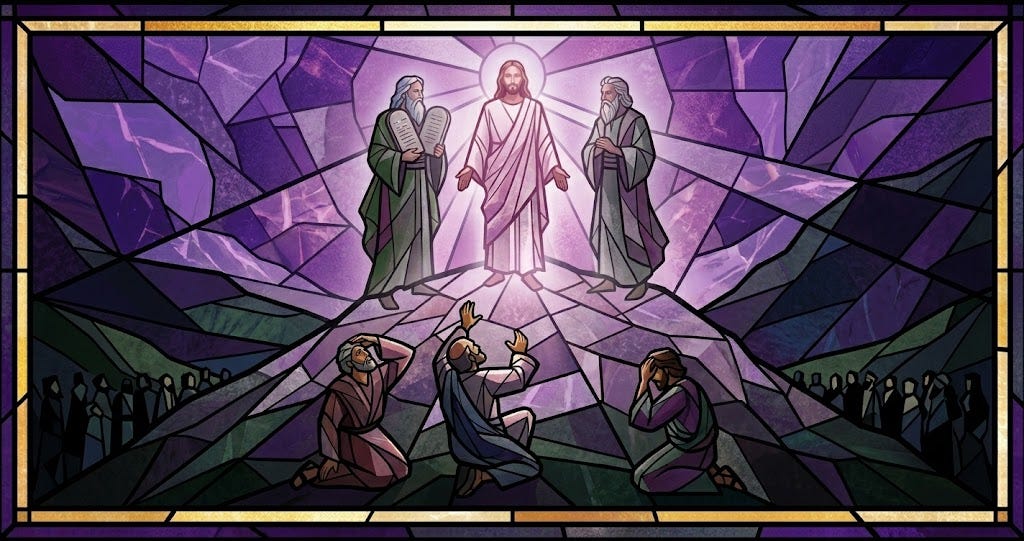
“Jesus took Peter, James, and John, his brother, and led them up a high mountain by themselves. And he was transfigured before them; his face shone like the sun, and his clothes became white as light.” — (Matthew 17:1-2)
There is a moment on the mountain when everything becomes clear. The veil lifts. The glory breaks through. And for one shimmering instant, Peter, James, and John see Jesus as he truly is — radiant, luminous, unmistakable.
Peter’s response is profoundly human: “Lord, it is good that we are here.” He wants to build tents. He wants to stay. He wants to capture the glory and hold it in place, to construct something permanent around a moment that was never meant to be permanent.
We know that impulse. We know it in our bones.
Americans are a people who build tents on mountaintops. We are addicted to peak experiences — the rally, the inauguration, the viral moment, the Sunday morning that feels like heaven itself has descended. We want the glory without the descent. We want Easter without Good Friday. We want a transfigured nation without the transfiguring suffering that precedes it.
But the Transfiguration is not a destination. It is a glimpse — a fleeting vision of what is coming, given precisely so that the disciples can endure what is about to happen. Jesus takes them up the mountain not to escape the world but to strengthen them for the valley below, where a father waits with a convulsing child whom the other disciples cannot heal. Where the Cross awaits. Where the real work begins.
This is the compelling story of Christianity.
It isn’t simply a spiritual tradition devoid of meaning. It isn’t a spa therapy that helps us reduce our stress. At its core, it is a human encounter with a person who endured temptation, suffering, and death on a cross to redeem the entirety of the human race.
A Christian faith with just banners and balloons and without a cross is boring and superficial. It provides no meaning to people beyond childhood. It doesn’t give us a sense of how to deal with darkness, pain, and suffering. This is where the drama of life occurs, and this is where the faith matters.
Today’s first reading tells us that before there was glory, there was departure.
