


Thank you for reading! Letters from Leo is a reader-supported publication and the fastest-growing Catholic community in the country. To receive new posts and support this movement, consider becoming a free or paid subscriber.
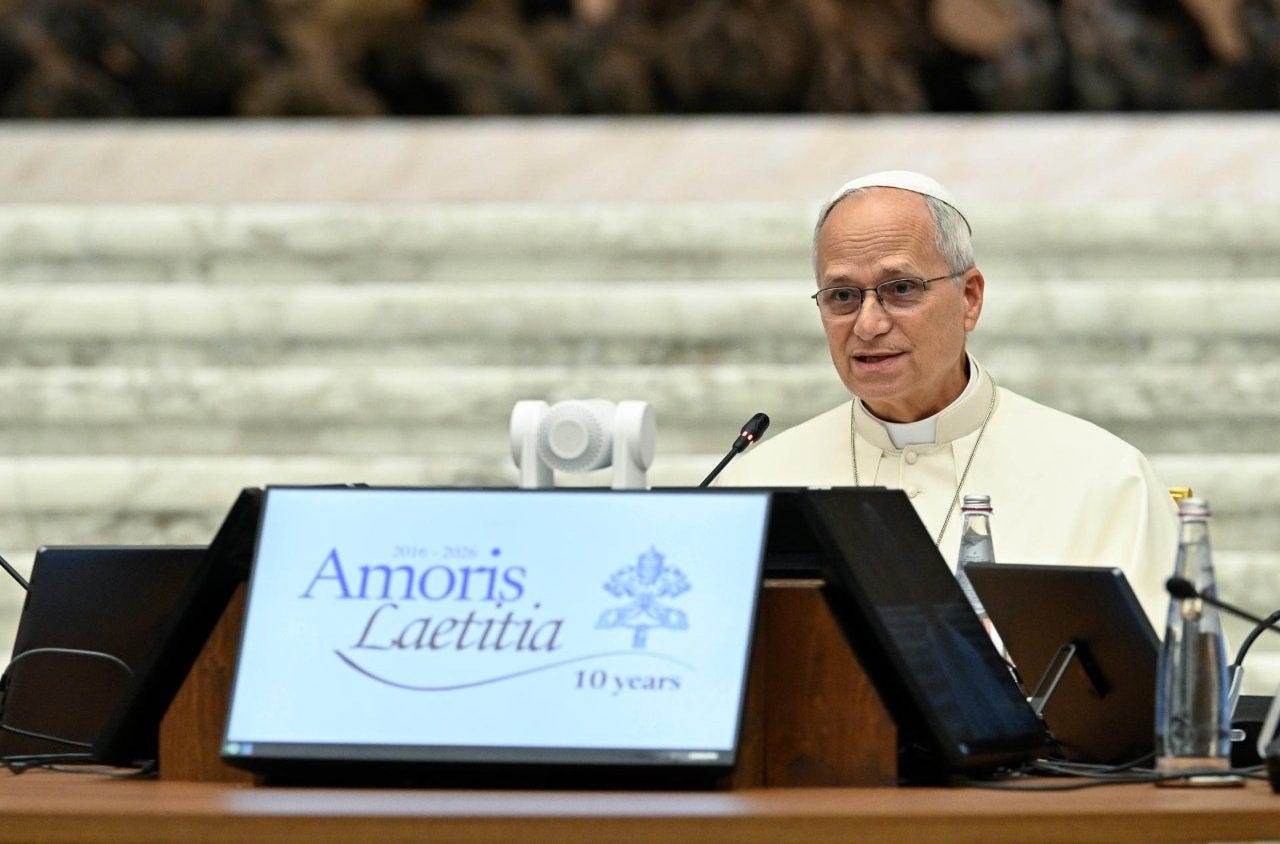
Pope Leo XIV opened his weeklong Vatican summit on Amoris Laetitia on Wednesday afternoon with the full tenth-anniversary logo of Pope Francis’s most contested document displayed in front of him in the Paul VI Hall.
I joked on X that the setup made the American pope look like a candidate at a campaign rally. But I think the joke holds up.
Nobody prints an anniversary logo for a document they plan to retire.
During Leo’s beautiful speech, he defended Francis’s exhortation in Francis’s own vocabulary, with mercy at the center of the address and the freedom of the Holy Spirit running underneath it. The conservatives who spent months predicting a rollback got the opposite.
The meeting runs through Oct. 14 and brings together 111 presidents of bishops’ conferences, the heads of the 15 Eastern Catholic Churches, married couples and theologians, according to the Vatican.
Leo called for the meeting in March, on the tenth anniversary of the document’s signing.
A footnote and a decade of fury
Amoris Laetitia runs 256 pages on courtship, child-rearing and the ordinary strain of married life, and almost none of it drew fire.
The fight came over footnote 351, which opened a path for some divorced and civilly remarried Catholics to return to the sacraments, Communion included, after discernment with a priest or bishop.
The AP’s Nicole Winfield wrote last week that the document became “the focal point of conservative opposition to his papacy.”
In 2016, Cardinal Raymond Burke and three other cardinals (Walter Brandmüller, Carlo Caffarra and Joachim Meisner) sent Francis five dubia, formal questions demanding he clarify whether chapter 8 had broken with John Paul II.
Francis never answered them directly.
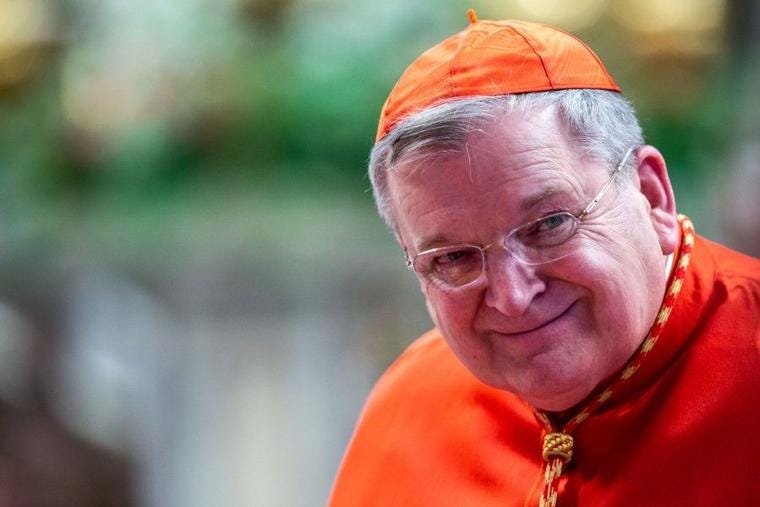
Burke tried again in 2023, this time with four other cardinals, on the eve of the Synod on Synodality.
The opposition never really ended. It just waited for a new pope.
When Leo warned judges of the Roman Rota in January against “misunderstood compassion” in annulment cases, Crux noted that attentive observers heard an echo of the old complaints about footnote 351. (The same speech told the judges to guard the truth with “rigor but without rigidity,” a line the rollback crowd preferred to skip.)
The more polished version of that hope came from the National Catholic Register, which ran a commentary by Larry Chapp on the eve of the meeting.
Chapp praised most of Amoris as a meditation on marriage and family, called the Communion debate “thoroughly legitimate,” and predicted the summit would retrieve the document as a blueprint “fully in line with Familiaris Consortio.”
He never called for reversing footnote 351. His reading simply sets it aside.
Austen Ivereigh, Francis’s biographer, said the idea that the footnote would be ignored or pushed aside is “pure fantasy.” This week, he wrote, is about receiving Amoris, not undermining or reversing it.
His sharper point concerned method. Familiaris Consortio 84 is the passage that asks divorced and remarried Catholics to live “in complete continence” before receiving Communion. Ivereigh noted that reading Francis through it gets Catholic interpretation backward, since the Church reads “previous magisterial documents in the light of later ones, not the reverse.”
Reading Amoris “in the light of Familiaris,” he added, was “a favourite way of repudiating it back in 2016.”
Traditionalist outlets ran the cruder version, with InfoVaticana framing the gathering around Burke’s dubia, still unanswered after a decade.
Leo’s answer
There is no evidence of a rollback, and Leo nipped the speculation in the bud on Wednesday.
He placed Amoris Laetitia in a half-century line running from John Paul I through John Paul II’s Familiaris Consortio and into Francis, and he told the bishops the exhortation “marked an important stage” in the Church’s life, as Crux reported.
A pope preparing a reversal would not describe his target that way. Leo kept Amoris in continuity with John Paul II, as Chapp expected, but he did it in Francis’s language of mercy, which Chapp’s reading leaves little room for.
Then he turned to the people footnote 351 was written for.
Every Catholic, Leo said, knows “the gap between the good we desire and what we are able to live.”
He asked whether the truth the Church proclaims can be met through the “patience, closeness and mercy of our pastoral presence,” in the words of the full text.
He also pressed the bishops to recognize grace in lives marked by “limits, wounds and apparent failure.”
Couples who try to live the Church’s ideal and fall short, in other words, sit at the center of Leo’s pastoral vision.
Leo framed all of it as the work of the Spirit.
“The Holy Spirit often speaks through the very situations that challenge us,” he told the bishops.
He asked them to speak to one another with the “evangelical freedom” of the Acts of the Apostles, and he closed by praying that the Lord would give them the freedom to listen.
I heard echoes of Francis throughout the entire intervention.
At the close of the 2014 synod on the family (the gathering that eventually produced Amoris Laetitia), Francis warned the bishops against a hostile rigidity that hides behind the letter of the law, calling it a failure of “not allowing oneself to be surprised by God, by the God of surprises,” according to the Vatican translation.
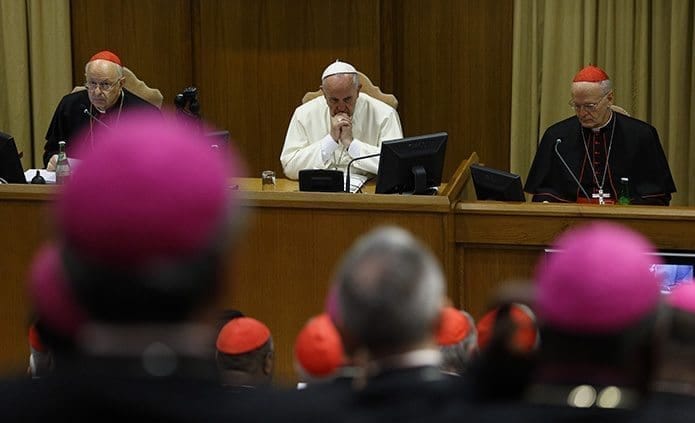
Twelve years later, a canon-lawyer pope who weighs every word set the same choice before the world’s bishops. He came down where Francis did.
The whole family, not one footnote
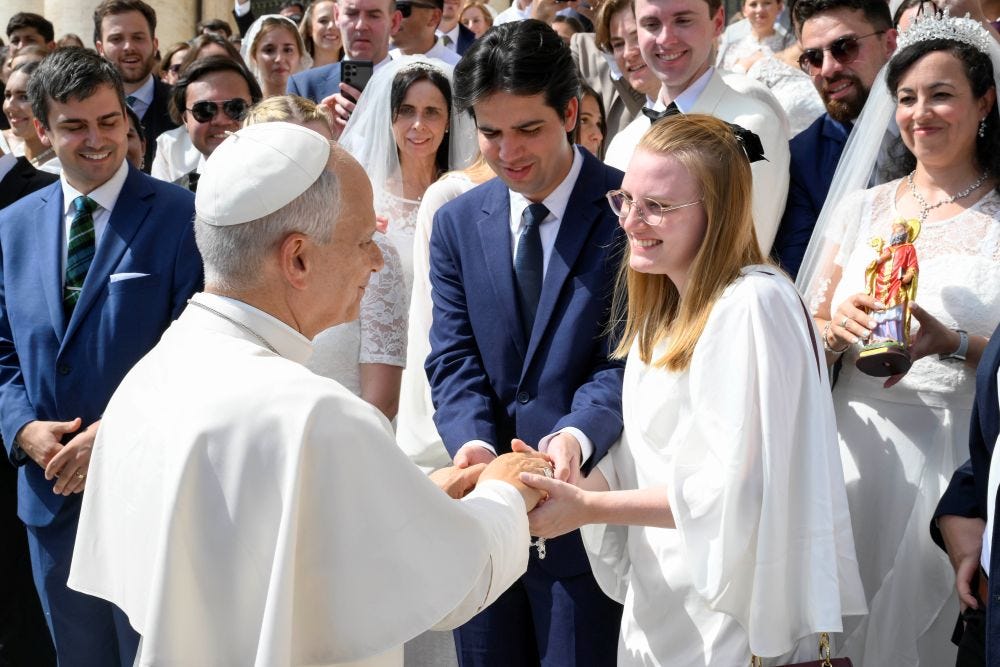
Leo also refused to let the conversation shrink back to the controversy itself. He spoke about young people who still long for love and fidelity yet struggle to believe that a lifelong commitment can deliver it.
He named economic insecurity, migration, violence and loneliness as forces that shape what couples imagine their future can hold, a list any young couple priced out of starting a family will recognize.
Justin McLellan, the National Catholic Reporter’s Vatican correspondent, reported that Amoris was only “tepidly received” in the United States, where, as Jesuit Fr. James Keenan of Boston College put it, Catholics “decided to have a debate about one point rather than looking at the document.”
By calling the bishops back to Rome to discuss it anew, McLellan wrote, Leo “is seeking a course correction.” The thing being corrected is the American Church’s narrow reception of Francis’s exhortation.
Keenan also pointed out that earlier Church documents on marriage mostly turned on whether couples could use contraception, while Francis wrote about how families talk to one another and work through their problems.
That narrowing was the real damage of the last decade.
For years the Church’s public voice on family life shrank to a few hardline questions about sex. Leo reopened the conversation on Wednesday, continuing what Francis had done over a decade ago.
Every few months, some corner of the Catholic right announces that the real Leo is about to arrive, the reactionary who will quietly undo the Francis years. Those hopes keep going unmet because that pope does not exist
As I wrote in June, Leo has spent his pontificate advancing what Francis started, and on Wednesday the Church under Leo XIV kept moving forward with the anniversary logo hanging right behind him.
At Letters from Leo, we stand with Pope Leo XIV and with every family that has ever felt the distance between the life it hoped for and the life it actually lives.
The divorced mother wondering whether she still belongs at Mass deserves a Church that walks toward her. So does the young couple delaying marriage because rent swallows their paychecks. Leo told the bishops that mercy is how the truth reaches people, and we intend to keep telling that story.
This is the fastest-growing Catholic community in the country because people are hungry for a faith that heals instead of a faith that polices.
If you believe this movement matters — Catholics and people of goodwill standing for mercy against those who would shrink the Gospel to a rulebook — I am asking you to join us.
If you’d like to invest in our mission, here are three ways you can help:
Subscribe as a paid member to receive exclusive posts about the life and formation of Pope Leo and help sustain this newsletter.
Donate with a one-time gift to fuel this project’s mission.
Share this post (and Letters from Leo) with a friend who might enjoy it.
Paid subscribers get our ongoing series on Pope Leo’s life and formation, along with investigations like the Epstein-Bannon Investigation into the campaign against Pope Francis, plus our Sunday Scripture Reflection Series.
Whether you give $0, $5, $50, $500, $1,000, or more, your presence here matters — no matter your faith or your politics.
Thank you for reading. I’ll see you on the road.

"As I wrote in June, Leo has spent his pontificate advancing what Francis started," though this is true only insofar as Leo's main priority has been unity, and a complete reversal of the Francis pontificate would cause more disunity. A continuity of his predecessor is more in line with Leo for the sake of unity, but I think we need to wait and see for Leo to form his own pontificate that may well be different than Francis, in both pastoral and theological frameworks.
The Curia, key ecclesiastical choices, and the first red hats will fully reveal Leo's vision for the Church.
If there is one thing I hope Leo improves from his predecessor, is clarity and conviction. Francis was brilliant and inspiring in pastoral theology, but at times the ambiguity when it came to documents left more confusion. There ought to be a balance of accompaniment and truth, I hope Pope Leo can hold both those mediums within the Church.