
“Dignity Has No Passport” — Pope Leo XIV Turns Europe’s Dock of Shame Into a Pulpit
At Arguineguín, where 2,600 migrants once slept on concrete, the pope bowed before the survivors of the Atlantic crossing. Then he told Europe its shores are becoming unmarked graves.
Thank you for reading! Letters from Leo is a reader-supported movement of Catholics and people of goodwill standing for human dignity. To invest in this mission, please consider becoming a free or paid subscriber.
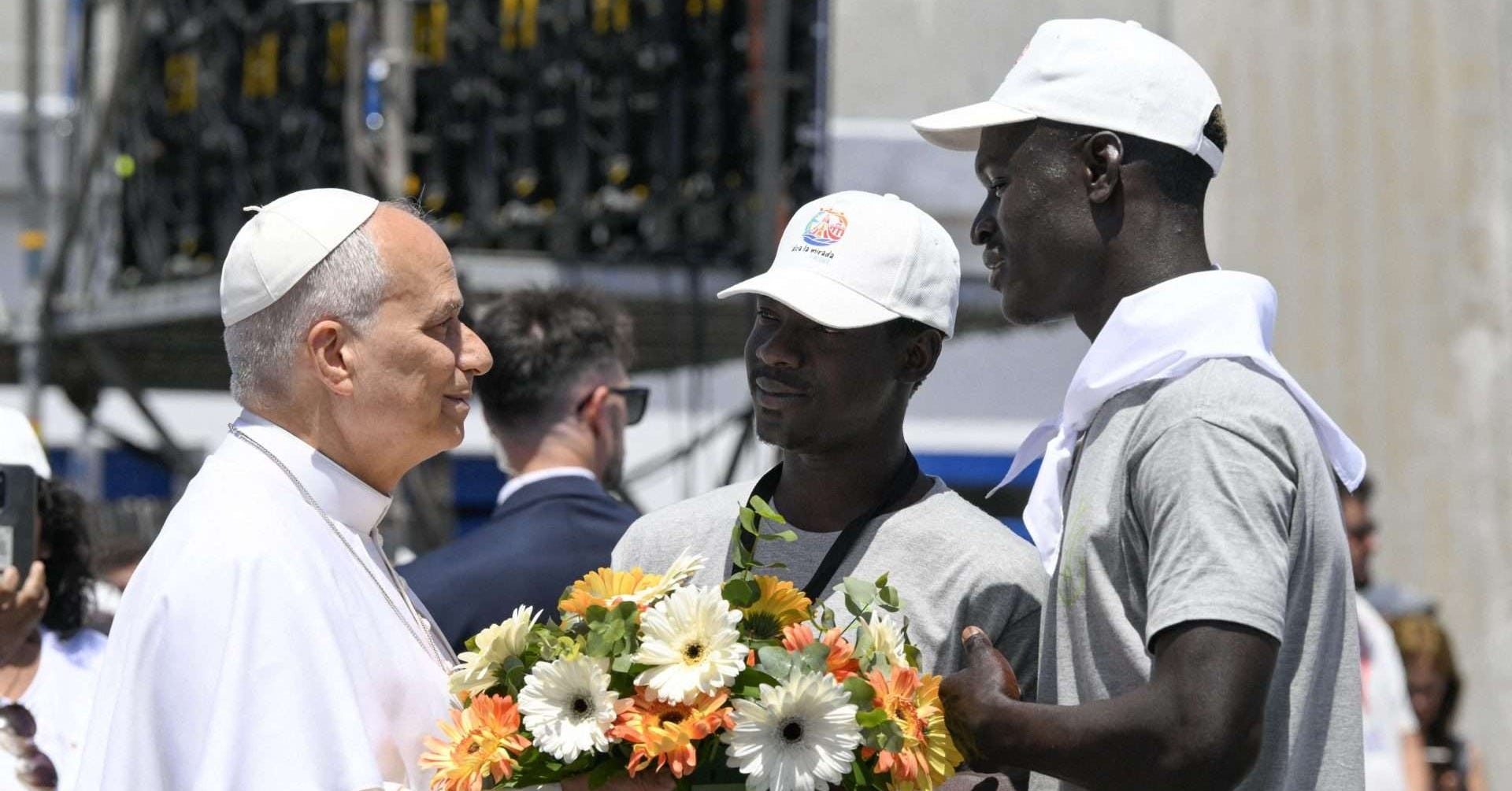
“Dear migrants, before saying anything else to you, I want to bow before your dignity,” Pope Leo XIV said Thursday morning at the port of Arguineguín on the island of Gran Canaria. “You are not just numbers or files. You are people who have left behind families and homes. You have dreams that no one has the right to despise.”
Relief workers call this pier the “dock of shame.” In 2020, more than 2,600 men, women, and children slept here in the open — six times the dock’s capacity — after crossing the Atlantic from West Africa in wooden cayucos and rubber dinghies.
No pope had ever made an apostolic journey to the Canary Islands. Pope Francis told reporters in September 2024 that he wanted to come “because there are situations with migrants arriving by sea,” and the Diocese of Canarias held a signed letter confirming his intention. He died before he could make the trip. On Thursday, his successor finished it for him.
The pope spent the first part of the morning listening.
Tito Villarmea, a captain with Spain’s maritime rescue service, told him he has pulled more than 20,000 people from the Atlantic across 18 years at sea. One rescue stays with him: a mother, finally safe on deck, pulled the cap and jacket off the child she had disguised as a boy and fastened gold earrings on her daughter. “It was a girl,” Villarmea said. The father of two teenage daughters, he wept.
A Caritas volunteer described the first gestures of welcome on the dock — biscuits, milk, a coat, a cup of coffee, help with documents. A testimony read on behalf of Blessing, a Nigerian survivor of trafficking, recounted hunger, coercion, debt, and separation from her child before Church social workers helped her begin a new life.
Bishop José Mazuelos Pérez of the Canary Islands called the rescuers, Red Cross workers, Civil Guard officers, parish volunteers, and local fishermen who meet the boats the “guardian angels” of the migrants.

When Leo rose to speak, he began with the twenty-fifth chapter of Matthew’s Gospel, where Jesus places himself in the body of the stranger: “I was a stranger and you welcomed me.” Beside this sea, the pope said, the Gospel becomes concrete. The people who step off the boats arrive “stripped of almost everything.”
He pointed to the Fisherman’s Ring on his hand and tied Peter’s vocation to these islands, where rescuers pull the living from the water and recover the dead. “Each life that arrives,” he said, “asks what remains of our humanity.”
“Human dignity has no passport,” Leo said, “and does not lose its value when it crosses a border.”
“Even today, monsters lurk in these seas: mafias that profit from despair, traffickers who enslave women and children, and those whose indifference allows the poor to be swallowed up by exploitation or forgetfulness.”
It’s worth reading that list once more.
Leo placed the indifferent — the governments and citizens who look away — in the same sentence as the enslavers. To the migrants themselves he said: “Do not surrender your lives to those who trade with them. Do not believe those who promise easy paradises in exchange for your body, your money, your silence or your freedom. Those false promises are ‘siren songs’; they are industries of death.”

Managing arrivals is not enough, he told Europe and the wider international community, and neither is counting statistics, reinforcing borders, or mourning the dead after the fact. Dignity, he said, makes demands: legal and safe pathways, rescue and assistance at sea, protection for victims of trafficking, serious reception and integration, and policies that let people remain in their homelands with dignity.
He named the consciences he intends to disturb, one by one: the nations migrants leave, which owe their people “conditions for peace, justice and development”; the transit nations, called to protect the vulnerable rather than abandon them to criminal networks; and Europe, which he said “cannot claim to uphold human dignity while growing accustomed to the Mediterranean and the Atlantic becoming unmarked graves.”
“We cannot grow accustomed to counting the dead,” he said near a memorial to those lost at sea. “May history never accuse us of having turned the suffering of those who suffer into the ordinary landscape of our shores.”
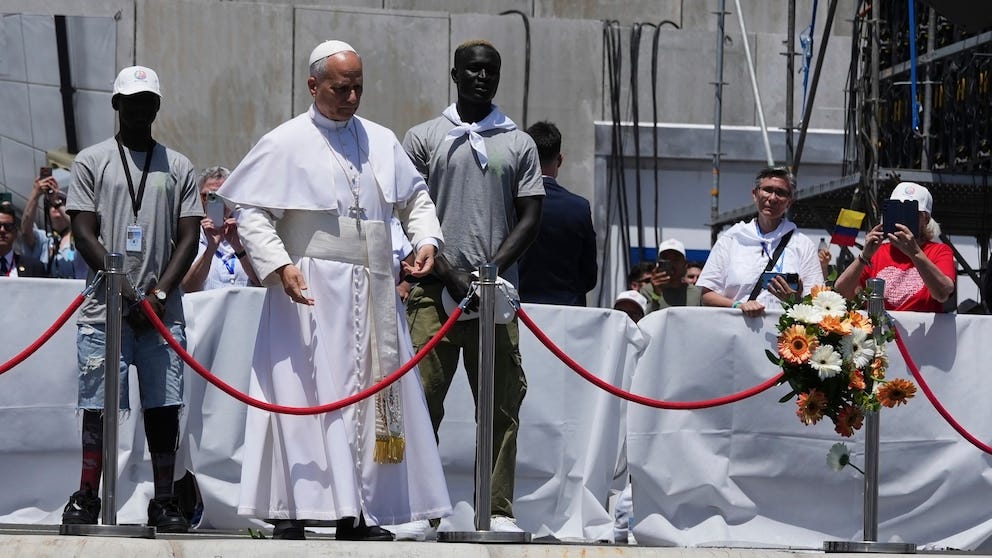
Before leaving the port, Leo laid flowers for the thousands who have died on the Atlantic route and blessed a cross built from the wood of a migrant boat, set beside an image of Our Lady of Mount Carmel.

The pope reserved a challenge for the Church itself. Welcoming migrants, he said, “cannot be a secondary matter that is left to a few volunteers.” Christians kneel before the altar to adore Christ in the Eucharist, he reminded the crowd, and for that very reason “we cannot then ‘pass by’ the small boats and rafts.”
Some 50,000 people filled the Gran Canaria Stadium for the evening’s Mass — the first a pope has ever celebrated in the islands — on the vigil of the Solemnity of the Sacred Heart of Jesus. Leo opened the liturgy by asking the crowd to pray “for the brothers and sisters who have lost their lives at sea.”
The homily carried the morning’s argument into the Church’s own practice. Charity, Leo preached, “must not be mere assistance” — it must “integrate people, toward their full realization, spiritual, intellectual and physical, and their dignified and constructive insertion into the community.” Only that fuller love, he said, turns even painful encounters into “an occasion to scatter seeds of hope on humanity’s path toward a better future.”
The first Augustinian pope then reached for his order’s founder. “Where there is authentic humility there is love, and where there is love there is peace,” he said, recalling the teaching of St. Augustine, “because only in humility do we truly know who we are.” Wealth, he warned, often blinds us into believing happiness means needing no one — and the truer joy of life requires coming down “from the pedestals of arrogance that divides, to meet one another in the humility that makes us brothers.”
He closed the Mass with an appeal: “May wars cease in the world, and may a new humanity grow around us, reconciled in love.”

American Catholics have heard this argument before, aimed at their own government. Leo has said that treating migrants “like garbage” is a “serious crime.” At his urging, the U.S. bishops issued a historic rebuke of the administration’s raids. Border czar Tom Homan answered the pope’s witness by mockingly inviting him on an ICE raid, and the administration blocked priests from bringing the Eucharist to detained migrants. Arguineguín shows what the other road looks like: a society that decided the stranger was worth meeting at the dock.
The Road Through Barcelona
The pope arrived at that pier by way of a week that built toward it. He opened the journey on the flight to Madrid by retiring the warhawks’ favorite doctrine, the “just war.” Madrid heard him rebuke the politics of “weapons and walls.” Before Spain’s Parliament he warned that “the world is in profound crisis,” and 40,000 young people at Barcelona’s Olympic stadium watched him put the “economy that kills” on trial.
Wednesday belonged to the prisoners, the monks, and the basilica.
The day began at the Brians 1 penitentiary outside Barcelona — the first prison a pope has ever visited in Spain. “Someone’s past does not condemn their future,” Leo told some 80 inmates and visitors. “Rather, it offers the opportunity to change our decisions and choices.” Every human being is worthy, he said, “by the mere fact of having been willed, created and loved by God,” and he left them with an instruction: “keep dreaming God’s dream.”
At midday he prayed the rosary with the Benedictine monks at the mountain abbey of Montserrat, Catalonia’s spiritual heart. Ignatius of Loyola laid his sword before the Black Madonna in this abbey in 1522 and kept vigil through the night before setting out to found the order that would one day produce Pope Francis — Leo’s immediate predecessor.
By evening he stood beneath the new Tower of Jesus Christ at the Sagrada Família, inaugurating the 172.5-meter spire that makes Gaudí’s basilica the tallest church in the world — one hundred years to the day after the architect’s death. Nine thousand people filled the nave, the King and Queen of Spain among them, while an estimated 120,000 more followed the Mass from the streets outside. Gaudí, Leo said in his homily, was “an architect inspired by faith,” and in the basilica it is “faith that shapes the stones.”

“Dear brothers and sisters, we cannot believe in Jesus and promote war. We cannot believe in Jesus and kill the innocent even before birth. We cannot believe in Jesus and abandon those who suffer, those who weep, those who flee from misery.”
The next morning he was on a concrete pier blessing wood salvaged from a migrant boat. The itinerary was the homily. A basilica that took 144 years to crown and a boat lashed together for a single desperate crossing belong to the same Gospel, because the consecrated stone and the salvaged plank both point to the God who became a stranger.
Days earlier, before Spain’s Parliament, Leo had already named the standard by which he wants nations measured: “The moral greatness of a nation is manifested, above all, in its capacity to accompany, protect and love those lives that are most fragile.” By that standard, the week in Spain was an examination of conscience for every Western democracy — including, and especially, our own.

The pope bowed to people the powerful refuse to look at.
Whatever Europe and America now decide to do with their borders, the Church’s position carries a date, a dock, and a sentence: dignity has no passport. What remains is the question Leo handed to history — whether the suffering of those who suffer will remain the ordinary landscape of our shores.
At Letters from Leo, we stand with the migrants of Arguineguín and the guardian angels who pull them from the sea — and with a pope who bowed before people the world teaches us to ignore. The Gospel never asks where a person’s papers were printed before commanding us to love them.
This is the fastest-growing Catholic community in the country because people are hungry for something deeper than rage and propaganda.
They are looking for courage, for truth, for love made visible in action — and at a moment when the deaths of the poor have become a statistic washing up on the world’s shores, that hunger has never been more urgent.
If you believe this movement matters — Catholics and people of goodwill standing for the dignity of every person, no matter what waters they crossed to reach us — I am asking you to join us.
If you’d like to invest in our mission, here are three ways you can help during this critical time:
Subscribe as a paid member to receive exclusive posts about the life and formation of Pope Leo and help sustain this movement.
Donate with a one-time gift to fuel this project’s mission.
Share this post (and Letters from Leo) with a friend who might need it.
Paid subscribers make this work possible, and they receive the full archive: the biographical series on Pope Leo’s Life & Formation, the exclusive investigations, his ongoing confrontation with the tech titans in Pope Leo Takes On Silicon Valley, and the Sunday Scripture Reflection Series.
Whether you give $0, $5, $50, $500, $1,000, or more, your presence here matters — no matter your faith or your politics.
Thank you for reading. I’ll see you on the road.


