
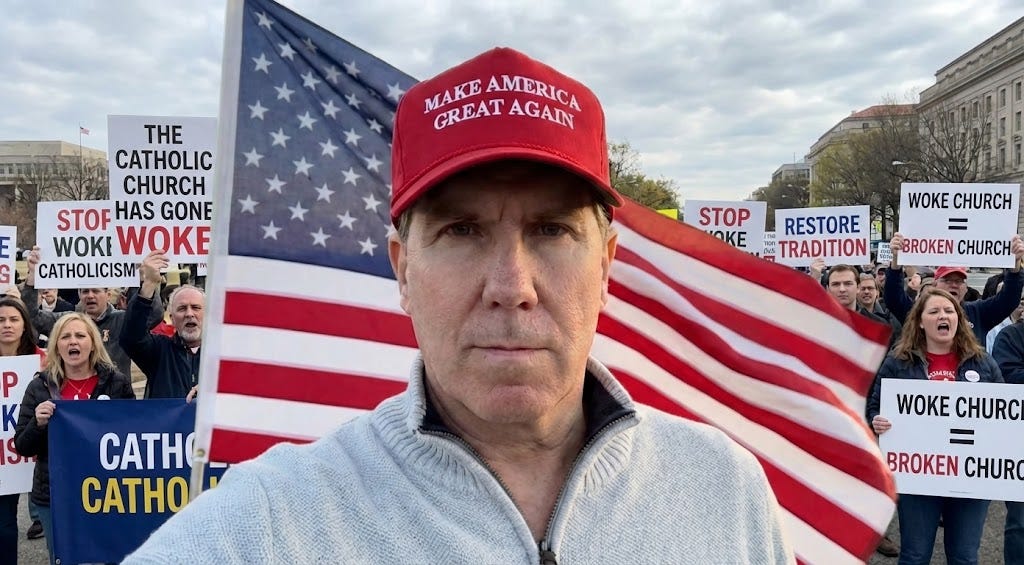
“Don’t Trust the Hygiene” — MAGA Catholic Brags About Refusing the Eucharist from Indian Woman
After refusing Communion from an Indian laywoman and invoking anti-immigrant conspiracy theories, a far-right Catholic faces sharp condemnation from a bishop, priests, and Catholic groups.
Thank you for reading! Letters from Leo is a reader-supported publication. If you find value in my work, please consider becoming a paid subscriber or making a one-time donation.
A disturbing video surfaced on social media this week showing an American Catholic man named Michael Itack openly boasting about refusing Holy Communion from an Indian woman during Mass.
In the clip, he describes how he crossed the aisle to avoid receiving the Eucharist from the Indian lay minister and instead went to a white male priest.
His reason? “Look, I don’t care how holy she is. I just don’t trust the hygiene,” Itack declares bluntly.
He proceeds to unleash xenophobic slurs about India: “You know how they live over there — the streets, the fecal matter everywhere, the open defecation problem. I’m not putting that in my mouth, even if it’s supposed to be the Body of Christ.”
Itack’s rant doesn’t stop at insults. He frames his refusal in extremist “Great Replacement” terms.
The “Great Replacement” is a white nationalist conspiracy theory embraced in MAGA circles that claims Democrats are deliberately encouraging non-white immigration to “replace” native-born Americans and lock in electoral power.
It reframes demographic change as an existential threat and uses fear and dehumanization to justify exclusion.
He even admits he’d rather be considered a bad Catholic than accept India’s influence: “If that makes me a bad Catholic, so be it — I’d rather be a bad Catholic than let this country turn into India. Deal with it.”
In effect, he proudly chose racial prejudice over reverence for the Sacrament, reducing the Body of Christ to something “hygiene-based” and unworthy if offered by someone of a different ethnicity.
In a follow up video, he claimed that the Catholic Church had been captured by woke ideology and that God would be “support me for defending our homeland.”
Such public defiance of Catholic unity and teaching sent shockwaves through both the faithful and wider community.
The spectacle of a self-proclaimed “MAGA Catholic” rejecting the Eucharist, which Catholics revere as Jesus Christ himself, due to racist disgust was described by observers as beyond appalling — a grotesque reversal of the Gospel message that “whatever you did to the least of my brethren, you did to me” (cf. Matthew 25:40).
Backlash from Faithful and Advocacy Groups
Outrage was swift and widespread. On social media, countless Catholics and others denounced Mike’s behavior as bigoted, un-Christian, and downright disgusting.
The advocacy group Stop Hindu Hate Advocacy Network (SHHAN) reposted Mike’s video to call it out, especially warning Indian Christians not to be lulled into a false sense of security. “A lesson to Indian Christians who think they are white-adjacent. You’ll always be treated as Indians!”
In other words, they claim Indian-origin Catholics are not spared from Hindu-phobic and racist hate — bigots will target them for the color of their skin regardless of shared faith. This message resonated painfully, as many Indian Catholics in the diaspora have long seen themselves as part of the Church’s fabric, only to face prejudice from fellow Catholics who have chosen MAGA ideology over Christ’s teachings.
Prominent Catholic voices also weighed in, forcefully condemning Mike’s actions.
Conservative Archbishop Alexander Sample of Portland, for example, invoked St. Paul’s teaching that “there is neither Jew nor Greek — for you are all one in Christ Jesus” (cf. Galatians 3:28).
Emphasizing the Church’s universality, Sample declared “There is no place for racism in Christ’s universal Church.”
This is the second time in the past few months that Sample has stood up for the dignity of minority communities. In November, Sample released a poignant statement calling Trump’s crackdown on immigrants an affront to “human dignity” that comes from God, not government.
Jesuit author Fr. James Martin pointed out the bitter irony of Mike’s stance: “If he’s not going to receive Communion from ‘someone who’s non-white,’ that would mean he wouldn’t have received it from Jesus at the Last Supper.”
After all, Jesus was a Middle Eastern Jew — decidedly not a white American. Martin’s sharp observation underlined how racism blinds one to Christ himself, who comes to us in the Eucharist through all types of ministers and people.
Many priests highlighted that Mike’s attitude violates the very essence of Catholic fellowship.
Everyday Catholics — converts and cradle Catholics alike — took to social media to voice solidarity with Indian Catholics and to insist that “racist Catholics” like Mike do not speak for the faith.
The consensus was clear: Mike’s “hygiene” excuse was just racism, plain and simple, and it has no home in a faith that proclaims the equal dignity of all God’s children.
Church Teaching: Racism as Grave Sin, Eucharist as Source of Unity
Mike’s behavior has spurred fresh reflection on what the Catholic Church officially teaches about racism, the Eucharist, and the sanctity of every person. The Church has unequivocal doctrine here.
The Catechism of the Catholic Church explicitly condemns racism, stating that every form of discrimination or prejudice violates human dignity and is incompatible with Christ’s teachings (cf. CCC 1935).
The U.S. bishops have flatly called racism a sin — indeed “a sin that divides the human family” and “a mortal sin” that “violates the fundamental human dignity” of our brothers and sisters.
In Catholic understanding, a mortal sin is a grave offense against God that destroys the charity in one’s heart — unless repented, it cuts the sinner off from God’s grace. Racism fits that bill when knowingly and deliberately embraced. It’s not a mere personality flaw; it’s a soul-threatening moral evil.
As Archbishop Nelson Pérez of Philadelphia has written, “Racial hatred has no place in our Church or in the hearts of people. Racism is a mortal sin and an attack on the gift of life.”
In Mike’s case, the sin of presumption also lurks in his words. By saying he’d “rather be a bad Catholic” than change his views, he shrugs off the serious risk to his soul.
Presumption is assuming we don’t need repentance or that God will save us regardless of our unrepented sins — a dangerous attitude.
Mike essentially presumed that disobeying Christ’s law of love was somehow a lesser evil than his paranoid fear of cultural “contamination.” This is upside-down theology.
The Eucharist Mike spurned is, in Catholic belief, the very Body and Blood of Christ, offered to us for spiritual healing and unity.
Yet St. Paul warns that if we receive unworthily — without discerning Christ or while clinging to grave sin — we profane the Body of the Lord and eat and drink judgment on ourselves (cf. 1 Corinthians 11:27-29).
Thus, approaching Communion with a heart full of racist hatred is far more “unhygienic” spiritually than any fear of physical uncleanliness. Holiness does matter — profoundly so — but Mike utterly misunderstood it.
Holiness isn’t about the ethnic purity of ministers; it’s about the purity of one’s heart before God.
Catholic theology also emphasizes that the efficacy and sacredness of a sacrament do not depend on the minister’s personal traits — an ancient principle called ex opere operato.
As long as the Eucharist is validly consecrated, Christ is truly present, whether the minister is male or female, Indian or Irish, saintly or sinful.
In the early Church, a heresy called Donatism claimed that sacraments were invalid if the priest was morally impure. The Church rejected that as false — God’s grace isn’t so limited.
Mike’s attitude (“I don’t care how holy she is”) bizarrely twists this truth: he admits the lay minister might be very holy, yet refuses Christ’s Body from her due to his own prejudice.
In doing so, he engages in a sort of self-excommunication. He literally walks away from Communion — from communion with Christ and neighbor — to stand in a separate line defined by racism. It’s a heartbreaking image of how hate separates us from God.
Furthermore, Mike’s fixation on “keeping our churches ours” betrays a fundamental ignorance of Catholic identity. The word catholic means “universal.” The Church is not his or mine or any one race or nation’s possession — it belongs to Christ, and Christ commissioned it to “make disciples of all nations” (cf. Matthew 28:19).
The beauty of Catholicism is that in Christ there is no “us” and “them.”
As Pope St. Paul VI wrote, “the Church is by her very nature missionary,” destined to take root in every culture. Today, the Catholic Church is a truly global family — the Body of Christ composed of “many parts” from every people (cf. 1 Corinthians 12:12).
The idea of a racially “pure” church is not only anathema to Catholic teaching, it’s impossible in practice.
A Universal Church Enriched by Many Cultures
It bears repeating: the Catholic Church is universal.
This incident highlights the rich diversity within the Church — and why that diversity is a gift, not a threat. In the United States, for example, Catholics of Indian origin are an integral part of parish life. In fact, Indian clergy have become essential in American dioceses, often serving in parishes that might otherwise have no priest.
Thousands of Indian priests and Indian religious sisters serve across the U.S., ministering to people of all backgrounds.
Indian Catholics bring deep faith traditions, whether from the Latin Rite or the Syro-Malabar and Syro-Malankara Eastern Catholic traditions, enriching the tapestry of American Catholicism.

They are our pastors, campus ministers, hospital chaplains, and theologians. The global makeup of the Church means an American Catholic may receive the Eucharist from a Nigerian deacon one Sunday, a Vietnamese-American lay minister the next, and an Indian priest the week after.
It is supremely ironic that while one misguided man rails against “foreigners” in the Church, the Successor of St. Peter himself embodies the Church’s multicultural reality.
Pope Leo XIV, our current Holy Father, is the first American-born pope — and he is proudly of mixed heritage. His family roots span Latin American and Black American ancestry, as he grew up with Black Creole grandparents from New Orleans and a rich multicultural family story.

In a sense, Leo XIV personifies the message that the Catholic Church belongs to every race and nation. The fact that the Bishop of Rome himself has African and Latin lineage is a powerful reminder that our Church is “catholic” in more than name — it truly is for all peoples. Any attempt to “keep our churches” racially exclusive is not only morally wrong, it’s a denial of what the Church is.
A Call to Conversion and Communion
This viral incident, ugly as it is, can serve as a wake-up call. It challenges all Catholics — and indeed all people of good will — to examine our hearts. Prejudice can lurk in subtle ways even if we’d never do what Mike did.
As the U.S. bishops wrote in their 2018 letter Open Wide Our Hearts, “Racism can often be found in our hearts — in many cases placed there unknowingly by our upbringing and culture. We must acknowledge and confront those sinful attitudes, and purge them through grace.”
The Gospel demands nothing less.
For those of us watching this saga in anger or disgust, Leo XIV might remind us to channel that energy into constructive action. As the living symbol of the Church’s rich diversity, he urges us: be builders of bridges, not walls.
In the end, the only “great replacement” we should desire is to replace sin with grace, hatred with love, and division with communion.
Last year, something unexpected happened. The Advent Reflection Series became one of the most widely read and shared parts of Letters from Leo.
Many of you wrote to say those reflections helped steady your hearts during a difficult year — one marked by division, anxiety, and genuine moral uncertainty.
Because of that response, I’ve decided to make these Mass reflections a permanent part of this work in 2026.
These Sunday reflections will be available to all paid subscribers as a small but sincere way of saying thank you for making Letters from Leo possible.
Here is this week’s reflection.
Paid subscribers will also have access to the Q&A mailbag opening this week, where you can ask me anything about American politics, Catholicism, Donald Trump, Pope Leo, JD Vance — or my own faith, biography, and life.
Letters from Leo is open to anyone who wants to be informed and inspired by our pope — and to turn that inspiration into action that leaves America and the world more just, less cold, and more alive with hope.
If you’d like to invest in our mission during this new year, here are three ways you can help:
Subscribe as a paid member to receive exclusive posts about the life and formation of Pope Leo and help sustain this newsletter.
Donate with a one-time gift to fuel this project’s mission.
Share this post (and Letters from Leo) with a friend who might enjoy it.
Whether you give $0, $1, or $1,000, your presence here matters — no matter your faith or your politics.
Thank you for reading. I’ll see you on the road.


What is wrong with this man? That he thinks he would be supported by God in his refusal to accept communion from a non-white woman tells me that he has never read the four Gospels. More than anything, I feel pity for him. He seems unaffected by any criticism of his stance.
My Hindu friend from India, Raman, has read the entire Bible 5 times. I doubt Mr communion refuser has read it once.