
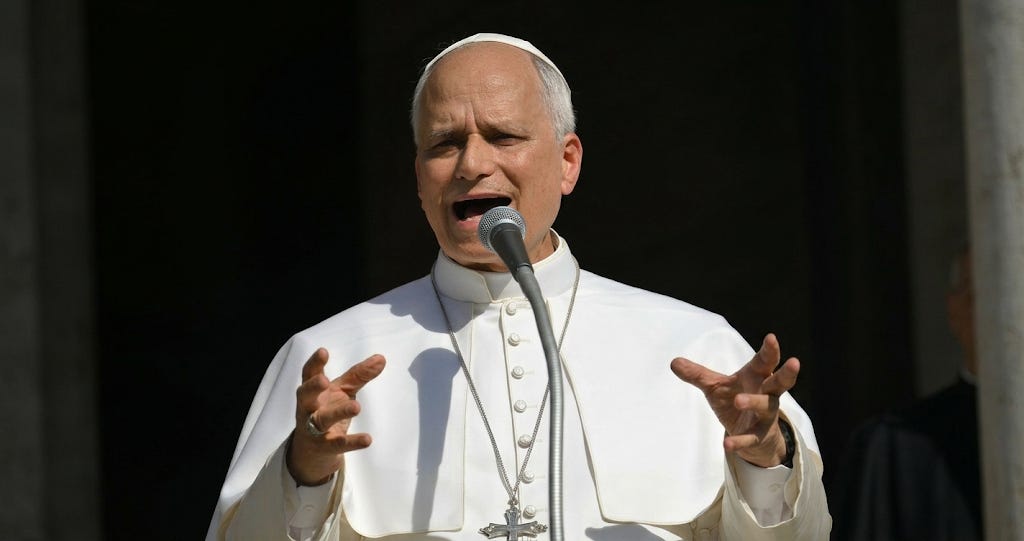
‘Enough With the Bullying’ — Pope Leo XIV Sets the Stage for His July 4 Trip to Lampedusa
On Saturday the pope venerated St. Augustine’s relics in Pavia and knelt before the heart of Mother Cabrini, patron of migrants. Every step pointed toward the Isle of Tears — and toward America.
Thank you for reading! Letters from Leo is a reader-supported publication. To receive new posts and support this work, consider becoming a free or paid subscriber.
“Enough with insults, enough with bullying, enough with all those things that wage war between people, between communities, between countries!”
Pope Leo XIV said that on Saturday evening in Pavia’s Piazza Vittoria, to a crowd that had waited hours in the northern Italian heat to see him.
He had come north for two relics, the bones of one saint and the heart of another. Both pointed the same way, a rehearsal for where he goes next.
Saturday was a six-hour pilgrimage folded into a single afternoon. Leo flew to Pavia to pray before the remains of St. Augustine, the fourth-century bishop whose Confessions shaped the Augustinian order he entered as a young man.

Then he traveled a few kilometers east to Sant’Angelo Lodigiano to kneel before the literal heart of Frances Xavier Cabrini, the patron saint of migrants.
In Pavia, Leo prayed before a gold-rimmed glass case holding Augustine’s relics at the Basilica of San Pietro in Ciel d’Oro. He told the priests and religious of the diocese that they must learn to be Christian communities centered on the essential, “even if this entails renouncing some structures and some securities of the past.” The essential, he said, “is to live with Christ.”
He framed the saint as a gift the whole Church still needs. “Saint Augustine does not belong to us; he belongs to the Church,” Leo said of the order he once led, and our task is to make him known, because “he has so much to offer in this time.”
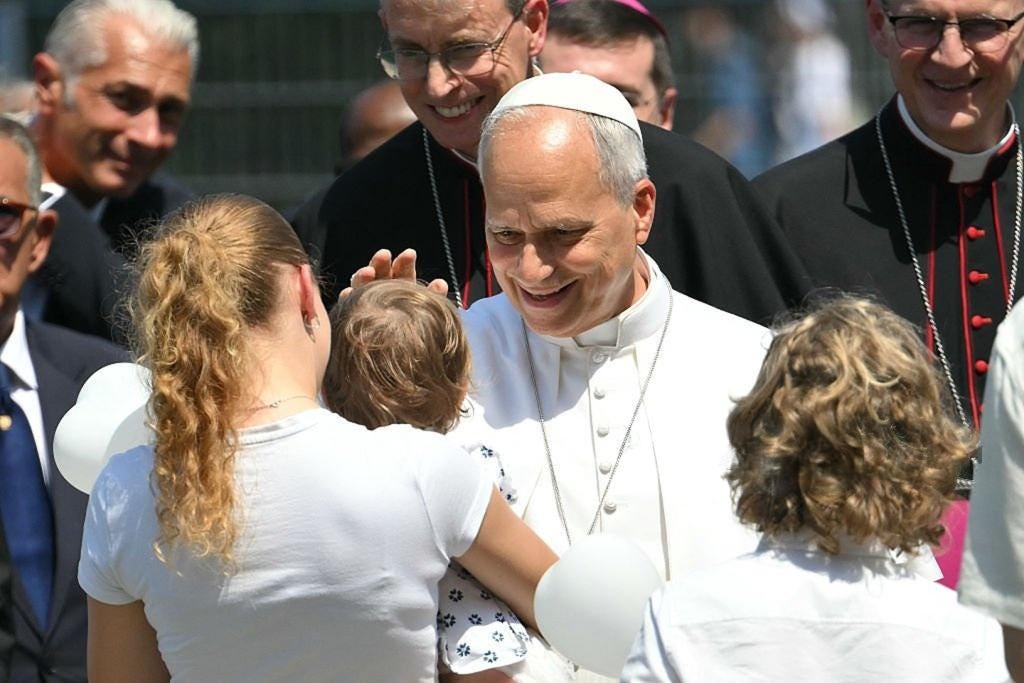
Outside the cathedral, he quoted Augustine to the crowd — “If we want to change the times, if we want the world to live in peace, we must begin with ourselves” — and steered the thought toward peacemaking before the rebuke against hate and bullying.
He pressed the young people hardest, urging them to build “authentic friendships, not just friendships made on screens or cell phones,” and to be present to one another in the flesh.
The second stop carried the real weight of the day. Cabrini was born in Sant’Angelo Lodigiano in 1850 and died in Chicago in 1917 — Leo’s own hometown. The first citizen of the United States to be canonized, she remains the patron of migrants, and her spiritual daughters, the Missionary Sisters of the Sacred Heart of Jesus, carried a relic of her heart from the motherhouse in Codogno so the pope could pray before it.

Leo refused to let the symbolism sit quietly. He recalled that when Cabrini wanted to sail east to China, in imitation of Francis Xavier, Pope Leo XIII redirected her with eight words: “Not to the East, but to the West.” She went instead to the slums, prisons, and mines where Italian immigrants in America were dying poor and forgotten.
She herself described the calling without flinching: “No task will be too difficult, no land too distant” for those sent to carry Christ’s love into the world. Leo praised her soul as “at once contemplative and active,” a woman whose love for the poor never let her rest.
Then he turned the day toward the present. “If Mother Francesca were alive today, what would her missionary soul say to her?” Migration, he answered, has entered “a different phase, certainly more complex, yet no less capable of challenging the Church.”
Everything Cabrini did flowed from the Heart of Christ, the love that Francis made the subject of Dilexit nos, the final encyclical of his life. Leo lingered on his predecessor — praising Francis as a son of Italian immigrants who had made the care of migrants a defining work of his pontificate.
He cast himself openly as Francis’s heir. “I have inherited and carried forward the Magisterium of Pope Francis,” Leo said, pointing to his own exhortation on love for the poor, Dilexi te, where Cabrini stands beside St. John Baptist Scalabrini as a model of accompanying migrants.
He has spent his first year insisting that the Gospel measures a country by how it treats the stranger — a conviction that has put him in open conflict with the Trump administration’s mass deportations.
That clash has been concrete. ICE agents have arrested parishioners and swept through Catholic parishes; one pastor whose flock was targeted was elevated by Leo to lead a diocese in Trump’s Florida. When the president attacked him by name, Leo answered plainly: “I am not afraid.”
Saturday reads as a prelude. On July 4 — American Independence Day — Leo travels to Lampedusa, the speck of Sicilian rock where migrants from North Africa come ashore and where thousands have drowned trying to reach it. Italians call it the Isle of Tears.
Pope Francis chose Lampedusa for the first journey of his papacy in 2013, days after a migrant boat capsized in the Strait of Sicily. Leo returns thirteen years later as the first American pope, on the day his own country celebrates its founding.
That 2013 homily still sets the terms. Francis built it around the question God puts to Cain in the Book of Genesis — “Where is your brother?” — pressing it on a comfortable West that had stopped listening for the answer.
He named “the culture of comfort” that “makes us insensitive to the cries of other people.” A “globalization of indifference” had taken hold, he said, leaving us all “nameless and faceless.” “We are a society which has forgotten how to weep” — then he asked God “for the grace to weep.”
The Fourth of July has always been America’s running argument with itself over who belongs. Leo intends to answer it from a pier where the bodies still wash ashore, holding in his memory the heart of a Lodi-born nun who became a citizen of the country now turning migrants away.
The geography of that gesture is impossible to miss. To stand at Europe’s southern door on Independence Day, fresh from cradling the heart of the woman who served America’s immigrants, is a sermon told in places rather than words.
I’ll be on Lampedusa to cover it in person. Saturday told us what to listen for — a pope who keeps insisting that the worth of a country, and of a Church, is the stranger waiting at its gate.
Before he left Sant’Angelo Lodigiano, Leo urged the young to read Cabrini’s letters and travel diaries, and quoted the line she chose for her order from St. Paul: “I can do all things through Christ who strengthens me.” She crossed the Atlantic dozens of times for people the world had written off. On the Fourth of July, her American successor will stand where that crossing still kills — and say so.
At Letters from Leo, we stand with Pope Leo XIV and the millions of Catholics — and countless others of goodwill — who believe that no human being is illegal, that the stranger at the border carries the face of Christ, and that a nation’s greatness is tested at the water’s edge where the desperate arrive.
In an age that has learned to look away from drowning men, we remain rooted in a faith that refuses to rank human lives by the passports they carry.
This is the fastest-growing Catholic community in the country because people are hungry for something deeper than cruelty and slogans. They are looking for courage, for truth, for love made visible in the works of mercy — and as our own government turns migrants into enemies, that hunger has rarely been more urgent.
If you believe this movement matters — Catholics and people of goodwill standing for human dignity against a politics that treats migrants as disposable — I am asking you to join us.
If you’d like to invest in our mission, here are three ways you can help during this critical time:
Subscribe as a paid member to receive exclusive posts about the life and formation of Pope Leo and help sustain this newsletter.
Donate with a one-time gift to fuel this project’s mission.
Share this post (and Letters from Leo) with a friend who might enjoy it.
Paid subscribers make this work possible, and they unlock the full archive — the biographical series on Pope Leo’s life and formation, deep dives like the Epstein-Bannon investigation and Pope Leo XIV Takes on Silicon Valley, and the weekly Sunday Scripture Reflection Series.
Whether you give $0, $5, $50, $500, $1,000, or more, your presence here matters — no matter your faith or your politics.
Thank you for reading. I’ll see you on the road.


Thank you, Pope Leo, for leading by example. Thank you, Christopher, for committing to share with us all the important aspects of the papacy as they happen. Much appreciated.
Thank you, Pope Leo XIV, for giving us all a place to find and harbor HOPE.