
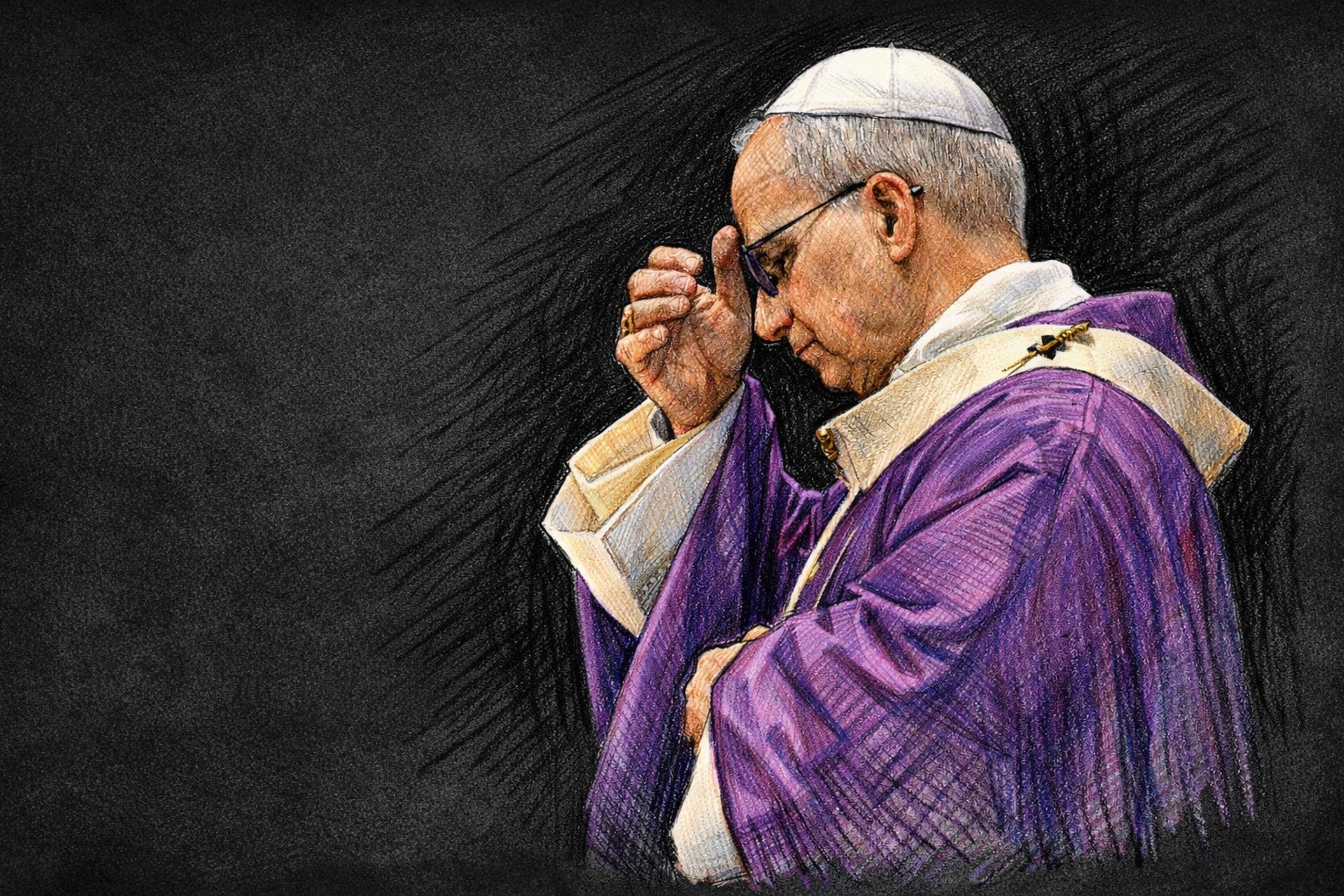
“Go to Confession” — Pope Leo XIV Challenges Christian Leaders Behind War
The pope asked whether leaders responsible for armed conflict have the courage to examine their consciences. The timing was unmistakable.
Thank you for reading! Letters from Leo is a reader-supported publication. To receive new posts and support my work, consider becoming a free or paid subscriber.
On Friday morning in the Clementine Hall, Pope Leo XIV looked out at a room full of priests and seminarians training to hear confessions and asked a question that would echo far beyond the Vatican walls.
“Do those Christians who bear grave responsibility in armed conflicts,” the pope said, “have the humility and courage to undertake a serious examination of conscience and confess?”
He named no one. He didn’t have to.
The United States and Israel launched a joint military assault on Iran on February 28 under the Pentagon codename “Operation Epic Fury.”
In the two weeks since, at least 1,332 people have been killed, including more than 160 girls in a primary school struck on the first day of the bombing.
Six American service members have also died. President Trump, raised Presbyterian, has called for “unconditional surrender.” Vice President JD Vance and Secretary of State Marco Rubio — both Catholics — have defended the campaign without reservation.
Pope Leo’s question on Friday was addressed to the participants of the 36th Course on the Internal Forum, organized annually by the Apostolic Penitentiary to train priests in the theology and practice of the Sacrament of Reconciliation.
The setting was deliberately chosen.
Leo was speaking to the men who will sit behind the screen and listen when powerful people kneel down and confess their sins. The pope wanted those future confessors to understand the gravity of what they may one day hear — and to hold the powerful to the same moral standard as everyone else.
The speech went further. Leo described confession as a “laboratory of unity” — a sacrament that restores the penitent’s relationship with God, with the Church, and with themselves. That interior reconciliation, he argued, is a precondition for peace between nations.
“Only a reconciled person,” he said, “is capable of living in a way that is both unarmed and disarming.”
That single sentence contains an entire theology of peace. A leader who has not reckoned with his own conscience before God cannot credibly claim to act in the service of justice abroad. The bombs falling on Tehran and Isfahan amount to the projection of unreconciled power onto the bodies of the vulnerable.
Friday’s remarks did not arrive in isolation.
Six days earlier, on Saturday, March 7, Pope Leo received the members of the Military Ordinariate of Italy to mark the centenary of its founding. Speaking to bishops, military chaplains, government officials, and soldiers gathered under the banner Inter Arma, Caritas — “In the Midst of Arms, Charity” — Leo laid out a vision of military service that is incompatible with the theology of total war.
He quoted the Second Vatican Council’s Gaudium et Spes: “Insofar as men are sinful, the threat of war hangs over them. But insofar as men vanquish sin by a union of love, they will vanquish violence as well.”
Christian service members, the pope insisted, are called to defend the weak, protect peaceful coexistence, and respond to disasters. Their vocation cannot be reduced to a profession. It demands conscience, discipline, and a spirit of sacrifice ordered toward the common good.
“It is necessary to inspire the codes, norms, and missions of military life with the lifeblood of the Gospel,” Leo told them, “so that, in the service of security and peace, the common good of peoples always comes first.”
Read those two speeches together, and a pattern emerges. Pope Leo XIV is constructing a sustained theological argument against today’s conflicts — one brick at a time, one audience at a time.
The military heard that their vocation is peace, their patron saints are saints of mercy, and their service answers to God before any commander-in-chief. The confessors received a harder charge: when the architects of this war come to you — if they come to you — hold them accountable to the Gospel they profess.
Leo has now spoken several times on the war in the past two weeks.
On March 1, he demanded an end to the “spiral of violence” and warned of “a tragedy of enormous proportions.” On March 8, he begged for the “thunderous sound of bombs” to cease.
On Tuesday, he met privately with Cardinal Dominique Mathieu, the archbishop of Tehran, who was evacuated from Iran as the strikes continued.
Cardinal Pietro Parolin, the Vatican’s secretary of state, has warned that recognizing a right to “preventive war” could “set the world ablaze.”
The pope doesn’t seem to be improvising.
Every speech adds another layer to a case — theological, diplomatic, and moral — that the war is unjust. Friday’s remarks sharpened the blade.
By invoking confession, Leo moved the argument from geopolitics to the most intimate space in Catholic life: the encounter between a sinner and God’s mercy. The men who ordered these strikes and the legislators who funded them now face a question that cannot be deflected with polling data or national security briefings.
Do you follow Jesus? Then act like it. Examine your conscience. Go to confession. The blood of 1,332 people — including schoolchildren — demands at minimum that reckoning.
The Catholic intellectual tradition has always held that war must meet stringent moral criteria to be considered just.
The criteria include last resort, discrimination between combatants and civilians, and a reasonable chance of success without producing evils greater than the evil being addressed.
A war launched after an Omani diplomat announced that peace was “within reach” through Iranian nuclear concessions fails the last-resort test on its face. A war that killed 160 schoolgirls on its first day fails the proportionality test by any measure.
Pope Leo knows all of this. He also knows that several of the most prominent Catholic political figures in the United States are prosecuting and defending this war without a visible flicker of moral doubt.
Friday’s speech was an invitation — spoken gently, in the language of sacramental theology — for those leaders to stop, kneel, and ask God whether the path they are on is the path of Christ.
The confessional is waiting.
At Letters from Leo, we refuse to look away from what is happening in Iran. More than 1,300 people are dead, schoolchildren among them, and the Catholic leaders of the most powerful nation on earth have yet to publicly wrestle with what the Gospel demands of them in this moment.
Pope Leo XIV has now spoken several times in fourteen days. He is not whispering. The question is whether anyone in Washington is listening.
This community exists because thousands of Catholics and people of goodwill believe that faith without moral courage is dead.
We are the fastest-growing Catholic community in the country because people are hungry for the truth — not spin, not talking points, but the radical, uncomfortable demands of the Gospel applied to the world as it actually is.
If you believe this work matters — holding powerful Catholics accountable to the faith they profess while a war rages in the Middle East — I am asking you to join us.
If you’d like to invest in our mission, here are three ways you can help this Lenten season:
Subscribe as a paid member to receive exclusive posts about the life and formation of Pope Leo and help sustain this newsletter.
Donate with a one-time gift to fuel this project’s mission.
Share this post (and Letters from Leo) with a friend who might enjoy it.
Paid subscribers get access to our ongoing biographical series on Pope Leo’s life and formation, exclusive investigations, including the Epstein-Bannon investigation, and the best of Letters from Leo.
Whether you give $0, $7, $70, or $700, your presence here matters — no matter your faith or your politics.
Thank you for reading. I’ll see you on the road.


Thank you for the article, Chris I will pray for Pope Leo. These times are difficult for him as it is for all of us.
You mentioned in passing that Trump was “raised Presbyterian.” This statement lacks some serious nuance. And it is an unfortunate, and undeserved, slap against the Presbyterians.
Trump’s religious upbringing and the theology that he “absorbed” was an unfortunate admixture of many elements, including ideas not far from “New Age” concepts.
There is a very succinct and well researched summary of this issue in a book by psychologist Dr. Steven Hassan, “The Cult of Trump.” Whether you accept Trump as a cult leader or not, that book’s evaluation of Trump’s theological/idealogical development is well worth reading. I highly recommend this to you.