


Dear friends —
Letters from Leo is publishing daily Lenten reflections through Easter, available exclusively to paid subscribers.
Each meditation will explore what it means to follow Jesus more faithfully in the midst of American civic and political life — not as partisans first, but as Christians whose consciences are shaped by the Cross.
Lent is a season of repentance, renewal, and resolve.
It is a time to confront our idols, strip away our illusions, and allow the light of God’s redeeming love to search and purify our hearts.
I hope you will walk this forty-day road with me — as your brother and fellow sinner — embracing prayer, sacrifice, and deeper conversion, and allowing the God of liberation to claim every corner of our lives and our public witness in an age of creeping authoritarianism.
“O God, be merciful to me, a sinner.” — (Luke 18:13)
I have a morning prayer routine. It is timed, structured, and efficient. The good days leave me feeling accomplished, like I checked a box that matters. I rush through the bad days and feel guilty afterward. Either way, I am the one running the show.
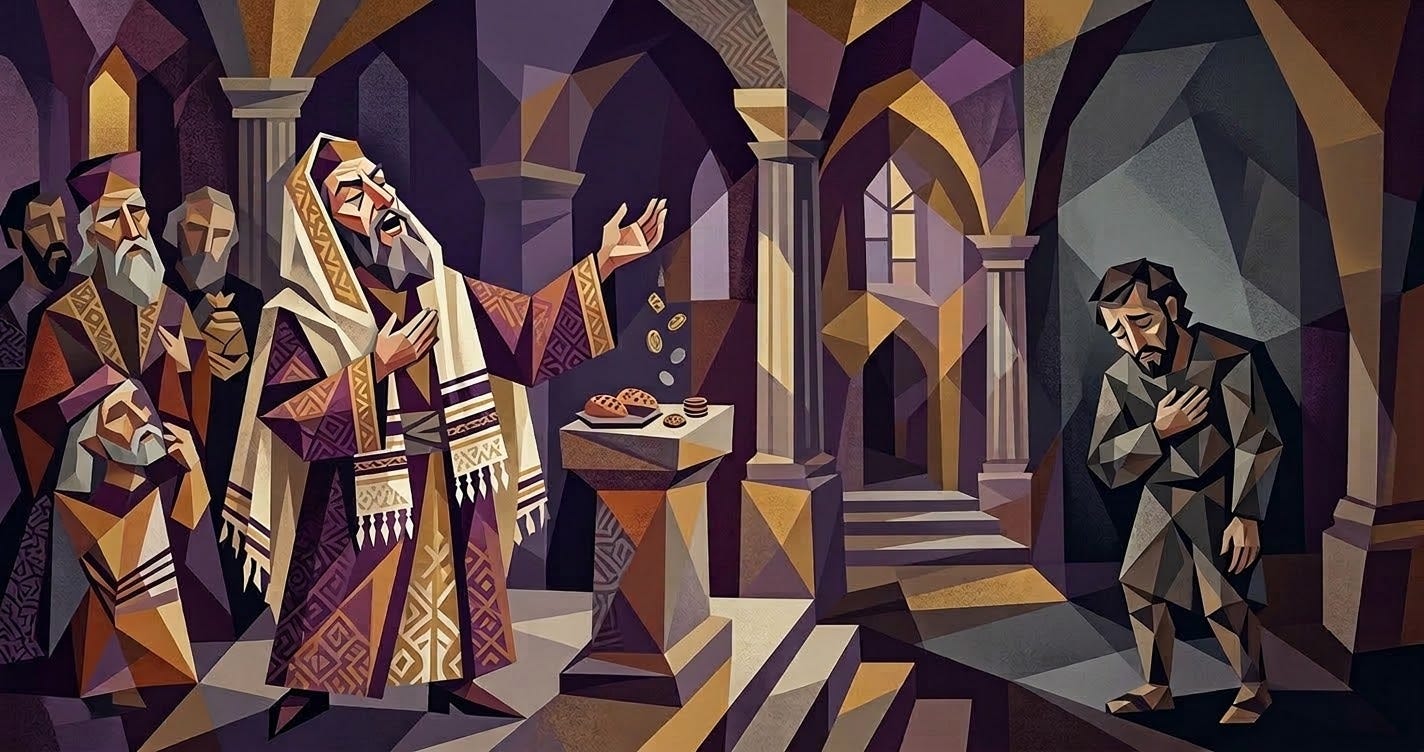
Today’s Gospel dismantles that. Jesus tells the story of two men who enter the temple to pray.
The Pharisee arrives with a script — he has rehearsed his lines about fasting and tithing and moral superiority over the tax collector standing at the back of the room. His prayer is a performance review delivered to an audience of one: himself.
Pope Leo XIV, preaching on this same passage in his Angelus address last October, put it plainly: the Pharisee’s observance was “poor in love, made up of ‘giving’ and ‘taking,’ of debts and credits, devoid of mercy.”
The tax collector has no script. He stands far off, beats his breast, and says seven words: “O God, be merciful to me a sinner.” There is no resume attached, and no attempt to negotiate. Just the raw truth of a man who has stopped trying to manage God’s opinion of him.
And Jesus says he is the one who goes home justified.
The prophet Hosea saw this coming.
“It is love that I desire, not sacrifice,” God declares through the prophet, “and knowledge of God rather than burnt offerings.”
The sacrifice God rejects is not the offering itself but the transaction we try to make of it. We bring our fasting, our donations, our morning routines, and lay them on the altar like a lawyer presenting evidence. We build a case for ourselves. God is not interested in our case.
I write this as someone who falls into the Pharisee’s trap constantly.
