
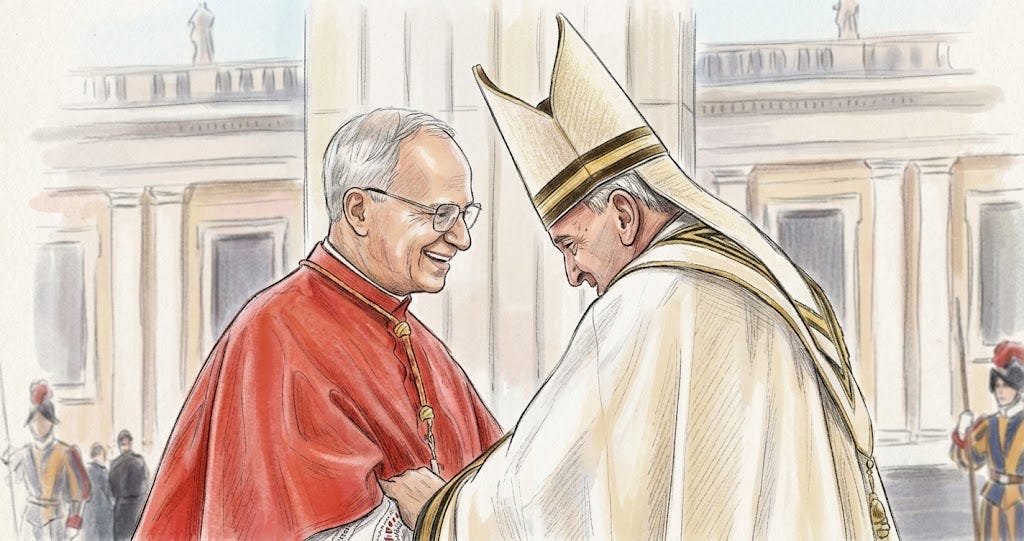
“He’s a Saint” — Francis’s Last Word on Pope Leo XIV
New reporting in Salvatore Cernuzio’s “Padre” shows Pope Francis had already seen the remarkable qualities in his future successor before anyone else knew who he was.
Thank you for reading! Letters from Leo is a reader-supported publication. To receive new posts and support this movement, consider becoming a free or paid subscriber.
Before you read on, join 50,000 Americans and sign our letter to President Trump demanding that he apologize for attacking Pope Leo XIV. We’ll deliver it to the president via JD Vance
Francis had already made up his mind about Robert Prevost long before the white smoke rose over Rome.
“Lui è un santo,” he told the Vatican journalist Salvatore Cernuzio during one of their quiet visits at Casa Santa Marta.
“He’s a saint.”
That verdict — spoken in Italian across an ordinary evening conversation, an old man’s reckoning about the man who would succeed him — is the detonating revelation in Padre, the new book Piemme released April 7, and one the Vatican press has been rereading ever since.
Cernuzio was no stranger to that apartment.
His friendship with Francis began with an impulsive letter sent during the papal flight to Iraq in 2021, followed by a phone call out of nowhere on a Roman evening: “Good evening, I’m Pope Francis.”
From there, the bond deepened into something rare inside the institutional life of a pontificate. Francis became his spiritual director, his confessor, and, by the end, what the old pope admitted plainly: a father.
The book’s title reads as a transcription. Cernuzio describes evenings of ice cream at Santa Marta, phone calls placed without a secretary, a pontiff who wanted to keep a generation of young Catholic men within arm’s reach.
Cernuzio is careful about what Francis meant by santo. It was not a canonization announcement slipped over espresso. Francis used the word, as his young confidant explains, for people who could hold complex situations with a calm hand, knit the fractured together, and carry institutional weight without dropping it.
That is the “saint” Francis named in Prevost — the same calm, unifying presence the world has been watching since the May 8 conclave.
In March I wrote here about Gerard O’Connell and Elisabetta Piqué’s minute-by-minute reconstruction of the conclave, which traced Francis’s last institutional gestures — the dizzying promotion of Prevost from bishop of Chiclayo, to Vatican prefect of the Dicastery for Bishops, to cardinal priest, and then, while Francis laid sick at Gemelli Hospital in February, to cardinal bishop of Albano, the senior tier of the College that elects a pope.
All of that was canonical machinery, done on paper and sealed in red wax.
Padre takes us somewhere else entirely — into the private conversations where Francis was naming what he saw in Prevost before anyone else would name it.
By then, Francis knew. On the morning of February 17, 2025, three days after his emergency admission for the double pneumonia that would ultimately claim him, the nurse on duty called Cernuzio and told him to come quickly. When the journalist arrived, the pope reached for his hand.
“Since you are like a son to me, a grandson, a brother — I wanted to say goodbye.” Cernuzio left the room in tears. Francis had summoned him so that he, the dying man, could do the blessing. During that same hospital stretch, he also pressed into Cernuzio’s hand a white rose from the shrine of St. Thérèse of Lisieux, the Little Flower he had carried close since boyhood.
Francis was, in the end, a giver of signs.
The book surprises on several fronts. Francis praised Italian President Sergio Mattarella as “un uomo illuminato,” an enlightened man.
He was amused, sometimes affectionately, by Prime Minister Giorgia Meloni, whom he once greeted at the Family States General event — she was dressed in white — by asking whether she had come for first communion, and who made him laugh aloud at a viral clip of herself with Vincenzo De Luca: “Hai visto quel video? Fortissimo.”
“Did you see that video? It’s awesome.”
Beneath the humor was the grief he never set down. What he had called years before “the Third World War in pieces” — Ukraine, Gaza, Sudan, Myanmar — kept him up at night. He telephoned Father Gabriel Romanelli at the Holy Family parish in Gaza City every evening of the war.
He intended to go himself, “a qualsiasi condizione” — at any cost — perhaps at Christmas 2025. His body ran out before he could.
All of which is the context for his last words, also reproduced in Padre.
On April 21 at about five in the morning, Francis rang for his personal nurse, Massimiliano Strappetti, and asked for a glass of water. He drank slowly. Then came a soft “Grazie, scusa per il disturbo.” Thank you, and sorry for the trouble.
A few hours later, he was gone.
A few hundred yards away, the cardinal he had called a saint, a cardinal unknown to most of the world, was still asleep. By the time the bells began to ring over Rome, el Padre had already made his last introduction and set in motion the future to come.
Whatever Leo XIV carries into his own pontificate — reform, campaigns for peace and justice, fights with world leaders, and a wounded Church that exhausted his predecessor and will test any man — he carries with a private blessing already written on his soul, the word Francis gave him at Santa Marta when no one else was listening.
Francis, ever the giver of signs, had given the last one to the son who would wear the ring.
At Letters from Leo, we carry the story of two popes who gave the Church something more than an agenda.
We stand with a global Catholic community — and countless people of goodwill — who believe that the moral witness of Francis did not end on Easter Monday 2025, and that the pontificate of Leo XIV is its second act.
In an era poisoned by cruelty and authoritarian spectacle, we remain rooted in a faith that refuses to flinch.
Francis named his successor a saint before anyone else knew who he was, and that American now wears the fisherman’s ring.
The story the world was told about Leo XIV’s election is incomplete without the private word Francis spoke at Santa Marta. Retrieving those private words and making them public is the whole reason a publication like this one exists.
This is the fastest-growing Catholic community in the country because people are hungry for something deeper than rage and propaganda. They are looking for courage, for truth, for love made visible in action.
When the dying pope blesses the new one standing up for us and our posterity, in language this plain, that hunger meets something real.
If you believe this movement matters — Catholics and people of goodwill standing for human dignity in the unbroken line between Francis and Leo — I am asking you to join us.
If you’d like to invest in our mission, here are three ways you can help this Easter season:
Subscribe as a paid member to receive exclusive posts about the life and formation of Pope Leo and help sustain this newsletter.
Donate with a one-time gift to fuel this project’s mission.
Share this post (and Letters from Leo) with a friend who might enjoy it.
As a paid subscriber, you gain full access to the archive, including the biographical series on Pope Leo’s life and formation, the ongoing Epstein-Bannon investigation into the networks arrayed against this pontificate, and the best of our full archive.
Whether you give $0, 5, $10, $100, $1,000, or more, your presence here matters — no matter your faith or your politics.
Thank you for reading. I’ll see you on the road.


I loved reading this as I in this short time have come to admire Pope Leo a lot - I am a non-practicing catholic but I love how he is standing up challenging the politics of America - I think he is calling back Catholics who went “to the dark side” of politics and forgetting about helping not hurting people. I hope he stays safe and healthy.
My gratitude increases with each post. Thank you.