


Dear friends —
Letters from Leo is publishing daily Lenten reflections through Easter, available exclusively to paid subscribers.
Each meditation will explore what it means to follow Jesus more faithfully in the midst of American civic and political life — not as partisans first, but as Christians whose consciences are shaped by the Cross.
Lent is a season of repentance, renewal, and resolve.
It is a time to confront our idols, strip away our illusions, and allow the light of God’s redeeming love to search and purify our hearts.
I hope you will walk this forty-day road with me — as your brother and fellow sinner — embracing prayer, sacrifice, and deeper conversion, and allowing the God of liberation to claim every corner of our lives and our public witness in an age of creeping authoritarianism.

“You may go; your son will live.” — (John 4:50)
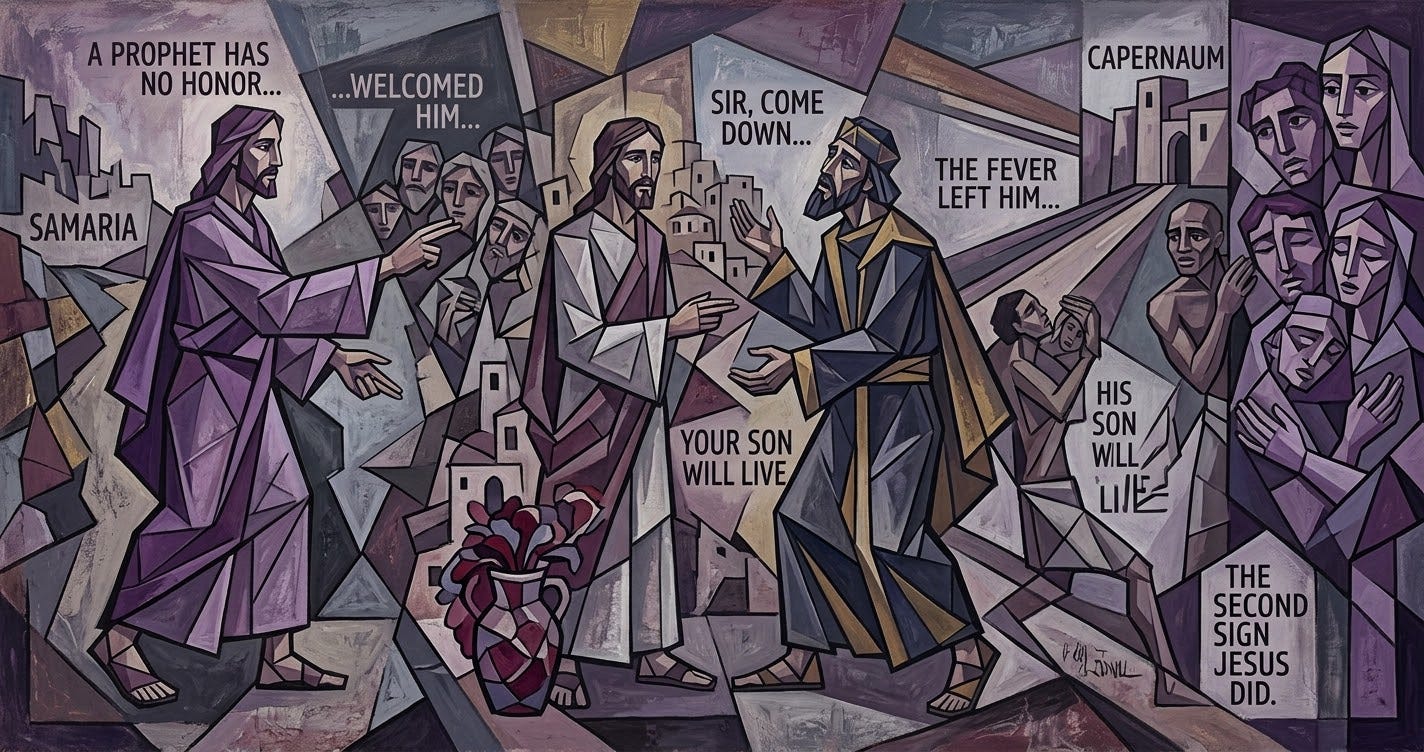
The royal official has a dying son. That is the fact he carries into Cana — the unbearable weight of watching a child slip away while you stand helpless beside the bed. He does not come to Jesus with a religious question. He comes because his boy is dying and he has nowhere else to go.
Jesus’s response is almost harsh: “Unless you people see signs and wonders, you will not believe.” The official doesn’t argue or try to defend himself. He simply asks again: “Sir, come down before my child dies.”
And then something extraordinary happens. Jesus does not go with him. He offers no miracle the man can witness, no dramatic healing to validate the journey. He gives the official nothing but a sentence: “You may go; your son will live.”
The man believes. And he walks home.
That walk — from Cana to Capernaum, roughly twenty miles through Galilean hill country — is the beating heart of today’s Gospel. The official has no proof, nothing the world would consider reasonable grounds for confidence. He has only the word of a man he barely knows, spoken into the worst fear a parent can carry. He walks all day and into the night with nothing but that word.
It is a walk made entirely on hope.
I have been thinking about hope for most of Lent. Of the three theological virtues — faith, hope, and love — hope draws the least attention, consigned to a vague supporting role between its more celebrated siblings.
St. Paul seems to reinforce the hierarchy: faith and love command the stage while hope waits quietly in the wings. Today’s psalm knows better. “At nightfall, weeping enters in,” the psalmist writes, “but with the dawn, rejoicing.”
That space between nightfall and dawn is where hope lives.
Pope Francis, in a homily at Santa Marta in October 2013, called hope “the most humble of the three theological virtues, for it hides itself in this life.”
He was right. Hope hides. It works in the dark.
