


Thank you for reading! Letters from Leo is a reader-supported publication. To receive new posts and support the mission, consider becoming a free or paid subscriber.
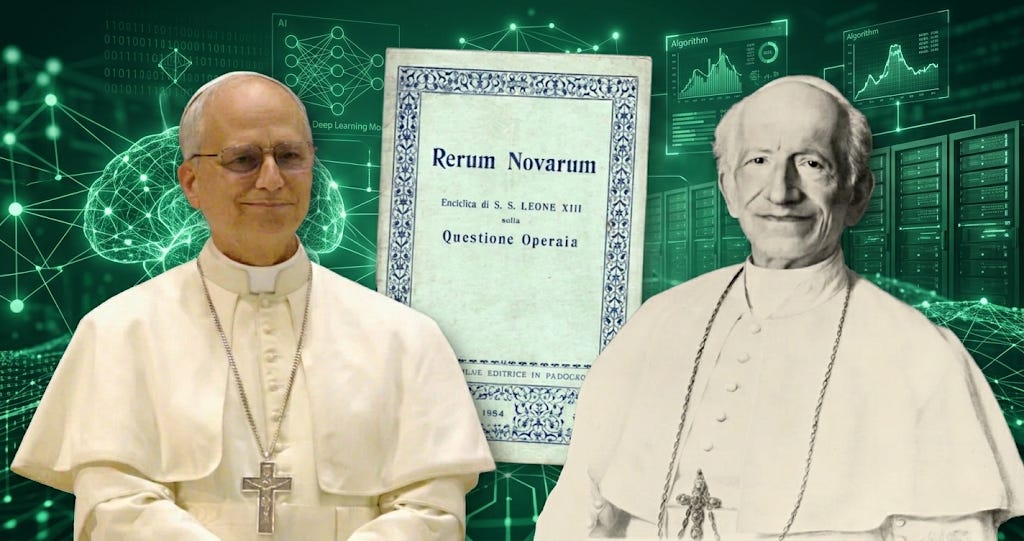
One hundred thirty-five years ago today, Pope Leo XIII signed Rerum Novarum and gave the Catholic Church its public voice on the great social question of the modern world.
The document landed on May 15, 1891, into a world being remade by coal, steam, and the unregulated industrial economy. Workers were broken on the wheel of the new machinery. A handful of industrialists controlled wealth on a scale the world had never seen.
Across Europe, socialism rose with promises of deliverance and threats of its own to the human person. Leo XIII refused both extremes and wrote a sweeping encyclical that became the founding charter of modern Catholic social teaching.
Today, May 15, 2026, the rumors out of Rome say his namesake has done it again.
Multiple Catholic outlets are reporting that Pope Leo XIV signed his first encyclical this morning under the working title Magnifica Humanitas — “Magnificent Humanity.”
Two independent sources close to the situation tell me the Vatican will release the document publicly on May 25.
The Holy See has confirmed none of it. The title and the date should be treated as rumors until they are confirmed. But the parallels are too pointed to ignore.
When Robert Prevost stepped onto the loggia of St. Peter’s last May and announced he would be called Leo XIV, he told the College of Cardinals two days later exactly why he chose the name.
Leo XIII had answered the first industrial revolution with Rerum Novarum. He, Leo XIV, would answer the next one — driven this time by artificial intelligence, algorithmic management, and the automation of human labor.
The encyclical reportedly coming out is the long-awaited fulfillment of that promise.
If the rumors are right, Magnifica Humanitas will be to the AI age what Rerum Novarum was to the steam age — the Church’s attempt to defend the dignity of the human person against a machinery that threatens to reduce it to a commodity.
Reading the new encyclical without reading the old one will be like reading the second act of a play without knowing the first. Leo XIII set the stakes, the vocabulary, and the method. The early signals of Leo XIV’s pontificate suggest he is inheriting all three and applying them to a world Leo XIII never imagined but somehow anticipated.
To know what is coming out, you need to know what came on May 15, 1891. The questions a 19th-century Italian pope asked about coal, steam, and the wage worker recur in a 21st-century American pope’s reckoning with silicon, scale, and algorithmically managed labor.
The vocabulary survives because the threat to human dignity is structurally the same.
What follows is the essential explainer — the top things to understand about Rerum Novarum, the way it created the social magisterium of the modern Church, and the way it is already shaping the early pontificate of Pope Leo XIV in real time.
Six Things to Know About Rerum Novarum
Industrial capitalism had built the modern world in fifty years and broken millions of workers in the process. Socialism was rising in response. Leo XIII saw that both systems would reduce the human person to an instrument of production, and he wrote Rerum Novarum to refuse that reduction. Six core claims define the document.
The worker is a person, not a commodity. Labor cannot be treated as another input on a balance sheet. Each person has a right to what is required to live, and the poor can procure it only through their work. Dignity, not productivity, is the measure of just labor.
Workers have a right to organize. The encyclical defended the right of working people to form associations — what would become the modern labor unions — as a natural extension of free association. In an era when organizing was being violently suppressed, the claim was radical.
Property is a right, but a conditioned one. Leo XIII affirmed private property against socialist confiscation while insisting that property carries what later popes called a “social mortgage” — its use must serve the common good, not only the owner. The right to own does not include the right to hoard while neighbors starve.
The unrestrained market is not the Gospel. What do I mean?
