


Letters from Leo’s Sunday Reflection Series are essays grounded in the Mass readings — offering a clear-eyed way to follow Jesus amid today’s political realities, not by retreating from public life or baptizing any ideology, but by letting the Gospel shape our conscience, courage, and compassion.
These reflections are available to all paid subscribers, as a small but sincere way of saying thank you for making Letters from Leo possible.
Letters from Leo is open to anyone who wants to be informed and inspired by our pope — and to turn that inspiration into action that leaves America and the world more just, less cold, and more alive with hope.
If you’d like to invest in our mission during this critical time, here are three ways you can help:
Subscribe as a paid member to receive exclusive posts about the life and formation of Pope Leo and help sustain this newsletter.
Donate with a one-time gift to fuel this project’s mission.
Share this post (and Letters from Leo) with a friend who might enjoy it.
Whether you give $0, $1, $100, $500, $1,000, or more, your presence here matters — no matter your faith or your politics.
Thank you for reading. I’ll see you on the road.

“Lord, save me!” — Matthew 14:30
Today’s gospel story is full of details that warrant a full review to understand what’s happening and why it matters to us today.
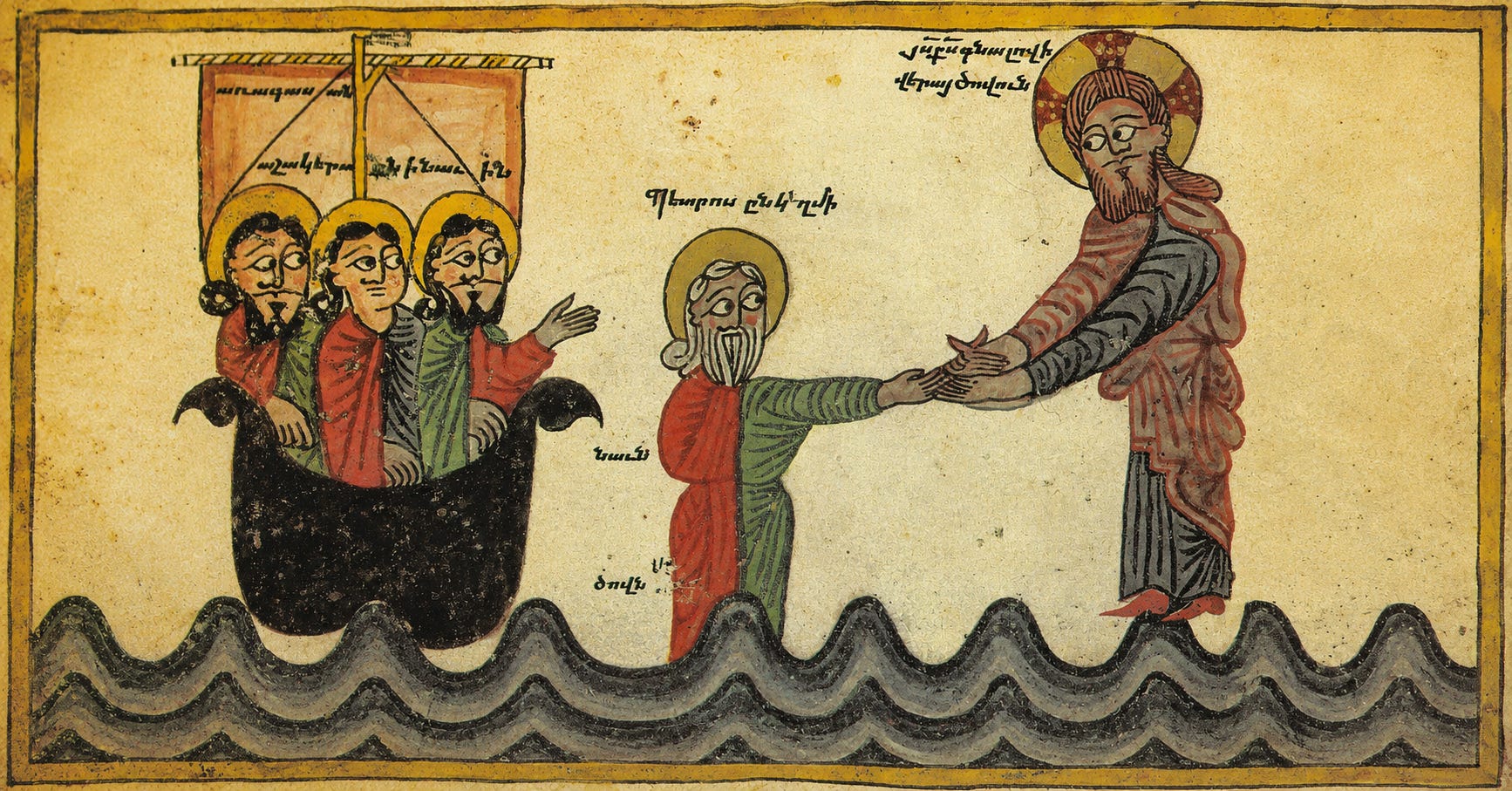
Jesus has sent his disciples ahead of him while he goes up to a mountain alone to pray. The disciples’ boat is a few hundred yards from shore in the middle of the night when the wind starts violently shaking it.
Jesus then appears on the shore and starts walking on the sea towards them. They, as they often do, think he is a ghost and start screaming.
Then, seemingly in violation of the Jewish law set forth in Deuteronomy, Peter makes a demand of Jesus.
“Lord, if it is you,” he says, “command me to come to you on the water.”
Notice that he doesn’t say, “Jesus, calm the storm.” He instead asks for the courage to move, and Jesus replies with a single word: “Come.”
Then Peter climbs over the side of the boat and starts walking on the water.
A few steps in, he notices the wind, starts panicking, and begins to sink. He cries out, “Lord, save me!” Jesus catches him and asks the question most Christians know by heart:
“O you of little faith, why did you doubt?”
For most of my Christian life, I’ve heard that question as a scolding.
I hear it differently now. Doubt is woven into faith from the start; faith presupposes it. A man who is certain needs no faith at all, the way a man standing on dry land needs no one to hold him up.
The Letter to the Hebrews calls faith “the realization of what is hoped for and evidence of things not seen,” and things not seen always leave room for the 3:00 AM suspicion that we have built our lives on the firmless foundation of water.
Peter doubted before he even left the boat. That’s exactly why his walk counts.
So what carried him those few steps? I do not think it was faith in any finished form. Jesus himself says Peter’s faith was little. What Peter had was hope, and hope was enough to move.
The three theological virtues of faith, hope, and love can be hard to tell apart. But it’s no secret that two win the public relations battles of the day.
Paul’s preference for love’s superiority is enshrined in his Pauline gem: “Faith, hope and love abide, these three. And the greatest of these is love.”
In Christian history, faith and love have received most of the attention, leaving hope to a vague supporting role, where it is often confused with optimism or expectation.
My career, both adjacent to and within American politics, has taught me something we completely misunderstand about hope.
