
Letters from Leo — the American Pope & US Politics

Letters from Leo — the American Pope & US Politics

“Jesus Didn’t Say Have Empathy” — Bishop Barron Contradicts Pope Leo XIV in Latest MAGA Crusade

Four months after Pope Leo XIV called empathy “a call from God,” the Bishop of Winona-Rochester told 3.6 million subscribers it threatens truth, justice, and love. Fr. James Martin answered from the Greek — and Barron’s own audience is talking back.

Christopher Hale's avatar
Christopher Hale
Sep 08, 2026
∙ Paid
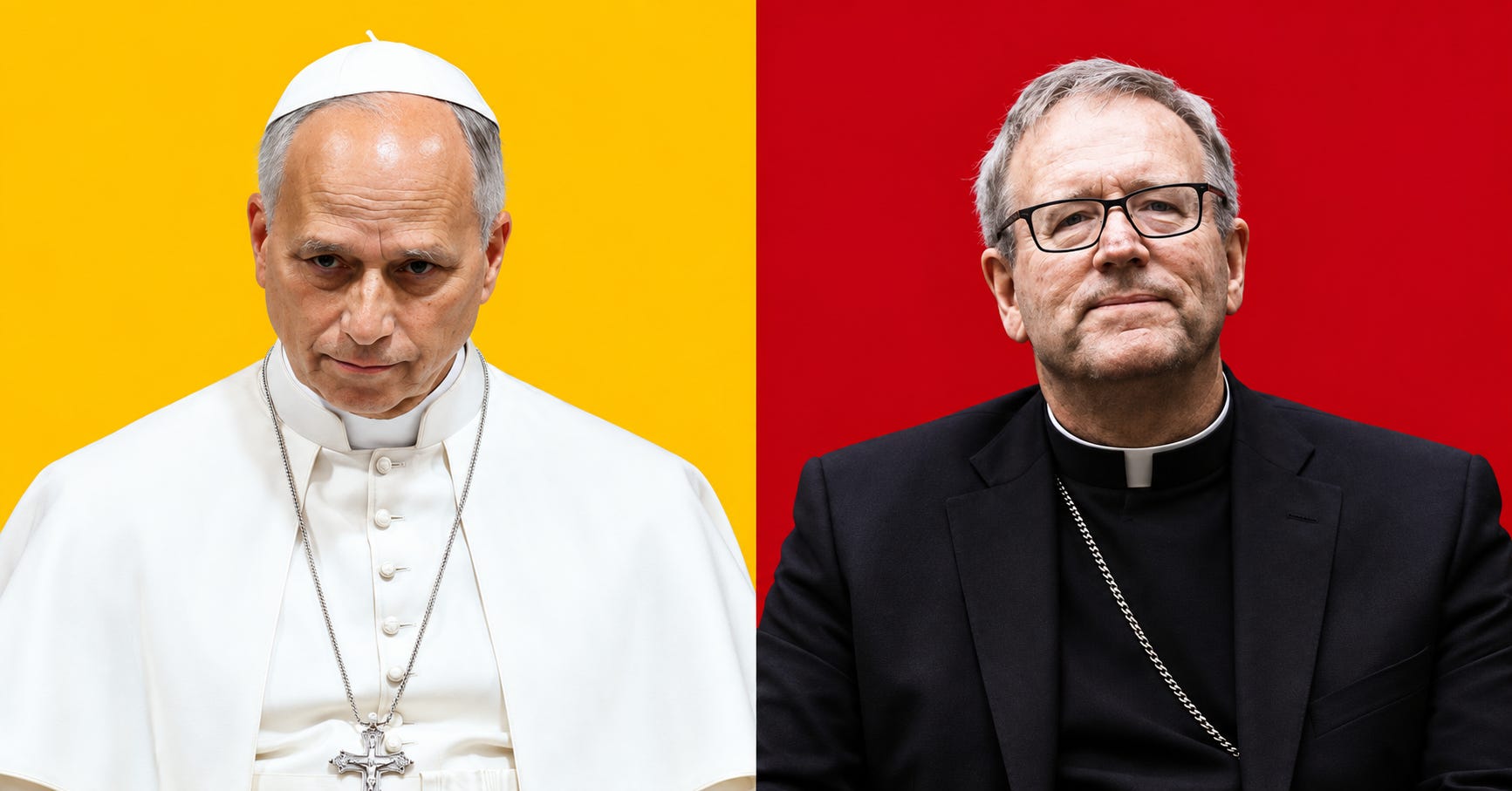
A composite of Pope Leo XIV during the release of Magnifica Humanitas in May and Bishop Robert Barron in a file photo from Word on Fire.

Thank you for reading! Letters from Leo is a reader-supported publication and the fastest-growing Catholic community in the country. The opening of this essay is free for everyone. The full essay, with a thorough account of Bishop Barron’s descent into MAGA, is for paid subscribers only. Join them today and help sustain this movement.

Make A One-Time Gift to Support My Work

Bishop Robert Barron told his 3.6 million YouTube subscribers on Sunday that empathy is “not a supreme value,” that it has grown “so exaggerated, in fact, that it threatens truth, reality, justice” and love, and that Jesus never asked for it, a homily that contradicts Pope Leo XIV’s teaching on the subject.

The pope clearly disagrees. Four months earlier, on May 11, he told a Vatican colloquium on compassion and empathy that the two “are not something additional or optional, but are a call from God to reflect his goodness in our daily lives,” and warned that both “are sadly in danger of disappearing today.”

Barron opened his homily for the Twenty-third Sunday in Ordinary Time, posted Sept. 6, with a book recommendation.

“Friends, I just finished reading a really interesting book called Suicidal Empathy,” he said, ranking Gad Saad’s book alongside Christopher Rufo and James Lindsay as “the best exposure and take-down of the lunacy at the heart of much of the wokeist philosophy that dominates things today.”

Thirty seconds in, the Bishop of Winona-Rochester had cited three culture-war polemicists and no scripture and no saints.

The phrase he was preaching has a short paper trail.

Elon Musk told Joe Rogan on Feb. 28, 2025, that “the fundamental weakness of Western civilization is empathy,” calling it “the empathy exploit” and warning of “civilizational suicidal empathy.”

Saad, a marketing professor at Concordia University in Montreal, turned the slogan into a book, and Musk and hedge fund billionaire Bill Ackman promoted it. Barron finished it in July, praised it on X, gave it a Word on Fire episode on Aug. 31, and then carried it into the sanctuary.

X avatar for @BishopBarron
Bishop Robert Barron@BishopBarron
I’ve just finished reading Gad Saad’s book Suicidal Empathy. It ranks, along with Chris Rufo’s America’s Cultural Revolution: How the Radical Left Conquered Everything and Helen Pluckrose and James Lindsay’s Cynical Theories, as the best take-down of the lunacy at the heart of…
1:01 AM · Jul 21, 2026 · 1.71M Views

580 Replies · 2.6K Reposts · 14.1K Likes

To his credit, Barron does not dismiss empathy outright. “Is empathy a good thing? Yeah. Perfectly decent thing,” he said. “All things being equal, you should be empathetic with people. All things being equal, don’t hurt people’s feelings.” His post on X repeated that empathy is “perfectly good and decent.” The trouble starts with his definition.

Empathy, in Barron’s telling, means “feeling the feelings of somebody else” and “a desire not to hurt or wound those feelings.”

The second half is his own addition (the psychologist who brought the word into English in 1909 meant feeling your way into another person’s experience), and, as far as I can tell, the definition exists so that it can fail.

The failures he listed: “we’ll let biological men compete in women’s sports,” “we’ll allow them, even if they’re unqualified, to have positions in universities and the corporate world,” “we’ll characterize the meritocracy as white privilege, et cetera.”

Those are Fox News segments, delivered from a pulpit by a successor of the apostles.

The theology followed. Love, he said, citing Aquinas, means “to will the good of the other,” and love can require hurting feelings.

His examples ran from a professor handing out a C (“If I got a C, I’d feel terrible, I’d probably be angry”) to a confessor telling a penitent to turn himself in to the police, and on to the parent who would be “the worst parent of the year” for never wounding a child’s pride.

No migrant appears in the thirteen minutes, and no prisoner; the poor get a single clause (“just for the record, I’m for social justice, I’m for caring for the poor”) before he moves on to Horkheimer, Adorno, Foucault, Derrida, and Marcuse.

Then the line that gives this essay its headline: “Can you see why Jesus didn’t say, ‘Have empathy for one another?’ What he said was, ‘Love one another.’”

He also argues that an ethic centered on empathy is what remains once objective truth has been thrown out. “What’s left? Empathy,” he said, after running through the critical theorists, which makes having empathy a form of moral relativism.

He never grasps what the pope himself has said: compassion and empathy are “essential attitudes” of the faith, part of love. Barron treats empathy as love’s replacement; for the pope it lives inside love.

Barron did preach on the readings for about ninety seconds. At the 6:41 mark, he turned to the second reading, Paul’s line in Romans 13 that “the one who loves another has fulfilled the law,” which he took as proof that Paul “doesn’t say, ‘Through empathy,’” and at 8:17 he announced, “Now, let’s go back to wokeism.”

The first reading, Ezekiel’s sentinel, and the Gospel, Christ’s instructions in Matthew 18 on correcting a brother who sins, went unmentioned. A homily of nearly fourteen minutes gave the Word of God a minute and a half and the culture war most of the rest, and that ratio more or less describes where Bishop Robert Barron has been headed the past few years.

One viewer wrote under the video: “The bishop forgot to spread the Gospel and went political. Today’s message had nothing to do with today’s readings.”

YouTube comment by @simgiven on Bishop Barron’s Sept. 6 homily

Fr. Martin answers from the Greek

Fr. James Martin, S.J., posted his reply on Sept. 7 without naming Barron.

“Since I’ve been asked this over the last few days and it’s being discussed on social media,” he wrote, sympathy means imagining how you would feel in another’s place, empathy means imagining “how the other person feels,” and compassion means “the willingness to suffer with, or alongside, the other person.”

All three, he said, fall “under the larger category of love.”

X avatar for @JamesMartinSJ
James Martin, SJ@JamesMartinSJ
Since I've been asked this over the last few days and it's being discussed on social media, here's how I understand sympathy, empathy and compassion, all important virtues in the Christian life (and all falling under, as I see it, the larger category of love). A spiritual…
5:58 PM · Sep 7, 2026 · 27.6K Views

17 Replies · 136 Reposts · 626 Likes

Martin went to the text. When the Gospels say Jesus “was moved with pity” for the sick and the hungry, the Greek is σπλάγχνον, the guts, “the seat of emotions for the Hellenistic world.”

Jesus felt it in his body before he did anything about it. “My sense is that this is what Jesus invites us to experience when we see any kind of suffering,” Martin wrote, “deep sympathy, or a radical empathy, which awakens in us both compassion and the desire to act.”

It reminds me of the story of the Good Samaritan. The priest and the Levite in Luke 10 willed no harm to the man in the ditch; they simply did not feel him, and they crossed to the other side of the road.

Luke says the Samaritan “was moved with compassion at the sight,” a verb built on the very root Martin named, and only after that come the oil and wine, the bandages, and the two coins for the innkeeper.

Barron warned that “if we allow love to devolve into empathy, then we have this collapse that we see all around us today.”

Love cannot devolve into empathy, because empathy comes first; it is love’s precursor, the stirring in the gut that the Samaritan felt before he knelt. Love was never an intellectual exercise; it is a core experience of body, mind, and soul, and of the acts that follow from all three.

The pope’s May address had more in it than one line.

“The constant flow of images and videos of the hardships of others can dull our hearts rather than stir them,” he said, calling that apathy “one of the most serious spiritual challenges of our time,” and in Rimini on Aug. 22 he said, “Before borders, definitions and institutions, there are always persons.”

Barron’s homily never mentioned him.

The hat that never comes off

None of this is new for the bishop. He accepted a seat on Trump’s Religious Liberty Commission in May 2025. This May brought the Trump-backed Rededicate 250 rally on the National Mall, which he headlined two days after telling Fox News that the real threat to the Church was wokeism.

I have been reporting this since October, and sometimes it looks like a MAGA hat has been chiseled atop Barron’s head like a permanent crown.

Here are four graphics that give a thorough accounting of Barron’s slide into MAGA delusion.

User's avatar

Continue reading this post for free, courtesy of Christopher Hale.

Or purchase a paid subscription.
© 2026 Christopher Hale · Privacy ∙ Terms ∙ Collection notice
Start your SubstackGet the app
Substack is the home for great culture