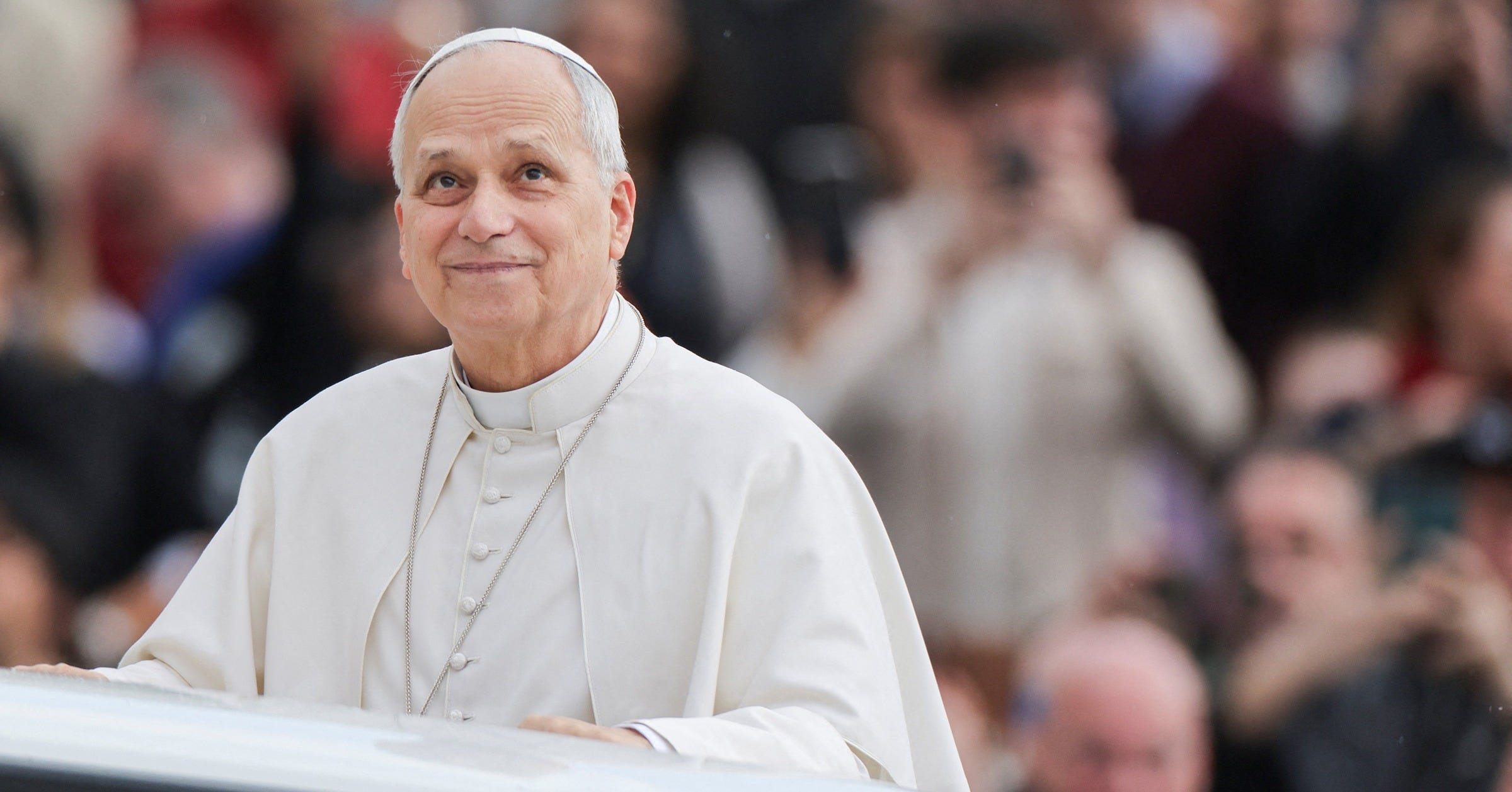
“Lift Our Gaze Toward Heaven” — Pope Leo XIV and His Predecessors’ Celebration of Space Travel
Fifty-seven years ago tonight, Apollo 11 left Psalm 8 in the Sea of Tranquility — a gift from Paul VI. Last July, Leo XIV prayed the same psalm with the man who brought it there.

“Beauty,” Pope Leo XIV told a crowd gathered for a Saturday evening concert in the courtyard of the Apostolic Palace at Castel Gandolfo, “helps us to see and to lift our gaze toward heaven.”
The line was a callback to his own itinerary. The pope flew to Barcelona in June to bless the final tower of Antoni Gaudí’s Sagrada Família a century after the architect’s death, and on Saturday he reminded his listeners that the whole purpose of that Spanish journey “was to lift our eyes, our gaze, toward heaven.”
The gaze goes back much further than Spain.
One year ago tonight, Pope Leo XIV ended a quiet Sunday at Castel Gandolfo by getting on Zoom with Buzz Aldrin.
The astronaut was 95 years old, the pope 69. According to the Holy See Press Office, the two men shared “the memory of a historic achievement” and, using the words of Psalm 8, reflected together “on the mystery of Creation, its greatness, and its fragility.”
“Anca and I were grateful and touched to receive the highest blessing from His Holiness, Pope Leo XIV on the 56th Anniversary of the Apollo 11 moon landing,” Aldrin wrote afterward. “What an honor!”

Earlier that afternoon, Leo had climbed into the domes of the Vatican Observatory above the papal villa to look over its telescopes. He ended up staying at Castel Gandolfo two days longer than planned.

Today marks fifty-seven years since the Eagle settled onto the Sea of Tranquility. On that July night in 1969, Robert Francis Prevost was a thirteen-year-old in Dolton, Illinois — a boy whose gift for numbers would eventually carry him through a mathematics degree at Villanova.
Another pope stood on the Castel Gandolfo hilltop that first night. Paul VI spent the evening of July 20, 1969, moving between a telescope at the Vatican Observatory and a television tuned to the landing. When Neil Armstrong stepped onto the surface, the 71-year-old pope applauded.
Then he sent the crew a message of his own: “Honor, greetings and blessings to you, conquerors of the moon, pale lamp of our nights and our dreams!”
Paul VI had also sent something ahead of them. NASA had gathered goodwill messages from the leaders of 73 countries, etched them onto a silicon disc about the size of a half dollar, and packed the disc aboard the lunar module. The pope’s contribution was Psalm 8: “When I see your heavens, the work of your fingers, the moon and stars that you set in place — what is man that you are mindful of him, and a son of man that you care for him?”
The Apollo 11 crew left that disc in the lunar dust at Tranquility Base. The psalm Leo XIV prayed with Buzz Aldrin last summer has been lying on the moon for fifty-seven years.
Aldrin brought his own liturgy along, too. An elder at Webster Presbyterian Church outside Houston, he quietly took communion inside the lunar module after touchdown, using bread and a tiny chalice of wine his congregation had given him — the first food and drink any human consumed on the moon.
That October, Armstrong, Aldrin, and Michael Collins came with their wives to the papal library for an audience with Paul VI. A piece of the lunar surface later given to the Vatican remains at Castel Gandolfo to this day.
When an oxygen tank exploded aboard Apollo 13 in April 1970, Paul VI prayed publicly for “those daring men, now in danger” — and once the crew splashed down safely, he cabled President Nixon his “profound gratitude to God, to men of science, and to all who contributed to make this possible.”
The Wound and the Long Repair
The Church did not always greet the heavens this warmly. In 1633 the Roman Inquisition tried Galileo Galilei for defending the claim that the earth moves around the sun, forced the old astronomer to abjure it, and confined him to his villa for the rest of his life. That trial has shadowed every conversation between faith and science since.

John Paul II refused to leave the shadow unexamined. He established a commission in 1981 to reopen the Galileo file, and on October 31, 1992, he received its findings before the Pontifical Academy of Sciences, describing the affair as a “tragic mutual incomprehension” and acknowledging that the theologians of Galileo’s day had wrongly read a cosmology out of the literal sense of scripture.
The repair was credible because the Church had never actually stopped doing astronomy. Gregory XIII set astronomers to work in a tower above the Vatican so that the calendar he promulgated in 1582 — and with it the date of Easter — would match the actual sky. Leo XIII refounded the Vatican Observatory in 1891 with the motu proprio Ut mysticam, declaring that he wanted everyone to see clearly that the Church and her pastors are “not opposed to true and solid science.”
Pius XI moved the telescopes out to Castel Gandolfo in the 1930s after Rome’s electric lights washed out the night sky, and the Jesuits of the Specola Vaticana now operate a major research telescope on Mount Graham in Arizona.
The priesthood has produced working cosmologists all along. Monsignor Georges Lemaître, a Belgian cleric and physicist, first proposed the expanding universe that the world now calls the Big Bang. Brother Guy Consolmagno, an MIT-trained Jesuit planetary scientist, directed the observatory for a decade until Leo XIV handed it to Father Richard D’Souza, an Indian Jesuit astronomer, in 2025.

Calls to the Heavens
Eventually the popes followed the astronauts into their own medium. On May 21, 2011, Benedict XVI became the first pope to speak with a crew in orbit, a satellite link connecting the Vatican Library to twelve astronauts aboard the International Space Station and the shuttle Endeavour.
He asked whether they found time to pray. Turning to Mark Kelly — whose wife, Congresswoman Gabrielle Giffords, was still recovering from an assassination attempt — the pope wondered aloud what humanity’s conflicts look like from up there, and Kelly answered that no borders are visible from the station. Benedict called spaceflight “an adventure of the human spirit.”

Francis made his own call on October 26, 2017, questioning the six-man crew of Expedition 53 for twenty-three minutes about joy, love, and humanity’s place in the cosmos, with the Italian astronaut Paolo Nespoli translating. Asked about Dante’s vision of the love that moves the sun and the other stars, a Russian cosmonaut reached instead for The Little Prince.

What Is Man?
Run the thread back through all of it, and you keep finding Psalm 8. The psalm asks the question that every technological triumph forces on humanity again: what is man? A species that can leave bootprints on another world can also build systems that treat human beings as raw material, and the century that produced Apollo produced plenty of those.
The Church keeps astronomers on staff because wonder is a moral discipline. Anyone who has honestly looked at the moon and stars — the work, as the psalmist says, of God’s fingers — will struggle to treat a creature made little less than the angels as disposable.
Leo XIV inherited this tradition knowingly. His namesake built the observatory he toured last July.
This May, he told the Vatican Observatory Foundation’s board that “the hunger to understand creation more fully is nothing less than a reflection of that restless longing for God which lies at the heart of every soul.”
The mathematician-pope who wrote Magnifica Humanitas to insist that artificial intelligence serve the human person is working the same seam Leo XIII opened in 1891 — a Church confident enough in God to love whatever the telescope reveals.
Tonight the moon will rise over Castel Gandolfo just as it rose for Paul VI, and somewhere in the Sea of Tranquility a psalm lies in the dust where the astronauts left it. No one will ever read it there. That was never the point. Prayer goes outward on the confidence that someone is listening, and after fifty-seven years the Church is still praying this one — while the man who carried it to the moon carries the blessing of the first American pope.
At Letters from Leo, we stand with everyone who still looks up: scientists and psalmists, Jesuit brothers at their telescopes, grandmothers at their novenas, and a pope who believes that wonder before creation and reverence for the human person are a single movement of the soul.
In an era when the powerful treat the heavens and their neighbors alike as territory to seize, this community bears witness that creation is a gift — and that every man and woman under this moon carries a dignity no government, no algorithm, and no market can revoke.
If you believe this movement matters — Catholics and people of goodwill defending human dignity in an age that keeps forgetting the question Psalm 8 asks — I am asking you to join us.
If you’d like to invest in our mission, here are three ways you can help during this critical time:
Subscribe as a paid member to receive exclusive posts about the life and formation of Pope Leo and help sustain this newsletter.
Donate with a one-time gift to fuel this project’s mission.
Share this post (and Letters from Leo) with a friend who might enjoy it.
Paid members receive the full biographical series on Pope Leo’s life and formation — including his Villanova years — along with our continuing coverage of the pope’s confrontation with Big Tech in Pope Leo Takes On AI and the Sunday Scripture Reflection Series.
Whether you give $0, $5, $50, $500, $1,000, or more, your presence here matters — no matter your faith or your politics.
Thank you for reading. I’ll see you on the road.


🕯️ The Data Deception We've Witnessed Before
We’ve seen these old tricks in the years that have passed,
When Cambridge Analytica gathered so fast.
They studied our Facebook to figure us out,
And flooded the zone with their anger and doubt. 📉
Now look at the files that the daylight has shown,
Where Steve Bannon's tactics are heavily known.
He partnered with Epstein to map out the mind,
To see what deep secrets and fears they could find. 🧠
The threat didn't end when the old systems died,
They partnered with Carbyne to gather and hide.
Not just our old "likes," but our real GPS,
Creating surveillance that causes distress. 📡
Now Musk and now Trump bring their wealth to the cast,
With $90 million to put them on blast.
They’re funding these techniques right up to the vote,
To amplify panic they purposely wrote. 💰
But listen, my dears, we are wise to the scheme,
We will not be swept in their data-filled stream.
When pundits start spinning their dangerous thread,
We call out the tactics and use our own head. 🗣️
No matter the millions they spend on the noise,
They cannot treat voters like digital toys.
Together united, our vision is bright,
We won't lose our hope in the middle of night. 🌅
We must teach our neighbors to see through the spin,
For that is the only true way we can win.
Don't let them divide us with panic and fright,
Just stand with the truth and step into the light. 🏮
So stand tall and steady, and vote with your mind,
Leave tricksters and data-collectors behind.
With facts as our lantern, our vision stays clear,
We'll protect our democracy boldly this year. 🇺🇸
————————————
We are the Pro-Democracy Comment-Chain Crew, using our comments to boost pro-democracy leaders and indie media. Advancingthe Algorithm Advantage so truth can grow! ✨🇺🇸🗳️⚖️🕯️🌱
Thank you for the newsletter, Chris. I am glad Pope Leo used the psalm. I will continue to pray for Pope Leo and this nation and those who lost their lives in the war with Iran. Most of all I pray this nation and its political struggles with the Doug Wilson who is a white Christian Nationalist.
