


Dear friends —
This week’s inaugural mailbag is about faith, politics, and the uncomfortable space where they meet.
In the questions I’m answering from you below, there’s a clear throughline: what does it mean to be Catholic in a country where religion is increasingly weaponized? And how should faithful people — lay, ordained, and otherwise — respond when the Church’s teachings are invoked to serve political power rather than challenge it?
We cover a lot of ground: same-sex blessings, Christian nationalism, whether Pope Leo will excommunicate JD Vance, and what Democrats need to understand if they want to govern again.
I also answer some more personal questions — about my own religious upbringing, my confirmation name, and whether Catholics can be Democrats at all.
Each of these questions cuts to the heart of the Church’s credibility in public life. And each deserves a direct, unambiguous answer.
The stakes aren’t abstract.
As I write this, American Catholicism is being reshaped in real time — not just from Rome, but in parishes, voting booths, and bishop conferences across the country.
A growing faction on the Catholic right continues to fuse religious identity with hard-edged nationalism. Meanwhile, many Catholics on the left still struggle to articulate a faith that’s both politically engaged and grounded in tradition.
Pope Leo XIV, in his first year as pontiff, has made clear that he expects more from all of us — not just statements, but action.
If you’re already a paid subscriber, thank you. If not, I invite you to join us.
Paid subscribers have access to the Sunday Scripture Reflection Series and an ongoing Q&A mailbag that commenced this past week, where you can ask me anything about American politics, Catholicism, Donald Trump, Pope Leo, JD Vance — or my own faith, biography, and life.
Letters from Leo is open to anyone who wants to be informed and inspired by our pope — and to turn that inspiration into action that leaves America and the world more just, less cold, and more alive with hope.
If you’d like to invest in our mission during this new year, here are three ways you can help:
Subscribe as a paid member to receive exclusive posts about the life and formation of Pope Leo and help sustain this newsletter.
Donate with a one-time gift to fuel this project’s mission.
Share this post (and Letters from Leo) with a friend who might enjoy it.
Whether you give $0, $1, or $1,000, your presence here matters — no matter your faith or your politics.
Thank you for reading. I’ll see you on the road.

Were you raised Catholic? Did you get confirmed, and if so, what was your confirmation name?
This first question jumped out at me, and I’m leading with it because it opens a window into who I am and what Letters from Leo is all about. The short answer: Yes, I was raised Catholic — albeit in a mostly secular household in Murfreesboro, Tennessee.
We went to Mass most Sundays and I dutifully attended CCD (religious education classes), but religion wasn’t a big topic of conversation at home. You could say we were what’s often derided as “cultural Catholics,” practicing the basics without much fanfare.
My Kentucky-raised parents had different faiths. My father grew up Methodist, and my mother was a cradle Catholic with deep immigrant roots — Irish on her father’s side and Italian on her mother’s.
I get my middle name Jolly from my grandfather. I get my faith from my grandmother. My maternal grandmother, Mary Michael Fiorella, was one of fourteen children in a devout Italian Catholic family.
From her lineage I think I inherited the ember of faith that later caught fire in me. For her generation, being an Italian immigrant went hand-in-hand with being Catholic; those dual identities permeated my childhood.
Like many kids, I went through the motions early on. But in my mid-teenage years, a series of events made me take my faith more seriously. I’m a millennial, and for many of us the 9/11 attacks were a defining coming-of-age moment – a jarring loss of innocence at 12. Not long after, my mom fought a battle with breast cancer. Those crises at home and in the wider world impressed on me, at a young age, how fragile life is.
I began searching for something solid to hold onto. Some of my closest friends were deeply involved in their evangelical Protestant churches, but I never quite fit in there.
By the early 2000s in the South, the evangelical youth culture (what was often called “non-denominational”) was booming — think praise-and-worship nights, Young Life guitar nights, and a strong dose of the religious right’s culture-war themes.
I remember going to an evangelical summer camp in 2002: the music was emotional and the altar calls were intense. I could sense their sincerity and admired how my friends’ faith guided their daily decisions. Yet I knew in my heart that the overwrought revival style wasn’t my path. They kept asking if and when I was “saved,” and I kept thinking: I encounter God differently.
In many ways, to be a Catholic kid in the Bible Belt was to be set apart. It meant you weren’t part of the megachurch/Young Life crowd that conferred so much social cachet in our town.
It also meant you didn’t automatically slot into the prevailing religious-right agenda.
Around me, being a “good Christian” often got reduced to opposing abortion and same-sex relationships. As a Catholic, I was taught those issues matter — but they weren’t the sole focus of faith.
In my suburban community, the “cool kids” were at the big non-denom church youth group on Wednesday nights. I was not. That sense of otherness was actually formative: it pushed me to own a Catholic identity that wasn’t about fitting a political stereotype.
A major turning point came in April 2005 with the death of Pope John Paul II.
I had just turned 16 and gotten my driver’s license. I’ll never forget waking up in the pre-dawn hours of April 8, 2005 to watch his funeral from Rome.
Anderson Cooper was anchoring live on TV as an immense crowd gathered in St. Peter’s Square. At one point the Book of the Gospels lying atop the pope’s simple wooden coffin began fluttering in the breeze — an image that gave me chills.
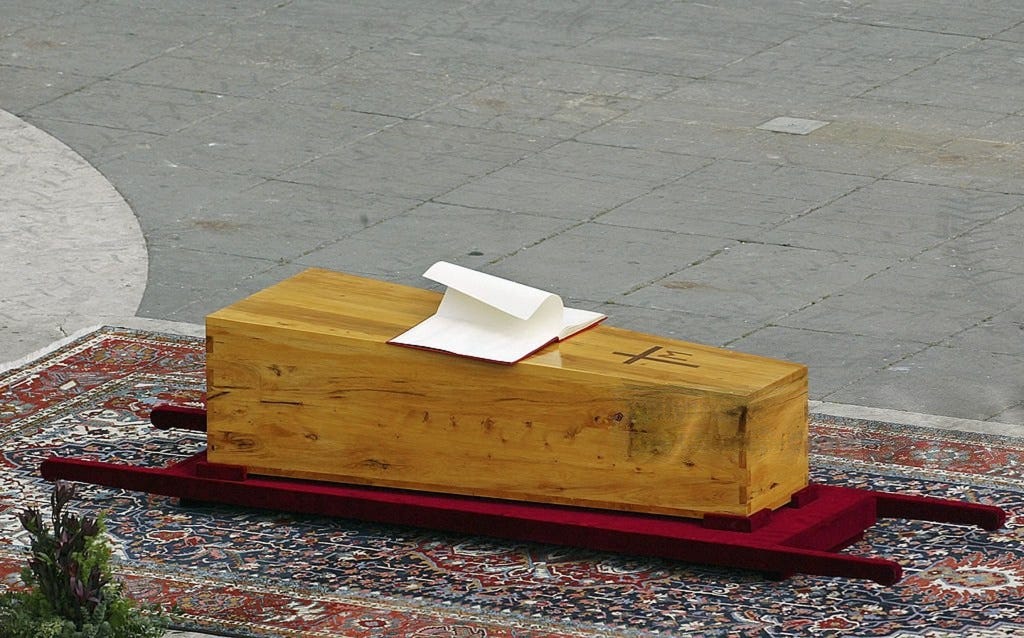
Beyond the striking visuals, what moved me most was the homily by Cardinal Joseph Ratzinger (the future Benedict XVI).
Ratzinger wove the Gospel of that day — “Simon, son of John, do you love me? Follow me.” — into a powerful montage of John Paul II’s life of discipleship. Over and over, he repeated Jesus’ words to Simon Peter, “Follow me,” showing how the late pope and future saint had answered that call at each step of his journey.
In the stillness of that early morning, in my own heart I heard the same invitation: Follow me.
From that day, my adolescent faith began to blossom. A year later, when I was preparing for Confirmation, I became more entranced in the writings of Augustine, Aquinas, CS Lewis, and Thomas Merton.
The Confirmation ritual includes choosing a patron saint’s name. Inspired by the Gospel of John shared at John Paul II’s funeral, I was determined to take “Simon Peter” as my confirmation name.
After all, Simon Peter was the first to follow Jesus’s call in that Gospel, and I felt a special kinship with this imperfect-but-passionate Apostle.
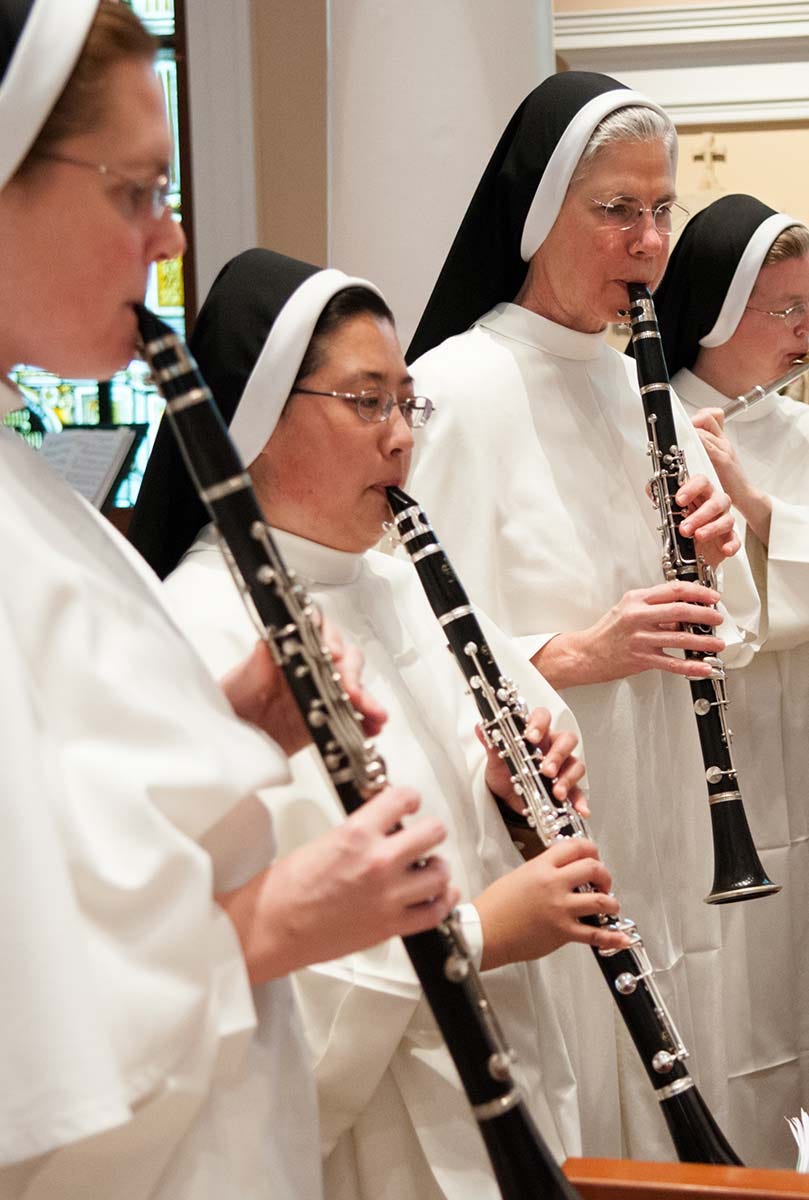
However, the Dominican nun running our confirmation class balked. “Simon was Peter’s Jewish birth name,” she told me. “You can choose Peter, but technically there’s no Saint ‘Simon Peter’ separately.”
Seventeen-year-old me was nothing if not persistent and a tad mischievous). Taking a playbook from Pope John Paul, I cheekily replied, “Then I’ll be a double saint — honoring St. Simon the Apostle and St. Peter the Apostle!”
Sr. John Agnes was not amused; she saw right through my shenanigans and nixed the idea. Officially, I was assigned just “Peter.”
But on Confirmation day, I came prepared. Pinning on my crisp paper name-tag “Christopher Jolly PETER Hale,” I pulled out a trusty Stainless Sharpie (the best pen on the market for left handers) and slyly inserted “SIMON” with a little arrow before Peter.
When our brand-new bishop, David Choby, anointed us, I pointed to my edited name-tag. With a knowing smile, he went along: “Simon Peter, be sealed with the gift of the Holy Spirit.”
Why share this little caper? Because it captures something essential about how I live my faith. I am joyfully Catholic, absolutely. I love the Church, and I am her loyal son.
But I’m also creative in my fidelity. Sometimes that means coloring outside the lines just a hair — not to break rules for ego’s sake, but to fully live the spirit of the faith.
Pope Leo XIV’s patron St. Augustine said it well: “in essentials, unity; in non-essentials, diversity; and in all things, love.
In hindsight, it’s fitting that I later studied under the Jesuits in college, who encourage finding God in all things and sometimes taking inspired risks in spreading the Gospel.
The Church today needs both courage and creativity from her sons and daughters.
God never ceases to surprise us; if we remain docile to the Holy Spirit, we can navigate turbulent times with both fidelity and innovation.
Fr. Adolfo Nicolás, the late Jesuit Superior General, argued that each generation must re-translate the faith of Jesus Christ for its own moment — not inventing a new Christianity, but applying timeless truth to the signs of the times. That is the ambition of this project, however modestly realized.
Will Pope Leo XIV actually excommunicate J.D. Vance?
