
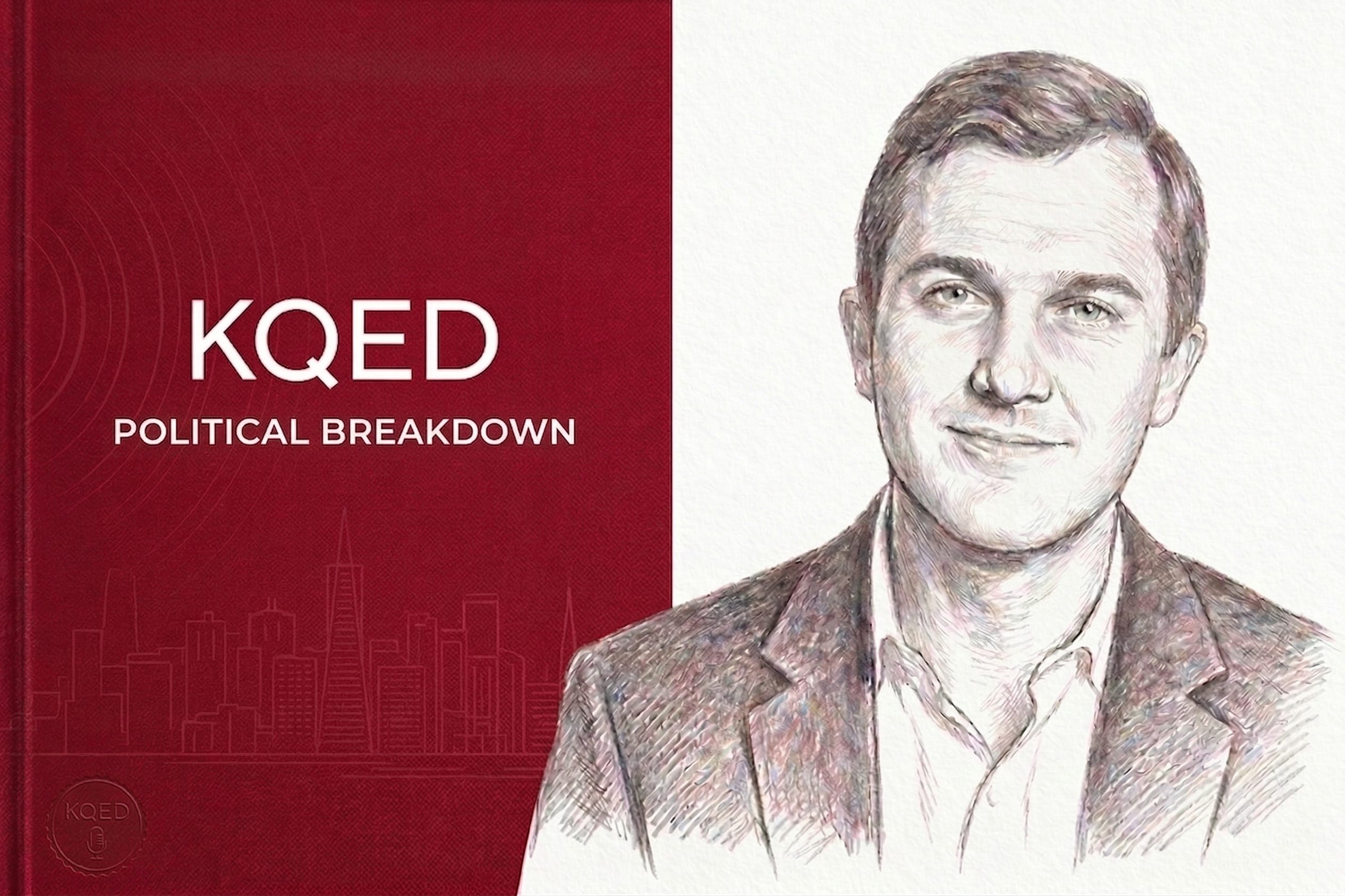
My KQED Interview: Catholics Can No Longer Accommodate Trump
I said it on KQED, and I’m saying it again: standing up to creeping authoritarianism is the biggest secular project American Catholics must undertake. That includes holding my own party accountable.
Thank you for reading! Letters from Leo is a reader-supported publication. If you find value in my work, please consider becoming a paid subscriber or making a one-time donation.
I said something on the radio earlier this month that I want to put in writing, because I think it matters more to you than almost anything else I can offer.
Scott Shafer, who co-hosts Political Breakdown on KQED in San Francisco, asked me a straightforward question about what Pope Leo XIV means for American politics.
My answer was blunt: the era of accommodating Donald Trump must be over. The decade-long project of Catholic leaders trying to find common ground with a movement that mocks the Gospel, cages children, and sends ICE agents into church parking lots has run its course.
Catholics in America face a choice. Follow the moral leadership of Pope Leo XIV, who made clear in his first apostolic exhortation, Dilexi Te, that the Church would not abandon its immigrant faithful. Or continue deferring to a political movement that treats cruelty as policy and intimidation as governance.
I realize that sounds like a provocation. Let me explain why I think it is something closer to a moral obligation.
The Moral Case
For years, Catholic leaders accommodated Donald Trump because of his pro-life positioning. Bishops who might have otherwise objected to his cruelty toward migrants, his compulsive dishonesty, his open contempt for the vulnerable — they held their tongues because he appointed the judges who overturned Roe. That was the bargain. And for a while, it held.
But there is nothing pro-life about Donald Trump. He adopted the cause because it was politically useful, and he will discard it the moment it becomes a liability. He has already started. When the politics of abortion shifted after Dobbs, Trump scrambled to distance himself from the very movement he once championed. He publicly criticized state-level abortion bans that his own judicial appointments made possible.
As I wrote in Letters from Leo earlier this year, pro-lifers themselves are beginning to reject Trump — because they can see that the pro-life movement was a vehicle for him, never a conviction.
So the bargain that justified Catholic accommodation of Trump has collapsed on its own terms. And what remains, stripped of the pro-life cover, is an administration that sends ICE agents into church parking lots.
A maintenance worker at St. Gabriel the Archangel Catholic Church in Hopkins, Minnesota — a man who had served the parish for years — was arrested by federal agents.
The White House openly mocked the pope for defending refugees, which amounts to mocking the Gospel of Matthew. When your government ridicules the Vicar of Christ for saying we should welcome the stranger, you have crossed well beyond the space of legitimate political disagreement.
What we are dealing with is creeping authoritarianism.
I use that phrase deliberately because it describes a process, not a single event.
Authoritarianism rarely announces itself with tanks in the street. It arrives through the slow erosion of norms — a president who lies with industrial regularity, a vice president who admitted to fabricating a story about migrants eating pets because it moved the media cycle, an administration that treats the Church as an obstacle to its immigration agenda rather than as the conscience of a nation.
Standing up to this creeping authoritarianism is, I believe, the biggest secular project American Catholics must undertake in the coming months and years. I do not say that lightly.
Catholic teaching offers a comprehensive moral framework — dignity of the human person, solidarity, the common good, a preferential concern for the poor. Every one of those principles is under assault from the Trump-Vance political project. The question is whether Catholics will defend them or continue pretending that accommodation is still possible.
The Choice the Bishops Face
There is progress to report. Eighteen bishops signed a statement ahead of the State of the Union, pushing back against the administration’s immigration enforcement. Cardinal Robert McElroy called the bishops to a higher standard of moral clarity.
The U.S. Conference of Catholic Bishops issued its first special message in twelve years, condemning the administration’s treatment of migrants and refugees. Their viral video denouncing the raids has been seen by millions.
These are real acts of institutional courage. They represent the closest thing to organized resistance that the American Catholic hierarchy has mounted against a sitting president in modern memory.
As I told Bloomberg News, even among conservatives, bishops have responded to Leo in ways they did not under Francis.
Mary Ellen Klas put numbers to this. Trump won 48 percent of Hispanic Catholics in 2024 — a 12-point gain that convinced Republican strategists they had locked in a durable realignment.
It lasted less than a year. By November, only 28 percent of Hispanic Catholics viewed the president favorably. Nearly seven in ten expressed little confidence in ICE.
Klas called it a “one-two punch” of immigration overreach and economic anxiety, which is precisely the combination Catholic social teaching has warned about for decades.
The numbers matter because Hispanic Catholics account for most of the growth in the American Church. When an administration alienates them at this speed, even the most cautious bishop starts doing the math.
But the resistance remains selective. Those eighteen bishops represent a fraction of the American episcopate. The rest are watching, calculating, waiting to see which way the wind blows.
I said on KQED that the young men entering the priesthood today are, by and large, quite conservative — and that the structural pipeline of the American Church tilts rightward even as the pope pulls in a different direction.
That candid assessment got some pushback. But honesty about the Church’s internal dynamics is essential if we want to change them.
Pope Leo XIV is forcing the question anyway.
He has declined Trump’s invitation to visit the United States in 2026. He issued an apostolic exhortation that made the Church’s position on migration unmistakable. He is the American pope chosen for this moment to stand against an authoritarian impulse rooted in his own country, and that reality creates a moral pressure that the bishops cannot indefinitely ignore.
An Honest Word About My Own Party
I want to be direct about something that Catholics on my side of the political spectrum too often avoid saying. The Democratic Party has serious work to do.
Opposing authoritarianism is necessary. On its own, though, it is not sufficient. Democrats must build a party that represents the core interests of working Americans and those on the margins — both economic and cultural. Too many working-class Catholics feel unseen by a party that talks about inclusion but struggles to deliver material results in their communities.
The cultural distance between the party’s professional class and the pews of a parish in Scranton or Saginaw or San Bernardino is real, and pretending otherwise helps no one.
I wrote about this tension after the 2024 election in Newsweek, and I explored what an expanded, Ezra Klein–style big-tent approach could look like for Democrats and Catholic voters.
I am not trying to win elections for their own sake.
I believe that Democrats taking back the House in 2026 and ensuring JD Vance does not succeed Trump matters for the future of this country — because the alternative is the consolidation of an authoritarian movement that has already shown its willingness to target religious institutions, deport parishioners from church grounds, and mock the moral authority of the pope himself.
The stakes are existential. But meeting those stakes requires a Democratic Party that earns the trust of working families, not one that merely expects their vote because the other side is worse.
Catholic doctrine demands more of all of us. The consistent ethic of life — from the womb to the tomb — does not permit comfortable partisanship in any direction. My criticism of Trump and Vance is grounded in Catholic moral theology, and that same theology requires me to hold my own political allies accountable when they fall short of the dignity every person deserves.
The Door Leo Has Opened
I told KQED’s audience that Leo represents a counterbalance to MAGA creeping authoritarianism — a moral voice that millions of Catholics, and millions more people of goodwill, have been waiting for. He is not a partisan figure. He is a pastor who understands that silence in the face of cruelty is its own kind of sin.
The era of accommodation is over. I believe that with every fiber of my Catholic faith. The question is whether we have the courage to walk through the door Leo has opened — and to build something on the other side that is worthy of the Gospel’s demands.
At Letters from Leo, we stand with Cardinal McElroy, the eighteen bishops who broke their silence, the parish workers and volunteers who refuse to let fear dictate how they serve their communities — they represent the Catholic resistance this moment demands.
Every person of conscience who believes that standing against authoritarianism is a moral obligation belongs in this fight.
In an era poisoned by fear and political cowardice, we remain rooted in a Church that refuses to abandon the stranger, the prisoner, and the poor — no matter how powerful the forces arrayed against them.
This is the fastest-growing Catholic community in the country because people are hungry for moral clarity in a moment that demands it. They are looking for a place where faith and conscience meet action, and where the hard truths about both parties get spoken out loud.
If you believe this movement matters — Catholics and people of goodwill standing for human dignity against creeping authoritarianism — I am asking you to join us.
If you’d like to invest in our mission, here are three ways you can help this Lenten season:
Subscribe as a paid member to receive exclusive posts about the life and formation of Pope Leo and help sustain this community.
Donate with a one-time gift to fuel this project’s mission.
Share this post (and Letters from Leo) with a friend who might enjoy it.
Paid subscribers get access to our ongoing series on Pope Leo’s Life & Formation, the Epstein-Bannon Investigation, the Lenten Reflection Series, and the Q&A mailbag, where you can ask me anything about American politics, Catholicism, Donald Trump, Pope Leo, JD Vance — or my own faith, biography, and life.
Whether you give $0, $1, or $1,000, your presence here matters — no matter your faith or your politics.
Thank you for reading. I’ll see you on the road.
Full Interview: KQED’s Political Breakdown — March 10, 2026
On February 26, I sat down over Zoom with Scott Shafer and Marisa Lagos of KQED’s Political Breakdown to discuss Pope Leo XIV, the Catholic Church’s resistance to MAGA authoritarianism, and why the era of accommodation is over. The full episode aired on March 10.
Below is the complete transcript.
Scott Shafer: Today on the Breakdown: under Pope Leo, the Catholic Church is strongly speaking out against right-wing politics around the world, including those of President Trump, especially on issues around immigration and treatment of migrants. It’s a stark contrast from his predecessor, Pope Francis, and a strong counterbalance to conservatives’ increasing use of scripture and faith to justify Trump’s policies.
Our guest today is Christopher Hale, a progressive Catholic writer and political operative who writes the Letters from Leo Substack, where he recently wrote that it’s time for Catholics to choose which direction to follow — the pope’s or that of President Trump and Vice President JD Vance. He’s been following the sharp change in tone and substance under Leo, the first pope ever to come from the United States of America.
Christopher Hale, welcome to Political Breakdown.
Christopher Hale: Really appreciate you having me today. Thank you so much.
Scott Shafer: You bet. Well, first of all, just set the table for us. Leo is the first American chosen to be pope. Remind us why it never happened before and the significance of that string being broken.
Christopher Hale: Yeah, it’s a great question. Well, for 500 years, straight up to 1978, there were only Italian popes. Obviously, the papacy resides in Rome, at least most of the 2,000-year history of the Catholic Church. That tends to be an Italian prerogative throughout history. But there’s also, in the post-World War II era, this belief that maintains to this day that a superpower ought not to control both secular power, temporal power, and spiritual power.
So, you know, a lot of Catholics growing up were taught that there would never be an American pope, really. I mean, in my education, I was taught two things: there would never be a Jesuit pope — and then we got a Jesuit pope in 2013 — and that there would never be an American pope — and then we got an American pope in 2025. So there’s a saying that nothing’s ever only happened once in the Catholic Church, but in the last 12 years, we’ve had a lot of first-timers.
Marisa Lagos: Yeah, I wonder why you think the cardinals thought this was the time. If there’s any analogy with the election of Pope John Paul II from Poland during the height of the Cold War.
Christopher Hale: You know, I definitely believe that. I could be wish-casting to some degree. I think the best answer is that there are thousands of different reasons that the cardinals choose who they’re picking internally. Catholics believe that the Holy Spirit guides the process. So I hope that one of the overarching reasons — there are internal politics that go on, and we can talk about that a little bit — but I think the overarching reason I hope is that just as John Paul II stood up to communism from behind the Iron Curtain, a truly Soviet pope if you will, he’s from Poland, he was in what was the USSR standing up to communism — I think that Leo represents a counterbalance to what I would call MAGA creeping authoritarianism.
I want to note though, I think it’s really important for your listeners to understand, Leo might be an American pope, but he’s also Peruvian. He’s spent the majority of his priestly ministry in Peru. And it’s really important for him, as the pope of 1.4 billion Catholics, not to have an American prerogative. So when he’s standing up to what I would argue is MAGA authoritarianism, he’s not doing it at the behest of American Catholics or the United States. I think he believes, and we can see, that he thinks authoritarianism is a threat globally, perhaps having a stronghold here in the United States.
Marisa Lagos: Well, in the US, the Catholic Church leaders, in recent years anyway, are more tied to right-wing politics around social issues like abortion in particular. How different are Pope Leo’s views from, say, the longtime New York City Cardinal Timothy Dolan, or here in San Francisco, Archbishop Cordileone?
Christopher Hale: So the answer is quite a bit different. And one of the things I think your listeners need to understand is it takes a long time — the Catholic Church is a huge ship. And Pope Francis was in charge for 12 years, but we really didn’t start seeing bishops that got appointed that really represented what I would call the Franciscan worldview until the latter portion of his pontificate, and really until after the pandemic. So really the last three or four years we started seeing more Francis-minded — Francis-coded, to use a phrase the young kids use — bishops here in the United States.
But there’s an issue. The episcopacy of the United States comes from the priests of the United States, and there aren’t that many progressives who are becoming priests. So there’s not a huge bullpen to choose from, and it will only get harder, I think, frankly. I think the young men entering the priesthood are quite conservative today.
So I think an honest assessment is there might be a liberal moment in the Catholic Church here in the United States. The question is, how long does it last? There is a reality that, you know, me and Archbishop Cordileone don’t have a lot in common, but he might really represent, unfortunately for folks like me, a better sense of the future of the episcopacy of the United States. The best way I describe it is: if there wasn’t a Francis, if there wasn’t a Leo, I think that the much more traditional-minded, really right-wingers would control the episcopacy of the United States. The best we can hope for is probably moderates.
Marisa Lagos: So does that reflect the flock, though? Like, I mean, in a city like San Francisco, I think the Archbishop’s public positions, including saying that Nancy Pelosi shouldn’t get communion, have not always necessarily reflected what we see among the city’s Catholics. So how do you square that? Is it just who goes into the actual church versus who’s in the pews worshipping?
Christopher Hale: That’s a great question. Yes. I mean, so in the Catholic worldview, in Catholic theology, essentially once a Catholic, always a Catholic — you can come but you can never go home. And so the reality of it is that people who are showing up consistently, day in and day out on Sunday, tend to be significantly more conservative than Catholics writ large.
However, I think, speaking religiously — and I think this really represents Francis and Leo’s pontificate — the pope is the pope of all Catholics and really the pope of humanity. And in the gospel, there’s a story of the man with two sons and the lost son who the father goes and searches for, or another story being the shepherd who leaves the 99 sheep in search of the one. Really, I think the argument that a lot of us are making is that the priority should be those who are not in the pews, not the MVP Catholics. But here’s the reality: that can make some MVP Catholics, who are paying the bills oftentimes, upset — as it did in scripture.
Scott Shafer: What drives Pope Leo’s views on things like immigration, authoritarianism, and so on? What concrete actions has he taken to promote those views within the church?
Christopher Hale: The distinction between Pope Francis and Pope Leo is in rhetoric. So Pope Francis was more prophetic, to use a kind word. To use a not-so-kind word, he was more Trumpian. He just kind of spoke from the gut and let the cards play as they might. Leo himself tends to be more — he’s a canon lawyer. He tends to be more judicial, more long-term focused. Francis walked into the pontificate thinking he’s going to die in five years, so he’s in a rush. Leo’s the first pope to be under 70 since 1989, I believe. So he has time.
So I think he’s going slower. He’s trying to make, if you will, fewer enemies. And there’s slow, but there are signs. You can see when he speaks off the cuff — he’s, once again, very juridical, he speaks from text. Francis just kind of winged it often. But when he speaks off the cuff, that’s where you get those moments that have really marked his pontificate. Those moments where he’s challenged Trump in a more direct way have come from interviews — there are like three interviews after he’s leaving what’s called Castel Gandolfo, which is where he rests. It’s like his respite away from Rome. So that’s where we’re seeing it.
But where he’s standing up the most, I think, is really on the question of migration. He views a strong anti-migrant mood to be rooted in nationalism. He’s a huge skeptic of nationalism. And he gave his Pentecost homily — he said in a way that ruffled a lot of feathers that with the Holy Spirit, God tears down all walls. Obviously, during the second presidency of Donald Trump, and also the first, anything about tearing down walls is going to be coded as a very negative criticism of the president. But for him, the wall mentality is not just migration. It’s also in terms of extreme nationalism, war and peace. He’s an old-school liberal, and I don’t mean capital-L liberal, but a classical liberal who believes in the polis, who believes in a global world order. And that is out of vogue all across the world. So I think he does stand out.
To put it in a little bit more blunt terms, he’s a boomer pope who believes in boomer things.
Scott Shafer: Welcome back to Political Breakdown. I’m Scott Shafer, here with Marisa Lagos. We’re talking with Catholic writer and progressive political operative Christopher Hale. He writes the Letters from Leo Substack.
Well, you mentioned earlier that Leo has spent a lot of time in Peru. How do you think that shapes his view of immigrants and migration and just sort of this globalist kind of viewpoint that you alluded to a minute ago?
Christopher Hale: I think it’s absolutely crucial. I mean, he’s in Peru starting in the early ’80s. He’s there consistently till 1998. So it’s a span of 17 years, more or less, that he lives in Peru. And he lives there during the darkest time of Peru. It’s called the Lost Decade in English — the 1980s, where there was global growth that was not working well in Peru. There was corruption, there was poverty. Also, El Niño. So he saw what people consider the early impacts of climate change.
And so a lot of these issues seem to come to the forefront of his ministry. But in particular, I think the best way to understand it is that he missed the conservative elevation throughout the 1980s, and you could argue in the ’90s, of the United States. That whole era was just completely foreign to him. And he saw what he would argue was the negative impacts of American intervention in Central and South America. He saw the other side of Reaganism. He saw the impacts of the Cold War on trade, on the currency, on way of life in the South.
So I think that is really important. He might be an American pope, but I think in his heart he is Peruvian. It’s really important to know — on that day, I was there on May 8th in Rome when he was elected. And when he comes out, he speaks in Italian, to be expected, and he speaks in Spanish. And I think — it was very notable, upset some conservative commentators — the joke being that Spanish was good enough for Jesus, it should be good enough for him. But he also mentions Chicaylo, which is where he was in Peru. He gives it a shout-out. He does not mention the United States.
And news came out just this past couple of weeks that he’s choosing to decline President Trump’s invitation to show up for the 250th anniversary. So I think he’s making a very pointed choice day in and day out. And I think the Peruvian worldview is probably much more typical of how he sees things.
Marisa Lagos: Yeah, I mean, you’ve written about how closeness to the people is sort of a driving force for him, that he is first and foremost a priest and a bishop. Why does that matter? And how does it differ from maybe not just his predecessors, but other leaders in the church?
Christopher Hale: There’s definitely a history in the Catholic Church to elevate bureaucrats — people who lead seminaries, who are functionaries, who go up through the desk jobs, if you will. And he was a parish priest. He understood the needs of people on the ground. He understood parishioners. He understood parish life. And that is distinctive. Even you could argue Jorge Bergoglio, who became Pope Francis, he too had a bureaucratic background.
And so I think he really represents, at least in the Catholic Church’s understanding, the first missionary pope. And what we mean by missionary is he served in a country he was not born in. And I think it’s really important. It really shakes him loose of an intense nationalistic pride, I would argue, but it also gives him a sense of universalism that once again is so key to him.
I would say that in many ways he is a quieter, more juridical — there’s that word again — version of Francis. But he is to the left of Francis in terms of belief in national ideology. He’s very skeptical of a nation-first mentality in culture and politics.
Marisa Lagos: Yeah. After Trump’s State of the Union speech, which you described as an angry partisan spectacle that failed to meet the most pressing challenges, you wrote this: “This is the dividing line — the way of Pope Leo XIV, or the way of Donald Trump and JD Vance.” What kind of reaction do you get when you write something like that?
Christopher Hale: Mixed. It’s definitely not necessarily a unifying vision. In some ways I’m unifying my community, but I think what I’m trying to say is the era of accommodation, which is what we have seen historically in the Catholic Church, is over. I think we’ve got to make a choice on which way we’re going here.
And I think that Leo — the Second Vatican Council made it very clear that Catholics were to take up the realm of politics. That was our calling — or sorry, lay Catholics. It wasn’t the priests, it wasn’t the bishops, it was us. And I think that Leo is giving us permission, if you will, to take up that realm.
But look, you know, can a Catholic be a Republican? Absolutely. Can a Catholic support Donald Trump? There are probably arguments for it. But I think that really going forward, there’s just really no way that you can continue to support this president and be a Catholic, and be a proud Catholic. He stands against so much of what we stand for.
Marisa Lagos: I want to go back to something you talked about earlier — how at its core, a lot of folks within the church who have power are still pretty conservative, far to the right of Pope Leo. And yet we’ve seen, both in America and abroad, like in Spain when he spoke out there, what seems like a willingness to go along with what he’s talking about. We saw 18 bishops release a statement ahead of the State of the Union calling for the end of mass deportations — the hardest stance against Trump’s immigration policies, after he spoke out about it. What do you make of that? Is this like, “we want to make the boss happy”? Or do you think some folks within America and elsewhere are sort of happy to see him take these moral stances?
Christopher Hale: There are definitely people who are happy to see him take these moral stances, and there are definitely bishops who support him. But I think — there were 18 bishops who signed that document, and there are over 200 active bishops in the United States. So it’s some, but there are a lot more who are cautious.
And I think that bishops have hard jobs because they have to deal with the ramifications. They can’t just — you know, when I speak out against the president, there are no functional ramifications for a flock I do not have. So once again, I think there are bishops who are willing to go along and take the fight to President Trump. But I think the expectation is actually that we, as lay Catholics, are the ones who should be leading this fight.
Scott Shafer: Well, a question: what difference does it make? The pope, of course, has a lot of power within the Catholic Church bureaucracy, if you will. But what about with members? If you’re a Catholic supporter of Trump, does the pope’s criticism of, say, the president’s anti-immigrant rhetoric and policies have an impact on them? Or are we becoming so siloed that it just kind of gets rationalized or dismissed?
Christopher Hale: I think what you’ve seen in the Catholic Church, and we notice in politics in general, is I don’t need to convince every Catholic. I don’t need to convince half the Catholics. We just need a margin. You know, really, I think I’m looking to change the opinion of five percent of Catholics.
Scott Shafer: Well, let me just stop you there. Why? Like, why five percent, ten percent? What is that?
Christopher Hale: That’s — to me, that sounds like it’s so we can win an election.
Scott Shafer: It is. So we can win an election.
Christopher Hale: I think that is — just to be frank — I am engaged in secular politics and I want to win an election. Yes. And I think it’s just reality. We don’t have the reality that we are able to convince everyone anymore.
Marisa Lagos: So let’s talk a little bit about the dynamics within the right-wing coalition here, because there are a lot of Catholics, including the Vice President, who are very much on board with Trump’s positions on all these things. And yet, evangelicals have been a huge driving force as well within the religious community and within politics on the right. You talk about Christian nationalism and MAGA authoritarianism as inherently anti-Catholic. Talk about what you mean by that. And what is the relationship right now between the evangelical community and the Catholic community here in the US?
Christopher Hale: I think the term Christian nationalism is a misnomer, and I talk about that quite a bit. It’s really what I would call Protestant evangelical nationalism. And what I mean by that is, in the Christian nationalist world, there is actually no room, I don’t think, for Catholics. I think that a good number believe that Catholics are in some capacity not Christian and not worthy of salvation. And I think that really plays a role in the way that they see us.
And so you see that play out with JD Vance as well. I think one of the issues that’s going to hurt in 2028 is the question of Israel. Catholics, on par, as you might know, tend to be much more skeptical on Israel than the evangelical Protestants. And it’s going to be issues like this, I think, that are going to hurt him.
Scott Shafer: All right, we’re going to leave it right there. Christopher Hale writes the Letters from Leo Substack. Great to have you with us.
Marisa Lagos: And that is a wrap for Tuesday, March 10th. Political Breakdown is a production of KQED. Our engineers are Jim Bennett and Brian Douglas. Our producer is Izzy Bloom. I am Marisa Lagos.
Scott Shafer: And I’m Scott Shafer. Thanks for listening.


I'm a broken record, but the Pope's standing on these issues is not being heard, felt or nourished at all at my church in the Florida Diocese of Venice.
Thanks so much for sharing this thought-provoking piece.