
“No War Is Blessed by God” — Pope Leo XIV Defies Trump as the U.S. Bombs Iran Again
Opening the year’s second consistory, the pope signaled the Vatican may rewrite the just war doctrine itself — the teaching JD Vance and Mike Johnson invoked to bless the strikes. The week-old ceasefire already lies in ruins.

Thank you for reading! Letters from Leo is a reader-supported publication. To receive new posts and support this movement, consider becoming a free or paid subscriber.
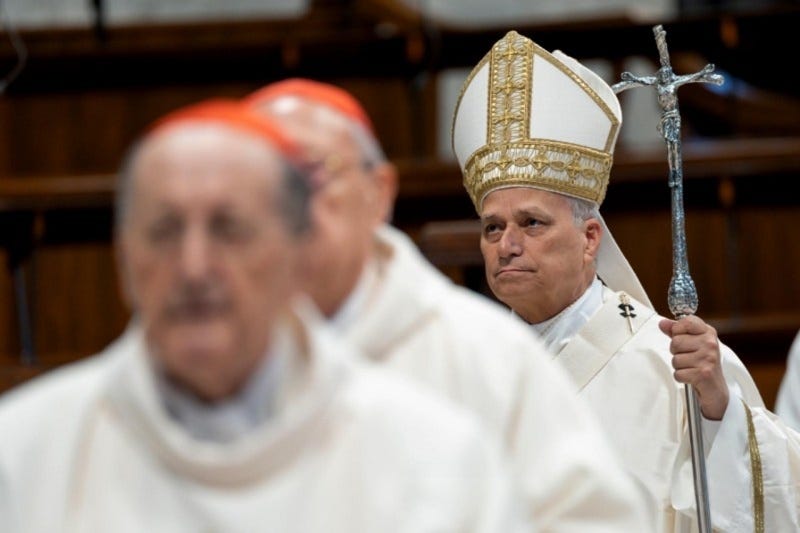
Pope Leo XIV opened the second extraordinary consistory of the year on Friday with a Mass in St. Peter’s Basilica, and he used the homily to render a verdict on the war his own country is waging — and on modern warfare itself.
“War is never worthy of humanity, and it is never blessed by God,” he told the cardinals before him, “because, even if we are equipped with high-tech weapons, the Creator has endowed us with intelligence and free will to resolve conflicts as human beings and not as beasts.”
It was the second time this year that Leo summoned the College of Cardinals to Rome, and 178 of the Church’s 241 cardinals answered the call. They came to take up the synod, the safeguarding of human dignity in the age of artificial intelligence, and above all the wars tearing across the globe.
The pope asked them to pray for “the gift of peace in unity.”
The timing escaped no one. As Leo gathered the cardinals to plead for peace, the United States was bombing Iran for the second straight day.
On Saturday, U.S. Central Command confirmed that American aircraft had struck missile sites, drone-storage depots, and coastal radar installations across southern Iran — the second wave of attacks in a weekend that broke a ceasefire barely a week old.
Trump accused Tehran of violating the truce after an Iranian drone hit a Singapore-flagged cargo ship in the Strait of Hormuz, and he warned on social media that “the Islamic Republic of Iran will no longer exist” should the attacks continue.
The pope’s appeal and the president’s missiles landed in the same news cycle, and the increasing breach between Rome and Washington moved into open view.
Beyond the rebuke, the Vatican has signaled a more concrete intention.
In his first encyclical, Magnifica Humanitas, released in May, Leo called the “just war” theory — the framework the Church has used since Augustine to judge when violence might ever be permitted — “outdated.” Humanity already holds better instruments for ending conflict, he argued: dialogue, diplomacy, forgiveness.
Vatican officials have since signaled that the pope means to formally revisit the doctrine, a revision whose reach would extend far beyond this one war.
The revision cuts close to home. Pope Leo XIV is the first pope drawn from the Order of St. Augustine, and the just war tradition he means to reopen traces its own roots to Augustine, who first asked when a Christian could ever take up the sword, and to Thomas Aquinas, who centuries later gave the conditions their lasting shape. The pope is reaching back into the inheritance that formed him.

The decision did not arrive in a vacuum. After Leo criticized the American strikes, two of the most powerful Catholics in the United States government stood up to defend them in openly theological language.
Vice President JD Vance, speaking at a Turning Point USA event, invoked what he called a “more than 1,000-year tradition of just war theory” to argue that the campaign against Iran satisfied the Church’s standard for a moral war.
House Speaker Mike Johnson followed close behind, placing the administration’s bombing under the same banner and crediting Trump and Vance with a “deep understanding” of the stakes.
Leo had already framed the deeper problem in his homily.
War, he said, is born within us, the fruit of a “culture of power” that corrupts politics, economics, and even religion — and against it he set what he calls a “civilization of love,” the order an Augustinian reads straight out of the City of God.
It is in the human heart, where Christ still meets and converts us, that peace is finally decided. A doctrine meant to restrain that impulse cannot be turned into the instrument that excuses it.
This is the point where the argument collapses, and it collapses on the Church’s own terms. The just war tradition Vance reached for was never written as a permission slip.
Thomas Aquinas, who gave the doctrine its enduring shape, laid down conditions meant to make war almost impossible to justify: a grave and certain threat, legitimate authority, right intention, proportionality, and the exhaustion of every peaceful alternative before a single shot is fired.
Theologians who studied the Iran campaign reached a flat conclusion — the operation fails on every criterion. Bombing a nation that had not attacked the United States, while a negotiated settlement was reportedly within reach, describes almost exactly the war the doctrine exists to forbid.
Cardinal Robert McElroy said as much from inside Washington itself. The archbishop of the nation’s capital declared the war “morally illegitimate” at a Mass for peace in April, judging that it failed the tests of just cause, right intention, and proportionality — the very tradition the administration was citing to bless it.
That phrase about a settlement within reach deserves a second look, because the administration’s own allies were telling a far rosier story a month ago.
Over Memorial Day weekend, conservative commentator Scott Jennings and other Trump boosters assured the public that a peace deal with Iran was “95 percent” finished, days from the finish line. The deal never closed.

Trump and Iranian President Masoud Pezeshkian managed only a brittle memorandum of understanding in mid-June, and within days the bombs were falling once more.
The diplomacy that followed never amounted to much more. Vance himself flew to Switzerland in June for a round of talks that delivered a photograph and a 60-day “road map,” yet produced nothing binding beyond the memorandum it was meant to build on.
Here, Leo’s teaching presses hardest.
No government can claim the mantle of a just war while walking away from the diplomacy the doctrine commands it to exhaust first. The Vatican has watched this administration announce a deal nearly done, abandon it, and then borrow an ancient Christian teaching to sanctify the violence that came after. Leo’s answer has been to ask whether the teaching itself can survive that kind of handling.
The rift between this pope and this president stopped being a quarrel over tone long ago. It opened last fall over immigration, when Leo and the American bishops condemned the mass deportations, and it widened in January over war and peace, when the administration’s intervention in Venezuela led the pope to warn that diplomacy was being replaced by “a diplomacy based on force.”
The breach hardened once the Iran war began in February, and Trump met the pope’s appeals by branding his foreign policy “dangerous,” accusing him of “endangering Catholics,” and even casting doubt on the legitimacy of his election.
Secretary of State Marco Rubio traveled to the Vatican in May to steady the relationship, yet the strikes this weekend undid whatever that meeting accomplished.

What the world watched this weekend was a contest between two understandings of power. The administration treats a sovereign nation as entitled to bomb its way to safety and then wraps that choice in the vocabulary of faith.
Leo begins from a different premise altogether — that the Creator gave the human family reason so it would not have to settle its quarrels like beasts — and he set the full weight of the papacy behind that conviction in front of the very men who will one day choose his successor.
Once the consistory ends, the cardinals scatter back to their dioceses. For decades to come, seminaries and chanceries will parse every line of Magnifica Humanitas.
And the question Leo pressed into the College this weekend will outlive the current war: whether the Catholics who wield power in Washington will obey a doctrine that demands peace, or keep stretching an old teaching until it blesses whatever the missiles have already decided.
He had set the warning down plainly in Magnifica Humanitas — no algorithm can make war morally acceptable. Whether a selected reading of Augustine and Aquinas can accomplish what an algorithm cannot is the question Vance and Johnson have now forced the whole Church to confront.
At Letters from Leo, we stand with a pope who refuses to let the language of faith be conscripted into the service of war, and with the millions of Catholics and people of goodwill who still believe that human life is not a bargaining chip and that peace is the harder, holier work.
This is the fastest-growing Catholic community in the country because people are weary of leaders who reach for the Gospel only when it sanctifies what they had already decided to do. They are hungry for a faith that holds power to account rather than blessing it, and that hunger is exactly what this movement exists to feed.
If you believe Catholics and people of goodwill should stand for human dignity against a politics that turns war into a moral afterthought, I am asking you to join us.
If you’d like to invest in our mission, here are three ways you can help during this critical time:
Subscribe as a paid member to receive exclusive posts about the life and formation of Pope Leo and help sustain this newsletter.
Donate with a one-time gift to fuel this project’s mission.
Share this post (and Letters from Leo) with a friend who might enjoy it.
Paid members keep this work alive and unlock the full archive — the Epstein-Bannon investigation, the biographical series on Pope Leo’s Life & Formation, our reporting on Pope Leo Takes On AI, and the Sunday Scripture Reflection Series.
Whether you give $0, $5, $50, $500, $1,000, or more, your presence here matters — no matter your faith or your politics.
Thank you for reading. I’ll see you on the road.


The Cabbage Patch Kid, the brand new Catholic, is a monumentally pompous ass to presume to lecture the pope on Catholic doctrine and matters of faith. Mike Johnson, who is a Christian nationalist, kisses Dirtbag Donnie’s ass every day. He is anything but a Christian.
The disgraced, far right wing Pillar Substack (same clowns who took Trump’s side over Pope Leo) is ‘reporting’ that many Cardinals are upset at the direction of the consistory. This probably means one racist Cardinal - Dolan most likely- made an off handed comment. Fight back against false reporting and division in the Church! No false Gods!