
On Christmas, Pope Leo Condemns ‘Falsehoods’ Behind the War in Gaza and Other Conflicts
The pope links Bethlehem’s fragile child to the children of Gaza’s ruins.
Thank you for reading! Letters from Leo is a reader-supported publication. If you find value in my work, please consider becoming a paid subscriber or making a one-time donation.
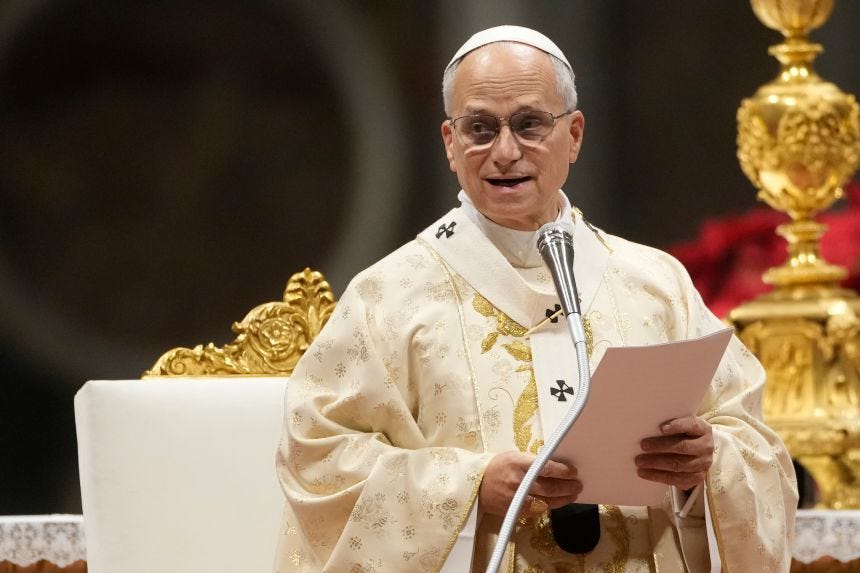
At St. Peter’s Basilica on Christmas morning, Pope Leo XIV offered a blunt vision of Christmas that stands in stark contrast to milquetoast Hallmark platitudes that usually mark the day.
Instead of dwelling on cozy manger scenes, the first American pope used his Christmas Day Mass homily to confront the brutal realities of our world.
Leo declared that the birth of Jesus cannot be separated from the plight of those who suffer war, displacement, and poverty.
“The Word has pitched his fragile tent among us,” he said. “How, then, can we not think of the tents in Gaza, exposed for weeks to rain, wind and cold?”
It was a jarring image on a day usually reserved for joy.
Yet it captured Pope Leo’s core message. In the very moment Christians celebrate God becoming flesh as a vulnerable infant,
Leo pointed to those vulnerable in our midst right now: families in Gaza displaced by war, refugees scattered across continents, and the homeless huddled in our own cities.
The pope’s words drew our eyes to the makeshift shelters and battered lives often forgotten in holiday cheer.
His mention of Gaza was especially striking. After months of siege and bombardment, nearly the entire population of Gaza has been left homeless or displaced, facing a bleak winter with too little aid.
By invoking their struggle during Christmas Mass, Leo ensured that the world’s most neglected people had a place in the Church’s nativity scene this year.
Pope Leo also issued a blunt moral indictment of the forces that perpetuate these sufferings.
He decried the “falsehoods” that justify wars and send young people to kill and be killed.
In a line that’ll reverberate in the coming days, he mourned how countless youths are driven to the trenches by leaders’ lies and ambition.
“Fragile are the minds and lives of young people forced to take up arms, who on the front lines feel the senselessness of what is asked of them and the falsehoods that fill the pompous speeches of those who send them to their deaths.”
With that single sentence, delivered on Christianity’s most celebratory day, Pope Leo laid bare the bitter truth behind modern conflicts.
He was effectively calling out the powerful — those “pompous speeches” of politicians and generals — for sacrificing the next generation on altars of pride and greed.
It’s the kind of frankness rarely heard from a pulpit on Christmas.
Yet Leo’s homily dared to say it: even as carols proclaimed “peace on Earth,” wars fueled by deception raged on, and it is our sons and daughters who pay the price.
This Christmas homily was anything but comfortable. Pope Leo did not mince words about our responsibility.
He insisted that the peace of Christ arrives not as a sentimental tableau, but as a radical call to solidarity.
True peace, Leo said, “begins not in rhetoric but in concrete compassion that listens, stays close, and responds to suffering.”
In other words, peace isn’t a pretty slogan — it’s born when we literally make room for the cries of others.
“When the fragility of others penetrates our hearts, when their pain shatters our rigid certainties, then peace has already begun,” Leo preached. The path to peace runs through open hearts: hearts willing to be broken by the sorrows of Gaza’s children, of war-weary soldiers, of anyone who suffers alone.
He echoed Pope Francis’s famous plea that we not keep the world’s wounds at arm’s length.
This Christmas, Leo put that ethos front and center. His homily told told the faithful: if you want to welcome the newborn Jesus, you must welcome the victims of today’s horrors.
There is no separating the manger in Bethlehem from the makeshift tent in Gaza or the shelter in a bombed-out village.
God chose the “radical nakedness” of human flesh as a shivering baby in a stable – and in doing so, Leo said, God forever bound himself to those who suffer in nakedness and need.
By spotlighting Gaza during one of the Church’s holiest liturgies, Leo also subtly rebuked the temptation to turn away from uncomfortable news during the holidays. Rather than allow Christmas to be an escape from reality, he made it a confrontation with reality — but one suffused with hope.
The pope insisted that despite all the darkness, “peace is real, and it is already among us.”
Leo’s homily comes at a time when the world is desperate for peace, yet cynicism runs high. From the Middle East to Eastern Europe and beyond, conflicts old and new have left millions displaced or grieving.
In Gaza alone, a recent ceasefire has not ended the humanitarian nightmare: entire neighborhoods lie in ruins and hundreds of thousands remain in limbo. Meanwhile, powerful leaders often speak of war in abstract terms, far removed from the blood and tears on the ground.
Pope Leo cut through that abstraction. By describing “rubble and open wounds” left by war, he forced us to picture the concrete human cost.
And by doing so on Christmas, he linked the mystery of the Incarnation — God entering our flesh — with a moral imperative: tend to the wounds of God’s children.
For Pope Leo, this is the crux of the Christmas message. In the cry of the infant Jesus, we hear God pleading for us to recognize every crying child as our own kin.
Critics might argue that a Christmas sermon should stick to purely spiritual themes.
But Pope Leo rejects any such split between faith and justice. His approach is deeply rooted in the Christian tradition that the Incarnation — God becoming human — dignifies every human life, especially the least and lost. On this foundation, Leo has consistently built a bridge between Gospel teachings and contemporary crises.
What does this mean for us, practically? Pope Leo is urging believers not to compartmentalize their faith from the world’s pain.
Christmas shouldn’t be a brief truce where we sing of peace and then return to business as usual. Instead, Christmas should propel us into action — “fresh impetus to a missionary Church,” as Leo put it, one that goes out to the margins and walks “together with the whole of humanity.”
As we celebrate Christmas, Leo’s words invite us to take a hard look at where we stand.
Are we content to admire the infant Jesus from afar, or will we embrace him in the flesh of our suffering brothers and sisters?
Perhaps that is the greatest gift he could give the world this Christmas: a reminder that the holy child in the manger comes with a mission — “to guide our feet into the way of peace” — a way that runs through Gaza’s tents, the refugee’s boat, and the neighbor’s empty cupboard, straight into the heart of God.
The past few weeks all paid subscribers have been receiving the Letters from Leo Advent Reflection Series — a daily companion to prepare for the coming of Christ at Christmas, and to reckon with what his arrival demands in a nation veering toward fascism.
As a gift of gratitude to you and those you love, today’s Christmas Day reflection will be available to all readers.
What Christmas Teaches Us When the World Falls Apart
This year exposed the depth of our darkness. Christmas reveals where light dares to enter.
If you have been edified by our Advent reflection series and all our work here at Letters from Leo, I’m humbly asking for your support.
If you’d like to invest in our mission during this sacred season, here are three ways you can help:
Subscribe as a paid member to receive exclusive posts about the life and formation of Pope Leo and help sustain this newsletter.
Donate with a one-time gift to fuel this project’s mission.
Share this post (and Letters from Leo) with a friend who might enjoy it.
Thank you for reading.
I wish you and those you a love a Merry Christmas!


God bless Gaza. God bless Pope Leo ♌️ 🙏.
Thank you, Pope Leo