
Letters from Leo — the American Pope & US Politics

Letters from Leo — the American Pope & US Politics

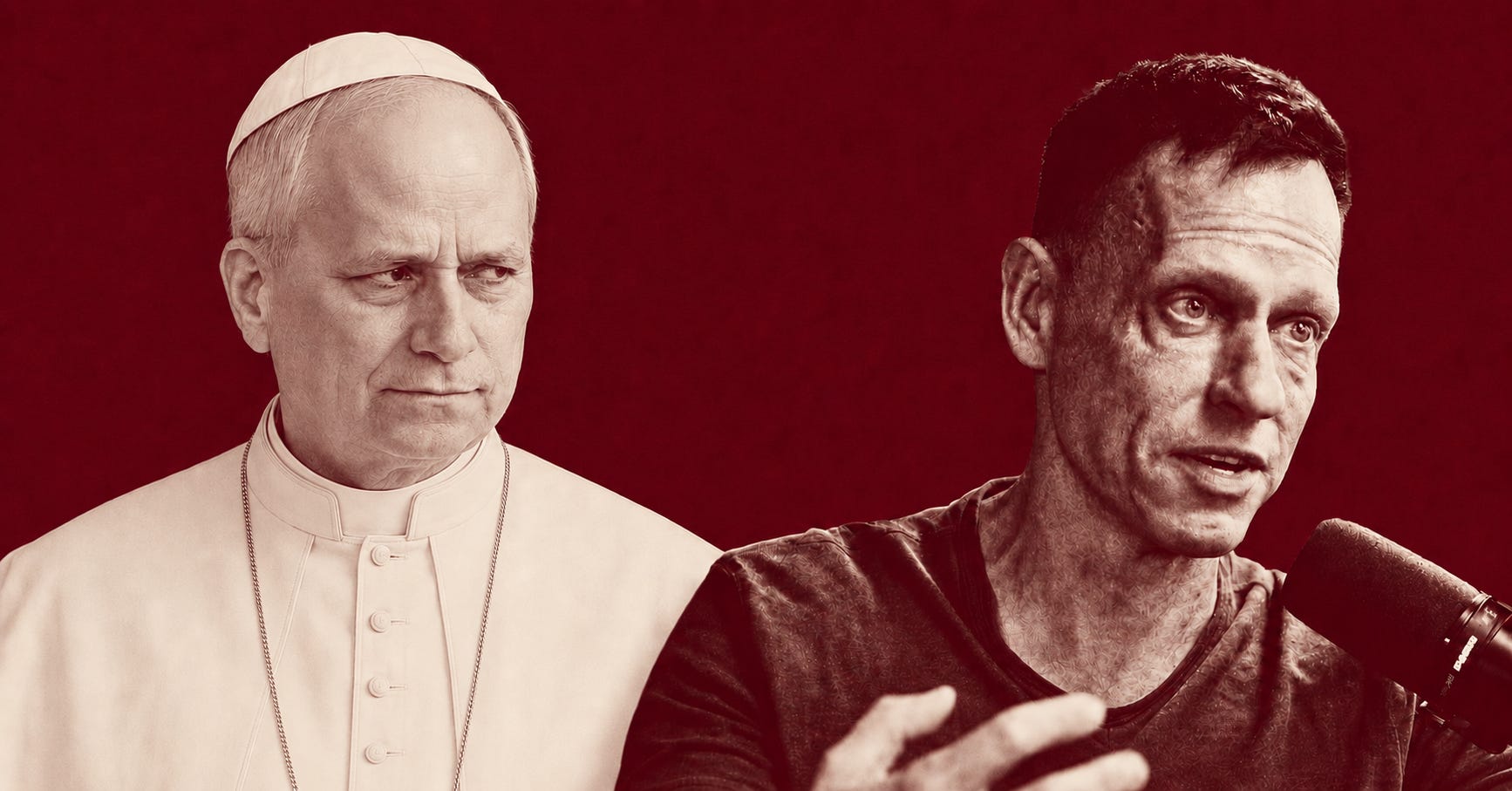
Peter Thiel Accuses Benedict XVI’s Longtime Friend of Being the Antichrist

Benedict hosted Hans Küng at Castel Gandolfo for four hours in 2005 and personally praised the global ethic that Thiel’s new First Things essay treats as the Antichrist’s signature. JD Vance’s benefactor left the dinner out.

Christopher Hale's avatar
Christopher Hale
Jul 17, 2026
∙ Paid

Thank you for reading! Letters from Leo is a reader-supported publication and the fastest-growing Catholic community in the country. To receive new posts and support this movement, consider becoming a free or paid subscriber.

Make A One-Time Gift to Support My Work

Peter Thiel has a new suspect.

Having already name-checked Pope Leo XIV, Pope Francis, and the climate activist Greta Thunberg for the dishonor, the Palantir co-founder has settled on a Swiss theologian who has been dead for five years.

The essay ran this week in First Things, the conservative religion journal, under the title “The Pope and the Antichrist.” Thiel wrote it with Sam Wolfe, a researcher at Thiel Capital.

Together they build toward a question that would have been unprintable in respectable Catholic circles a generation ago: “Did Benedict believe Pope Francis to be the Antichrist?”

Thiel calls the theory “tempting” before setting it aside. Benedict XVI, he argues, suspected somebody else — Hans Küng, the Swiss priest who served as one of the youngest theological experts at the Second Vatican Council and spent the last four decades of his life urging the world’s religions to talk to one another.

Küng died in 2021. His offense, in Thiel’s reconstruction, was preaching peace.

Hans Küng, celebrated and controversial Swiss theologian, has died |  National Catholic Reporter
Hans Küng, the Swiss theologian who served as one of the youngest experts at the Second Vatican Council. Küng died in Tübingen, Germany, in 2021 at 93. Peter Thiel’s new essay argues that Benedict XVI suspected him of being the Antichrist.

What the essay actually argues

The piece deserves to be read closely, because its architecture is stranger than the headlines suggest.

Thiel opens in a register of injured innocence. His invitation-only lectures on the Antichrist in Rome this spring drew paparazzi to a venue he calls “notionally secret,” and one Italian priest wondered publicly whether he should be burned at the stake. He assures readers he “did not come to Rome to try to be more Catholic than the pope,” though he did hope, “even as a Protestant, to be more Catholic than the average Catholic.”

From there the essay becomes an extended reading of Joseph Ratzinger — and a claim about what Ratzinger secretly believed.

“Benedict believed he was living in the end times,” Thiel writes. The evidence he assembles is real, and it is thinner than the claim requires.

He cites Ratzinger’s 1957 dissertation on Bonaventure and the apocalyptic prophecies of Joachim of Fiore, a 1969 radio address predicting a Church that would “become small and will have to start afresh more or less from the beginning,” and the 1988 Erasmus Lecture in Manhattan, which opened by invoking Vladimir Solovyov’s Antichrist.

Pope Benedict XVI's life in pictures - Catholic Courier
Joseph Ratzinger, the future Pope Benedict XVI, as a young theologian. His 1957 dissertation on Bonaventure’s theology of history is the text Thiel reads as evidence that Benedict privately believed the world was ending.

Then the later material: Cardinal Giacomo Biffi’s 2007 Lenten meditations on Solovyov, delivered at Benedict’s own request; a passage in Spe Salvi quoting Kant on the Antichrist; a 2015 letter to the Slovak politician Vladimír Palko warning that “the power of the Antichrist is expanding”; and a 2018 interview in which Benedict declined to deny his biographer’s suggestion that the resignation had been “a wake-up call for eschatological awareness.”

Notice the method. Thiel’s case rests almost entirely on what Benedict did not say. The pope “chose not to speak openly.” He “left us clues.” He “ventriloquized.” He dropped “one more breadcrumb.” He communicated “not only when he spoke ex cathedra, but when he spoke sotto voce.”

An argument built this way cannot lose. Every silence becomes confirmation, and a man who says nothing about the apocalypse for fifty years is revealed, on this reading, as its most careful prophet.

Then comes the turn. Thiel raises Pope Francis as an Antichrist candidate by way of Joachim of Fiore, who taught that the Antichrist would take the papacy directly after a virtuous pope who abdicated. Benedict resigned at eighty-five, as Celestine V had; Boniface VIII followed Celestine and drew the Joachimite accusation. Benedict laid his pallium on Celestine’s tomb in 2009. Thiel lets the syllogism assemble itself, then steps back: “Tempting as this theory is, Benedict suspected somebody else.”

That somebody is Küng, and the chain runs through Solovyov by way of the German philosopher Robert Spaemann. Solovyov’s Antichrist is a liberal theologian with a Tübingen degree whose bestseller promises universal peace. Spaemann attacked Küng’s Weltethos — his global ethic — in a 1996 essay Thiel quotes at length.

Küng taught at Tübingen. Küng’s formula held that there is no peace among nations without peace among religions, and none among religions without dialogue. St. Paul warned that the day of the Lord arrives while men cry “peace and safety.”

Lay those texts side by side, Thiel suggests, and the theologian of dialogue starts to look like the devil’s herald. “Nothing would have surprised Ratzinger and Spaemann less,” he writes, “than to learn that the Antichrist had appeared as a fellow academic like Küng.”

The closing line tells you where he believes history is headed: “The apocalypse, the revelation of all secrets and the end of all interpretations, arrives eventually.”

Massimo Faggioli, the Villanova University church historian, read it and called it “extreme.” “He truly believes that we are in the end times,” Faggioli told the National Catholic Reporter. Thiel, in Faggioli’s reading, “is saying that he believes that this is a time for war, not for peace.”

Küng and Benedict were friends

Here the essay stops being provocative and starts being false.

Thiel describes “Benedict’s quiet war against Küng, which began in the 1960s at Tübingen.” In the 1960s, Küng gave Joseph Ratzinger his career.

It was Küng who brought Ratzinger to Tübingen in 1966, luring him away from a post at Münster, as John L. Allen Jr. documented in his 2005 account for the National Catholic Reporter.

The two men served together as periti — theological experts — at the Second Vatican Council, where both belonged to the progressive majority. They co-edited a journal and kept a standing dinner appointment every Thursday evening to argue about it. Cardinal Giovanni Battista Montini, who would close the council as Pope Paul VI, singled out the two of them as the young theologians the Catholic world would be hearing from.

The rupture came later, over Infallible? in 1970 and the revocation of Küng’s license to teach Catholic theology in 1979. It was real, it was bitter, and it lasted decades. Küng once compared Ratzinger to the head of the KGB. Ratzinger wrote that Küng’s theology “leads nowhere.” None of that is in dispute.

Hans Küng, left, and Joseph Ratzinger. Küng brought Ratzinger to the University of Tübingen in 1966, and the two served together as theological experts at the Second Vatican Council before breaking over papal infallibility in 1970.

What Thiel leaves out is the ending.

A week after his election in April 2005, Benedict received a letter from Küng asking for a meeting. John Paul II had ignored the same request for twenty-six years. Benedict answered within days and offered Castel Gandolfo, his summer residence, because Küng had suggested a setting that would feel less formal.

They met at Castel Gandolfo on Sept. 24, 2005, and talked for four hours over dinner.

They found agreement, Küng told Allen afterward, on social policy, on the relationship between faith and reason, on science and religion — and on “the need for Christianity to collaborate with other world religions in building what Küng has termed a ‘global ethic.’” They reminisced about Tübingen. Küng called the evening “very joyful,” with “no reproaches, no polemics.” He did not ask for his license back.

“It’s clear that we have different positions,” Küng said. “But the things we have in common are more fundamental. We are both Christians, both priests in service of the church, and we have great personal respect for one another.”

Two days later the Vatican Press Office issued a communiqué, and Vatican News still carries the text. The meeting had taken place “in a friendly atmosphere.” Both men agreed there was no point relitigating the “persistent doctrinal questions” between Küng and the magisterium.

The conversation had centered instead on two subjects of “particular interest for the work of Hans Küng: the question of Weltethos (world ethics), and the dialogue between the reason of the natural sciences and the reason of the Christian faith.”

Then comes the sentence that should end this debate permanently.

Benedict XVI, the communiqué records, expressed his appreciation of “Professor Küng’s effort to contribute to a renewed recognition of the essential moral values of humanity through the dialogue of religions and in the encounter with secular reason,” and stressed “that the commitment to a renewed awareness of the values that sustain human life is also an important objective of his Pontificate.”

An important objective of his pontificate. Joaquín Navarro-Valls, the papal spokesman, said the same thing to reporters that weekend. And Küng told Allen that Benedict had drafted the statement personally and shown it to him for approval before it went out.

Read that against Thiel’s essay. The project Thiel identifies as the Antichrist’s calling card is the one Benedict XVI called an important objective of his own pontificate, in a text he wrote himself, in his third year as pope. He had already praised Küng’s work fostering dialogue among religions in his 1997 memoir, Milestones. He praised it again to Küng’s face over dinner, and then put it in writing.

So what is the theory here, exactly? That Benedict XVI hosted the Antichrist at Castel Gandolfo for four hours, reminisced with him about Tübingen, commended his life’s work in a papal communiqué he drafted by hand, handed it to him for proofreading — and did all of that for fun?

Thiel’s thesis requires Benedict to have spent his last years hinting that Hans Küng was the eschatological enemy of Christ. Benedict spent those years telling anyone who asked that Küng was a fellow priest he respected and that the global ethic was worth building. There is no hidden text to decode here. The pope said what he thought, out loud, in a statement he wrote by hand.

Küng, for his part, greeted Ratzinger’s election by calling it “an enormous disappointment” and then adding: “The papacy is such a challenge that it can change anyone. Let us therefore give him a chance.”

That is not the Antichrist. That is an old man extending grace to a rival.

The disease that has a name

There is a name for what is happening in this essay, and it isn’t just heresy.

Scientists call it Nobel disease — the tendency of laureates to take the authority earned in one narrow field and spend it recklessly in every other, until the man who cracked the structure of DNA is lecturing the world on race and the inventor of PCR is writing about astrology. The broader term is ultracrepidarianism, from the cobbler in Pliny who kept critiquing the painting above the sandal. Its distinguishing symptom is not stupidity. It is the conviction that having been right once, spectacularly, about one thing means the same instrument will work on everything else.

Peter Thiel was right about payments in 1998. He was right about Facebook in 2004. He wrote a diagnosis of why young Americans have soured on capitalism that was sharper than anything his peers managed. I have never disputed his intelligence, and I am not disputing it now.

He is not a theologian. He has read Solovyov and Girard and Ratzinger with real attention and no supervision, and he has arrived where autodidacts with unlimited money and no peers reliably arrive: at a private system that explains everything, in which the people who disagree with him are not merely mistaken but cosmically implicated.

Notice who keeps turning up on Thiel’s list of the Antichrist’s legionnaires. Regulators. Environmentalists. International agencies. Greta Thunberg. Anyone urging caution about artificial intelligence. Now a dead theologian who wanted religions to stop killing each other, and two popes who asked whether the technology might be pointed at human beings.

The Antichrist, in Peter Thiel’s theology, is always the person telling Peter Thiel no.

David Gibson, who directs Fordham’s Center on Religion and Culture, put it to NCR plainly. Thiel’s comparison of the pope to a Chinese agent reveals how Thiel “feels about anyone who would dare to set any limits on what Peter Thiel wants.”

What he told the vice president

None of this would matter much if Thiel were an eccentric with a lecture circuit. He is the man who made JD Vance and is his top backer for his likely 2028 presidential bid.

Here’s the backstory.

User's avatar

Continue reading this post for free, courtesy of Christopher Hale.

Or purchase a paid subscription.
© 2026 Christopher Hale · Privacy ∙ Terms ∙ Collection notice
Start your SubstackGet the app
Substack is the home for great culture