
Pope Leo: “Christians Have No Enemies — Only Brothers and Sisters”
Pope Leo proclaims that love and forgiveness — not force — must light the path forward. He ties the first martyr’s witness to today’s conflicts, insisting that joyful mercy is mightier than weapons.
Thank you for reading! Letters from Leo is a reader-supported publication. If you find value in my work, please consider becoming a paid subscriber or making a one-time donation.
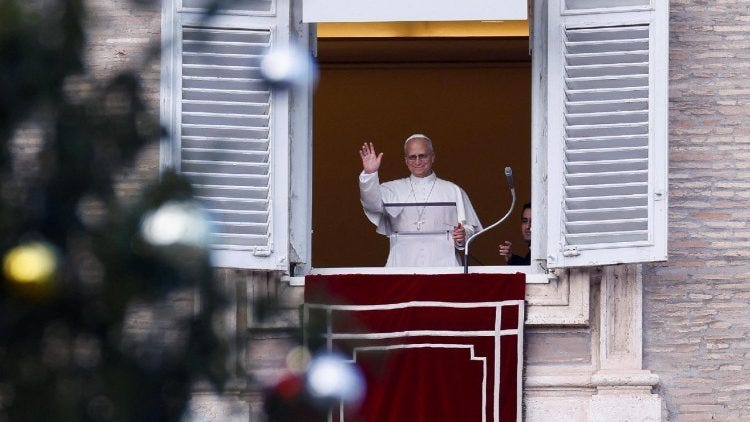
Under a bright Roman winter sky, Pope Leo XIV appeared at the Apostolic Palace window on December 26 to continue a cherished papal tradition: the Feast of St. Stephen Angelus.
With pilgrims packing St. Peter’s Square the day after Christmas, Leo reflected on the Church’s first martyr and the meaning of true Christian discipleship.
“Christians have no enemies, but brothers and sisters, who remain so even when they do not understand each other,” the pope declared in his Angelus message.
In the very season that celebrates God coming as a child, Leo urged believers to recognize the God-given dignity of every person — including those we might be tempted to see as adversaries.
Saint Stephen, whose “face was like the face of an angel” even as he was being killed, shows what it means to respond to hatred with love. His witness, Leo said, reminds us that we are “not born just once” but born ultimately for heaven.
Pope Leo acknowledged that walking the “unarmed path of Jesus and the martyrs” can seem naive or even draw scorn in a world obsessed with power.
From the beginning, the beauty of Christ’s way has “threatened those who struggle for power,” the pope noted.
Stephen’s Gospel-inspired challenge exposed injustice in Jerusalem, just as living the Beatitudes today can unsettle the powerful. Yet Leo XIV insisted that no worldly force — no tyrant, army, or ideology — can ever truly defeat the work of God.
Even in an era of uncertainty and suffering, Leo argued Christian joy stubbornly survives.
Hope sprouts, he said, and “it makes sense to celebrate despite everything.”
This defiant joy is not a denial of reality, but a trust that God’s light still shines in the darkness of our times.
That theme reverberates through Pope Leo’s Christmas messages this year. Just one day before, in his Urbi et Orbi address, Leo turned the world’s gaze to those enduring the darkest of nights.
He reminded everyone that Jesus chose to identify with the suffering: “with those who have nothing left and have lost everything, like the inhabitants of Gaza; with those who are prey to hunger and poverty, like the Yemeni people; with those who are fleeing their homeland… like the many refugees and migrants who cross the Mediterranean or traverse the American continent.”
And from the loggia of St. Peter’s, Pope Leo offered a Christmas prayer for today’s martyrs of violence — including “the tormented people of Ukraine,” for whom he begged an end to the “clamor of weapons.”
In a world still scarred by war and injustice, Leo XIV is amplifying the voice of the voiceless. He has not hesitated to spotlight civilian suffering in Gaza and the plight of migrants at the U.S. border this Christmas season, urging that responsibility and compassion guide our response.
Pope Leo XIV Condemns Treatment of US-Bound Migrants in First Christmas Urbi et Orbi
Thank you for reading! Letters from Leo is a reader-supported publication. If you find value in my work, please consider becoming a paid subscriber or making a one-time donation.
At the Angelus, Pope Leo drew these global sorrows into the light of Stephen’s example.
The birth of Christ in Bethlehem — “the Son of God among us” — empowers ordinary people to live as peacemakers, he said.
Even as conflict rages and injustices multiply, the Pope pointed to the “tenacity” of those who persevere in fraternity and nonviolence.
He praised those who “put peace before their fears” and serve others at great personal cost.
Such courageous love, Leo affirmed, is a “force more real than that of weapons” — a gratuitous force that weapons can never defeat. We saw that power in St. Stephen forgiving his killers, just as we see it when Christians today refuse to answer evil with evil.
Pope Leo’s message cuts against the grain of our polarized age. It’s striking that he explicitly said Christians “have no enemies.”
In a time when many fall into us-vs-them mindsets, the Pope is calling the faithful to a radically different mindset:
Everyone is a neighbor, even those who oppose us. Leo knows well that this commitment to universal brotherhood is counter-cultural. Indeed, he noted that peacemakers are often “ridiculed, excluded… and accused of favoring adversaries” by both secular powers and even some fellow Christians.
But the pope refuses to accept that cynicism. He insists that, through Christ, we can see even our “enemies” as family. This belief isn’t mere optimism; it’s rooted in the truth of Christmas. “The birth of the Son of God among us calls us to live as children of God,” Leo said, imitating Jesus in humility and forgiveness.
As he concluded the Angelus, Pope Leo practiced what he preached by leading the crowd in prayer. He renewed his Christmas wishes “for peace and serenity” in the world’s trouble spots and asked for St. Stephen’s intercession “for the communities that suffer most for their Christian witness.”
Pope Leo XIV’s Feast of St. Stephen Angelus is a timely reminder that the joy of Christmas demands something brave of us. It calls us to reject the cycle of enmity and retaliation, and to choose the harder road of mercy. Leo’s voice has been bold this Christmas season — from denouncing the “falsehoods” that fuel wars, to urging hospitality for migrants, to pleading for peace in the Holy Land.
But nowhere is his message more distilled than in this Angelus reflection. The pope is, in essence, echoing St. Stephen’s last words and Jesus’s own: Father, forgive them. He is telling the world that there is another way.
When Christians truly believe they have no enemies, when they greet hostility with the “face of an angel” and a heart of forgiveness, hope is reborn in history. This is how light breaks into the darkest places — not through hatred or revenge, but through the persistent, daring grace of Christmas.
The past few weeks all paid subscribers received the Letters from Leo Advent Reflection Series — a daily companion to prepare for the coming of Christ at Christmas, and to reckon with what his arrival demands in a nation veering toward fascism.
As a gift of gratitude to you and those you love, yesterday’s Christmas Day reflection is available to all readers.
What Christmas Teaches Us When the World Falls Apart
This year exposed the depth of our darkness. Christmas reveals where light dares to enter.
If you have been edified by our Advent reflection series and all our work here at Letters from Leo, I’m humbly asking for your support.
If you’d like to invest in our mission during this sacred season, here are three ways you can help:
Subscribe as a paid member to receive exclusive posts about the life and formation of Pope Leo and help sustain this newsletter.
Donate with a one-time gift to fuel this project’s mission.
Share this post (and Letters from Leo) with a friend who might enjoy it.
Thank you for reading.
I wish you and those you a love a Merry Christmas!


Pope Leo is shines a bright light in the darkness of the world today.
I just finished watching “It is a Wonderful Life” again. I watch it every year, and it always fills me with gratitude and love. In the end, my eyes fill tears of joy because it really is a wonderful life.
Merry Christmas!Christopher.
St. Luke, the traditionally ascribed author of the Gospel of Luke and the Acts of the Apostles, frames the martyrdom of Stephen (Acts 6–7) with theological, literary, and pastoral aims that reflect his broader concerns: the continuity of God’s saving work, the vindication of the Gospel amid opposition, and the model of faithful witness.
Though Luke does not recount Stephen’s death in the Gospel, his detailed treatment in Acts turns the episode into a hinge that both explains and propels the early church’s mission.
Luke places Stephen’s death at a decisive moment in the narrative of Acts. The stoning concludes the first phase of the Jerusalem church’s internal life and becomes the immediate cause of the scattering that sends believers into Judea and Samaria (Acts 8:1–4). Luke deliberately shows persecution not as the end of the church but as the providential catalyst for its expansion: human violence unwittingly advances God’s purpose for universal witness. In this way, suffering assumes a theological function within Luke’s account—a means by which the gospel moves beyond its Jerusalem origins into the world.
Stephen himself embodies several complementary roles within Luke’s design. As one of the seven chosen to serve the Hellenistic widows (Acts 6:1–6), he stands as a representative of the Gentile or Hellenistic faction within the Jerusalem community, showing that the Spirit works through leaders from diverse backgrounds. He functions prophetically: his long speech in Acts 7 is a sweeping, selective retelling of Israel’s history—from Abraham and Joseph through Moses and David—that highlights a recurring pattern: God’s call and presence often appear outside established cultic centers, and God’s messengers are frequently resisted by the authorities. By recasting Israel’s story in this way Stephen becomes the prophetic voice that indicts his listeners precisely by invoking the past.
Luke also frames Stephen as a Christlike sufferer. The vision in which he sees “the heavens opened” and Jesus standing at the right hand of God (Acts 7:55–56) resonates with Lukan and early Christian motifs of the exalted Christ and divine vindication. The detail that Jesus is “standing” rather than “sitting” suggests active advocacy and immediate welcome; it underscores the conviction that divine justice will vindicate Stephen even as he is rejected by human courts. Like Jesus at his passion, Stephen prays for his persecutors as he dies (Acts 7:60), commits his spirit into the hands of God, and experiences mockery of the temple and law alongside a revelation of God’s presence. Martyrdom thus becomes the ultimate imitation of Christ and the fullest form of discipleship in Luke’s theology.
Stephen’s speech itself is the theological centerpiece of the episode. His selective retelling of Israel’s history is not a neutral chronicle but an argument: it charges his contemporaries with repeating the recurrent sin of resisting God’s messengers. By emphasizing episodes in which God acts apart from the temple—calling Abraham in Mesopotamia, revealing himself to Moses in the wilderness, raising up leaders outside the court of the established priesthood—Stephen undermines any theology that confines God’s presence to a single cultic center.
His rhetorical charge that the Sanhedrin are “stiff-necked” and resistant to the Holy Spirit (Acts 7:51–53) links his own rejection to Israel’s historical pattern of rejecting prophets. The speech culminates in the vision of Jesus at God’s right hand, a final affirmation that divine vindication transcends human judgment.
Several distinctive Lukan theological concerns are highlighted in the story of Stephen. First, Luke develops a theology of persecution as missionary impetus: the scattering caused by Stephen’s death directly results in renewed proclamation beyond Jerusalem. Second, the Holy Spirit’s role is central—Stephen’s wisdom and authority are explicitly ascribed to the Spirit (Acts 6:3–8), so his martyrdom is not simply a human tragedy but a Spirit-enabled witness whose message survives and spreads. Third, by challenging temple-centered religion, Stephen’s indictment prepares readers for a broader understanding of God’s presence—no longer localized in a single building but present in a Spirit-empowered community commissioned for the Gentile mission.
The narrative also serves pastoral and apologetic purposes. For communities facing hostility, Stephen’s courage, clarity, and forgiveness provide a model for faithful endurance. His example instructs believers how to respond to persecution with reasoned witness and prayerful forgiveness rather than with violent retaliation. Apologetically, Luke seeks to explain the church’s rupture with some Jewish authorities without condemning the whole of Judaism: by depicting the fault as the repeated resistance of particular leaders, Luke both grounds Christian claims in Israel’s sacred story and differentiates between the people of Israel and the actions of their rulers.
In Luke’s hands Stephen is more than a tragic victim; he is a paradigmatic witness whose death imitates Christ and inaugurates the outward movement of salvation history that Acts traces. The martyrdom of Stephen encapsulates Luke’s key themes—prophetic continuity, Spirit empowerment, and mission—and demonstrates how God’s purposes are often worked out through human opposition. Stephen’s stoning thus becomes not the final silencing of a faithful servant but the opening scene of a wider, world-transforming proclamation.
Every year I greatly look forward to this feast.