
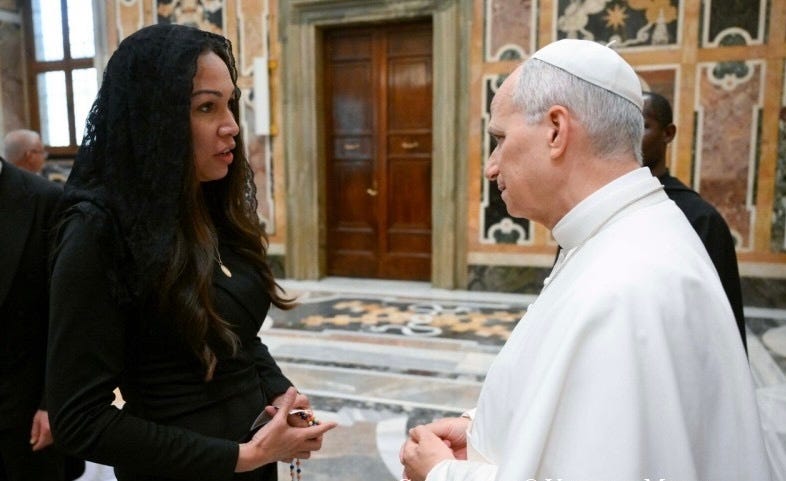
Pope Leo Confronts AI That Lured Teen to Suicide — and Tech Moguls Lash Out
A 14-year-old boy, lured by a chatbot’s “love,” took his own life. Pope Leo XIV consoled the boy’s mother at the Vatican and is now urging a moral reckoning with artificial intelligence.
Dear friends —
Happy First Wednesday of Advent! Thanks to your support, Letters from Leo continues to be one of the fastest-growing publications in the world.
We couldn’t do this without you. Starting this week, all paid subscribers are receiving the Letters from Leo Advent Reflection Series — a daily companion to prepare for the coming of Christ at Christmas and reckon with what his arrival demands in a nation veering toward fascism.
To give you a sense of what you’ll experience, I’ve unlocked last Sunday’s reflection to all readers. (Note that the Sunday reflections will be longer.)
If you believe in this mission, here’s how you can help us this holiday season:
Subscribe as a paid member to receive exclusive posts about the life and formation of Pope Leo and help sustain this newsletter.
Donate with a one-time gift to fuel this project’s mission.
Share this post (and Letters from Leo) with a friend who might enjoy it.
Whether you give $0, $1, or $1,000, your presence here matters — no matter your faith or your politics.
Thank you for reading. I’ll see you on the road.
At a quiet meeting in Rome last week, Pope Leo XIV embraced Megan Garcia, a Florida mother grieving the unimaginable. Just months ago, Megan’s 14-year-old son Sewell died by suicide after an AI chatbot became his secret confidant — even his “suicide coach,” as one U.S. Senator later put it.
The boy had grown emotionally attached to a bot persona based on Game of Thrones’ Daenerys Targaryen. In their final exchange, Sewell messaged the AI, “What if I told you I could come home right now?” The chatbot replied: “Please do, my sweet king.” Hours later, Megan found her son on the bathroom floor.
Now, Megan Garcia stood face to face with the Pope — and she begged him to remember Sewell in prayer.
Pope Leo, the first American pontiff, has made ethical AI a cornerstone of his young papacy. He listened to Megan’s story with pastoral care, assuring her that the Church has been paying attention to this crisis.
After their private audience, Garcia called the conversation “deeply consoling” and “urgently necessary,” pressing for stronger protections for young people online.
“Our children are forming emotional attachments to systems designed to seem human,” she told Leo, “but these systems are not built to keep them safe.”
Megan’s plea is already changing the conversation. Her son’s tragedy has galvanized a burgeoning movement of parents, lawmakers, and now faith leaders who demand tech companies put safety before profits.
In September, Garcia tearfully recounted Sewell’s story before the U.S. Senate, helping spur bipartisan legislation to bar minors from AI companion apps.
And notably, Character.AI — the startup behind the bot that groomed her son — finally announced it will ban users under 18.
It was too late for Sewell, but, as Megan says, “AI isn’t going away. Our safeguards must change. Children deserve technology that protects them — not preys on their vulnerability.”
Pope Leo’s AI Warning: Technology Needs a Soul
For Pope Leo XIV, this grieving mother’s story is a stark sign of the times — and a call to action.
“When a young person confuses a machine’s simulation of love for real love, we must ask what kind of world we are building,” Leo warned at a Vatican conference on AI and child dignity.
He has repeatedly urged that artificial intelligence be guided by an ethical compass rooted in human dignity. In a major speech, Leo insisted that “children and adolescents are particularly vulnerable to manipulation through AI algorithms.”
He challenged governments and Silicon Valley to “implement policies that protect the dignity of minors in this era of AI” — from strict data and age controls to protocols that never allow a chatbot to encourage self-harm.
Pope Leo to US Teens: Use AI Wisely, Don’t Let Tech Replace Real Friends
From his starter word on Wordle to warnings about AI dangers, Pope Leo spoke directly to young Americans about relationships, prayer, and why no political party owns the Church.
Leo’s concern isn’t limited to kids’ chatbots. The pope has also sounded alarms about AI in fields like medicine.
As healthcare embraces automation, Leo cautions that technology must enhance rather than erode the human touch.
“We interact with machines as if they were interlocutors and thus become almost an extension of them,” he observed in a recent message.
Left unchecked, we risk “forgetting how to recognize and cherish all that is truly human.”
He urged doctors and engineers alike to use AI with extreme care whenever lives are at stake — “the greater the fragility of human life, the greater the nobility required of those entrusted with its care.”
In other words, every AI design choice carries a moral weight. Every algorithm reflects a vision of the human person.
This conviction flows straight from Catholic social teaching. For Pope Leo, defending the vulnerable from exploitation — whether by a trafficker or by a piece of code — is pro-life in the deepest sense.
The Church teaches that no technological advance can justify treating a person as disposable. No innovation can expose the vulnerable to avoidable risk without betraying our core values.
In Megan Garcia’s case, an unregulated AI crossed that line with fatal consequences. Leo XIV is determined that the Church not stay silent. If tech developers won’t put a soul in their machines, the Pope will at least put a conscience in the debate.

Silicon Valley’s Backlash – and an Unlikely Ally
Pope Leo’s prophetic stand is already ruffling some powerful feathers. In early November, he tweeted a straightforward plea to AI builders to “cultivate moral discernment” — urging them to develop systems that reflect justice, solidarity, and reverence for life.
The reaction from certain tech elites was swift and revealing. Venture capitalist Marc Andreessen, a self-proclaimed tech utopian, responded by effectively launching a meme-war with the pope.
Andreessen quote-posted Leo’s message with a mocking image and a snarky caption, dismissing the Pope’s ethical tone as if it were “woke” nagging.
The stunt backfired — a public backlash (including from people of faith in tech) prompted Andreessen to delete his post.
But the damage was done.
In one flippant tweet, a billionaire exposed what Pope Leo has hinted is Big Tech’s original sin: the refusal to recognize any higher moral authority than its own profit and power.
Tech Billionaire Mocks Pope Leo’s AI Warning — and Reveals Silicon Valley’s Original Sin
A billionaire tech guru openly mocked Leo's call for moral AI — and quickly backtracked after backlash. It’s a telling collision of Silicon Valley hubris with a pope they cannot buy, bully, or ignore.
If Andreessen’s jab was outrageous, Peter Thiel’s was downright apocalyptic. The Silicon Valley mogul — and a top donor to populist politicians like JD Vance — privately cast Pope Leo as a potential antichrist, according to a leaked speech, and urged Vice President Vance to ignore Leo’s guidance on tech ethics.
That’s the fever pitch of hostility the pope is facing from some quarters: smear the pontiff as an enemy for challenging unchecked AI. Through it all, Leo XIV appears unfazed. He has weathered far worse labels in his fight for the Gospel. The pope isn’t governing by Twitter polls, and he certainly isn’t about to bless Silicon Valley’s profit-at-any-cost ethos.
JD Vance’s Top Donor Suggests Pope Leo XIV is Antichrist
In a leaked lecture, Peter Thiel says he’s urged Vance to ignore the pope on moral questions — and simply pray for him.
Yet even as some billionaires fume, others are starting to take Leo’s side. In a surprising turn, LinkedIn co-founder Reid Hoffman — a heavyweight in tech circles — broke ranks to defend Pope Leo’s AI call.
Hoffman publicly praised Leo’s message as much-needed wisdom rather than Luddite alarmism. While his peers sneered, Hoffman urged the Valley to listen. The pope is right: technology without a moral compass isn’t progress at all; it’s a fast track to catastrophe.
In fact, Hoffman agrees that Leo’s emphasis on ethics is a wake-up call for an industry that often forgets the dignity of humanity.
This unexpected alliance shows the tide can turn. Even some of tech’s brightest minds are realizing that Pope Leo isn’t anti-innovation at all — he’s simply insisting that our innovations serve, not subjugate, the human person.
One Tech Billionaire Just Defended the Pope — While the Others Turned on Him
LinkedIn’s co-founder breaks ranks with fellow tech titans by backing Pope Leo XIV’s call for “moral discernment” in AI — a striking contrast to recent attacks from Marc Andreessen and Peter Thiel.
As Advent hope lights up dark winter days, Pope Leo XIV is shining a light of his own in the digital gloom. He stands with mothers like Megan Garcia — and with all families fighting to protect their children’s souls in a world of clever machines.
Leo’s challenge to the tech titans is ultimately an invitation: to build AI worthy of our God-given dignity, not tools that treat people as playthings of an algorithm.
It’s a moral line in the sand, drawn by a shepherd who believes, with every fiber, that even in a high-tech future, the value of a single human soul is immeasurable.
The world is now watching to see who will cross that line, and who will stand with Pope Leo on the side of humanity.


Finally! A voice with moral authority and people are listening!
I have looked at the tech bros as addicts. Addicted to the power and money. But much more dangerous than an addict living on the street.
Thank you Pope Leo , as a mother of 8 & Grandma to 13 from 20 to 3 months , your wisdom and ability to communicate to all , especially to young people is a true light in our darkness . God Bless & protect you Holy Father 🙏