
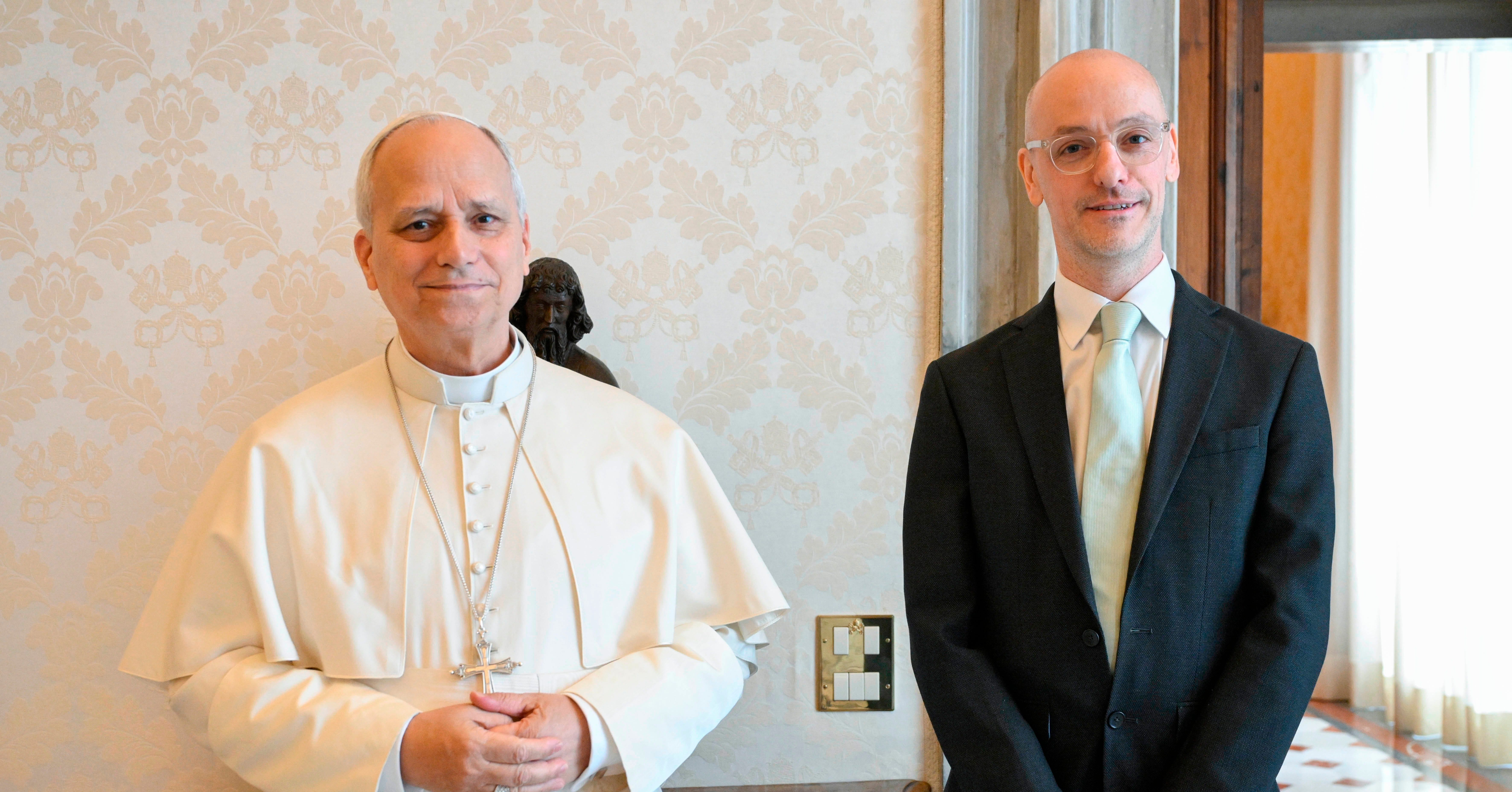
Pope Leo Meets Opus Dei Investigator Gareth Gore in Rare Vatican Audience
The pope sat with the British journalist for over forty minutes in the apostolic library — and Gore asked him to shut the organization down if the evidence warrants it.
Thank you for reading! Letters from Leo is a reader-supported publication. If you find value in my work, please consider becoming a paid subscriber or making a one-time donation.
On Monday, March 16, Pope Leo XIV held a rare private audience in the apostolic library of the Vatican with Gareth Gore, the British investigative journalist whose 2024 book Opus exposed decades of alleged abuse, financial fraud, and institutional cover-up inside one of the Catholic Church’s most powerful organizations.
The Vatican press office confirmed that the pope “wanted to have the meeting to listen first-hand to Gore’s allegations” — an extraordinary statement for a pontiff who meets heads of state and cardinals daily but almost never grants a private audience to a journalist.
Gore wrote about the encounter on his Substack in vivid detail. After presenting himself to the Swiss Guards at the Apostolic Palace and surrendering his phone, he was escorted through ornate rooms to Leo’s private library. The pope opened by congratulating him on the book, calling it “a rigorous piece of work.” Their conversation lasted more than forty minutes.
What Gore described to Leo was harrowing. He laid out how Opus Dei “actively targets young children, how it grooms and manipulates them into a lifelong commitment to serving its interests from the tender age of ten or eleven.”
He told the pope about a Spanish psychiatric facility known internally as “la cuarta planta” — the fourth floor — where members were treated for mental health crises linked to the organization’s practices. He handed Leo a report from Argentine prosecutors documenting human trafficking allegations.
He described the breaking of confession seals, manipulative spiritual direction sessions, financial exploitation, and legal intimidation campaigns waged against journalists and victims who dared to speak.
Gore’s appeals to the pope were direct. He urged Leo to launch an independent inquiry into Opus Dei, to consider closing the organization if the evidence warrants it, to reopen the canonization proceedings for founder Josemaría Escrivá, and to meet directly with survivors.
“It is also possible that he actually wants to do the right thing,” Gore wrote of Leo, “that he wants to hear the truth.”
The journalist added that even if the Vatican ultimately fails to act, the meeting itself creates a public record ensuring Church authorities can never again claim ignorance of these allegations.
The Larger Story
Today’s audience did not happen in a vacuum.
It arrives against the backdrop of months of reporting — from InfoVaticana, from Gore himself, and from Letters from Leo’s reporting last October on the Vatican’s plans to restructure the organization — suggesting that Pope Leo intends to effectively shutter the current governance of Opus Dei as we know it.
Last October, InfoVaticana reported that the Vatican was preparing new statutes that would dismantle Opus Dei’s unified structure and divide it into three separate juridical entities: a clerical prelature limited to its ordained priests, a renewed Priestly Society of the Holy Cross for diocesan clergy, and a public association of the faithful for laypeople.
The most consequential provision would strip the prelate of all authority over the laity — a move that, as veteran numeraries privately acknowledged, “changes the very essence of the institution.”
The Vatican framed the proposed reform as a canonical alignment with current doctrine on personal prelatures, consistent with Pope Francis’s 2022 apostolic constitution Ad charisma tuendum.
But the deeper motivation was unmistakable: Rome wanted to prevent Opus Dei from continuing to operate as what critics have long called “a parallel state” within the Church.
Opus Dei has pushed back at every stage. The organization called Gore’s book “littered with twisted facts” in 2024.
Its communications office dismissed the InfoVaticana report as “more of an opinion piece rather than a news article, citing anonymous sources and signed with a pseudonym.”
On Monday, it declined to comment on the pope’s meeting with Gore.
The pattern of silence is telling. Opus Dei’s leadership has operated for decades on the assumption that the institution’s proximity to power — its deep connections in Rome, its alumni in governments from Madrid to Washington, its links to the Heritage Foundation’s Kevin Roberts and Project 2025 — would insulate it from accountability.
Leo’s willingness to sit with Gore for forty minutes in the apostolic library signals that assumption may no longer hold.
What This Means
For the thousands of former Opus Dei members who have described psychological manipulation, coerced vocations, and spiritual abuse — many of whom gathered at a summit last December that the pope himself encouraged — today’s meeting represents something that has been absent for a very long time: the possibility that someone in authority is actually listening.
The Gore audience was not the only signal Leo sent on Monday.
On the same day, the pope addressed the Pontifical Commission for the Protection of Minors, telling its members that preventing abuse “is essential for the life of the Church and for building an authentic culture of care.”
He urged the commission to deepen its study of vulnerability in relation to abuse and to confront the growing threat of technology-facilitated exploitation of children. He stressed that accountability for bishops, religious superiors, and Church leaders “cannot be delegated.”
The juxtaposition is hard to miss. On a single Monday in March, the pope sat privately with the journalist who has done more than anyone to document Opus Dei’s alleged abuses — and then turned to the Vatican’s own safeguarding body to declare that institutional protection of the vulnerable is not optional but constitutive of what it means to be the Church.
This follows Leo’s historic meeting last fall with an organized group of Catholic sex abuse survivors, the first time any pope had done so.
Leo spent decades as a missionary in Peru, where Opus Dei’s influence runs deep and where its former cardinal, Juan Luis Cipriani, was placed under severe restrictions by Pope Francis in 2019 following sexual abuse allegations. The pope knows this terrain. The question has always been whether he would act on what he knows.
Monday’s audience is the clearest sign yet that he will. The work begun under Pope Francis with Ad charisma tuendum — the effort to rein in an organization that has resisted transparency for nearly a century — appears to be accelerating under Leo.
Gore’s reporting, meticulous and unflinching, has given the Vatican something it cannot easily ignore: a documented record of institutional failure that now sits on the pope’s desk.
Catholic teaching holds that every institution in the Church exists to serve human dignity. When an institution instead becomes a vehicle for the exploitation of the vulnerable, the Gospel demands a reckoning.
Pope Leo, who has built his pontificate on the principle that the Church must smell like its sheep, now faces a test of whether that principle extends to the sheep who were harmed by one of the Church’s most elite institutions.
The world is watching. And so are the survivors.
At Letters from Leo, we stand with the survivors of Opus Dei — and with every journalist, advocate, and person of goodwill who believes that the Catholic Church must hold its own institutions accountable, no matter how powerful or well-connected they may be.
In an era when too many in the Church would rather protect reputations than confront the truth, we remain rooted in a faith that refuses to look away from suffering or to excuse the abuse of power in God’s name.
This is the fastest-growing Catholic community in the country because people are hungry for something deeper than institutional defensiveness and clerical self-protection. They want courage. They want honesty. They want a Church that treats the cries of the wounded as sacred.
If you believe that mission matters — Catholics and people of goodwill demanding transparency and justice inside the Church itself — I am asking you to join us.
If you’d like to invest in our mission, here are three ways you can help this Lenten season:
Subscribe as a paid member to receive exclusive posts about the life and formation of Pope Leo and help sustain this newsletter.
Donate with a one-time gift to fuel this project’s mission.
Share this post (and Letters from Leo) with a friend who might enjoy it.
Paid subscribers have access to the Epstein-Bannon Investigation, the exclusive series on Pope Leo’s Life & Formation, the Lenten Reflection Series, and the Q&A mailbag, where you can ask me anything about American politics, Catholicism, Donald Trump, Pope Leo, JD Vance — or my own faith, biography, and life.
Whether you give $0, $1, or $1,000, your presence here matters — no matter your faith or your politics.
Thank you for reading. I’ll see you on the road.


For American readers — of whom I am one — many of us would appreciate seeing Opus Dei connections with Roberts/the Heritage Foundation and Project 2025 spelled out very clearly.
Amorphous allusions are hardly helpful.
I remember OD helping to bring about a lot of famous conversions in DC.