
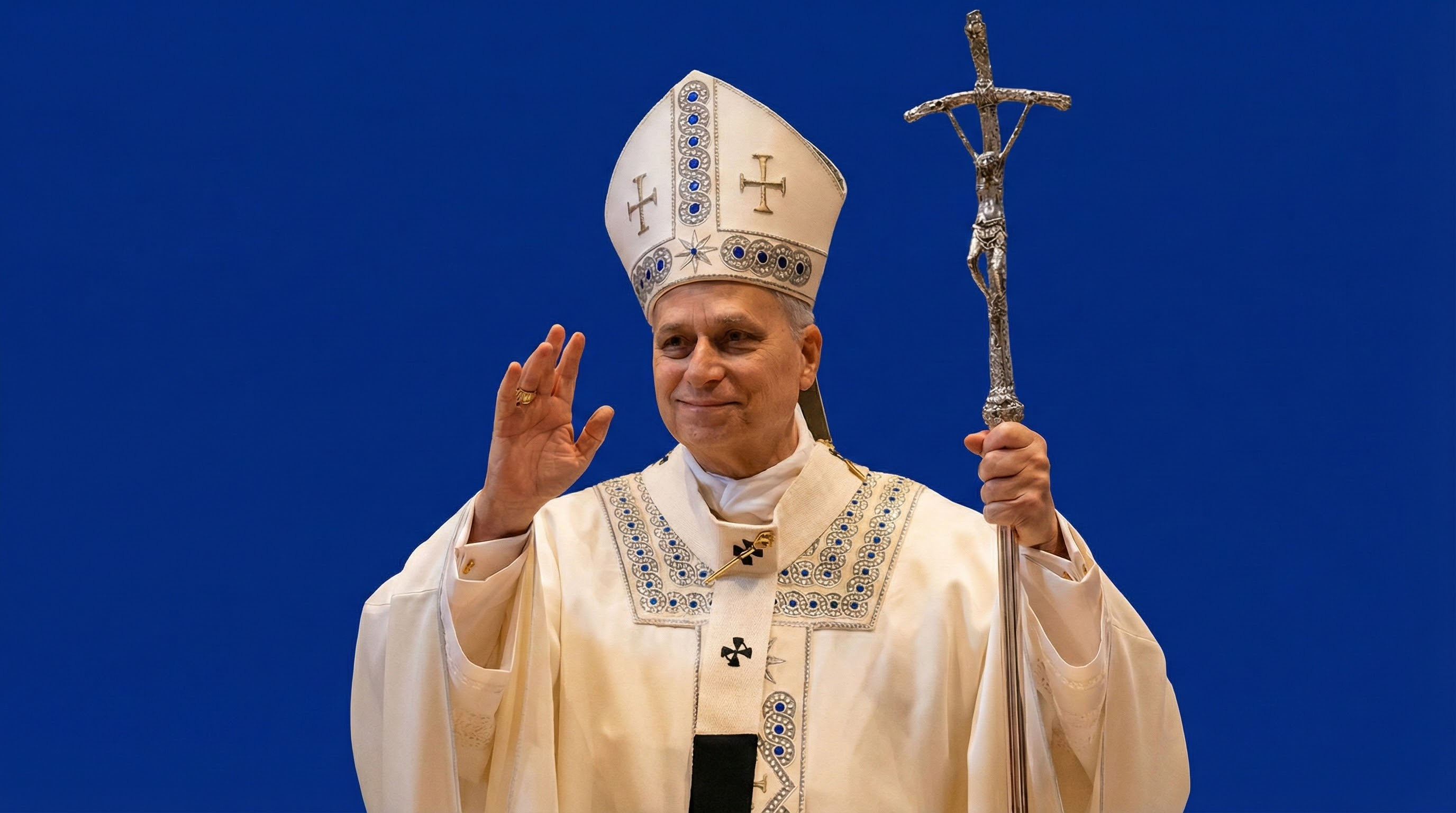
Pope Leo Rejects ‘Armed Peace,’ Calls for Security Rooted in Mercy
On New Year’s Day, Pope Leo XIV urged the world to embrace a peace that rejects violence yet has the power to soften even hardened hearts.
Thank you for reading! Letters from Leo is a reader-supported publication. If you find value in my work, please consider becoming a paid subscriber or making a one-time donation.
Celebrating Mass for the Jan. 1 Solemnity of Mary, Mother of God, Pope Leo said “every day can be the beginning of a new life, thanks to God’s generous love.”
The new year, he explained, is like an open road into the future — a chance for rebirth and freedom from past enslavements.
Mary’s role in Jesus’s birth illustrates this fresh start: by saying yes to God, she brought into the world a Savior who arrives “naked and defenseless” as a child.
God chose to come without force to show that “the world is not saved by sharpening swords” or coercion, but by mercy and forgiveness.
From that daily renewal flows Pope Leo’s New Year call for a peace that is “unarmed and disarming.”
At his Angelus address following Mass, he urged prayers for peace “first, among nations bloodied by conflict and suffering, but also within our homes, in families wounded by violence or pain.”.
In Leo’s view, peace must reach every level of human existence — from the global stage of warring nations to the intimate circle of the family.
He renewed the Church’s long-held conviction that peace is indivisible: a society torn by war cannot be truly at peace, and neither can a household torn by strife.
As St. John Paul II famously taught, “As the family goes, so goes the nation, and so goes the whole world in which we live.”
Pope Leo’s appeal bridges both spheres, insisting that the work of peace begins by healing hearts at home and then radiates outward to heal nations. In a world still scarred by conflicts — from battlefields soaked in blood to living rooms tense with resentment — he issued a challenge to reject violence at its roots.
“Dear friends, with the grace of Christ, let us begin today to build a year of peace, disarming our hearts and refraining from all violence,” Leo urged the crowd in St. Peter’s Square.
The choice of words that Leo has repeated consistently since his May 8 election is striking: disarmament begins in the heart. He echoed the consistent teaching of his predecessors that true peace cannot be imposed by force or secured by weapons stockpiles; it must be sown through conversion, justice, and forgiveness.
Pope Leo’s imagery of an “unarmed” peace draws directly from the Christmas story. God himself came into our world unarmed, Leo noted — “as naked and defenseless as a newborn in a cradle.”
The infant Christ disarms us by pure love, teaching that “the world is not saved by sharpening swords, nor by judging, oppressing or eliminating our brothers and sisters. Rather, it is saved by tirelessly striving to understand, forgive, liberate and welcome everyone, without calculation and without fear.”
This Gospel logic challenges the prevailing cultural assumption that strength is shown by force or retaliation. Instead, Leo lifts up Christ’s vulnerability as the true path to victory over sin and hatred.
Peace, he insists, “is unarmed and disarming” — conquers not by weapons but by moral clarity, dialogue and conversion of heart.
In fact, he warned, a peace built on threats or armed deterrence is a false peace.
“Peace is unarmed and disarming. It is not deterrence but fraternity, not ultimatum but dialogue,” the pope argued in October, rejecting the idea that stockpiling arms or issuing ultimatums can ever secure authentic safety.
Lasting peace, according to Leo, “will not come as a result of victories over the enemy, but as the outcome of sowing justice and courageous forgiveness.”
This radical message directly challenges popular notions of strength and justice. Our politicians glorify the avenging hero and the crushing of one’s enemies. One could argue that’s been the total modus operandi of American politics in the past year.
I Love This Church. I Love This Country. And I Refuse to Give Up on Either.
As we begin 2026, I’m asking you to help build something sturdy enough to stand against cynicism, authoritarianism, and despair.
But Pope Leo, like the saints before him, flips that script: “Have the courage to disarm!” he pleads — beginning with ourselves. “For no idea, faith, or politics can we kill. What must be disarmed, first and foremost, is the heart, because if there is no peace within us, we will not bring peace.”
His words recall his patron St. Augustine’s insight that even those who wage war ultimately seek a distorted peace of their own — “there may be peace without war, but there cannot be war without some kind of peace” sought on selfish terms.
Leo urges us to seek a different kind of peace: Christ’s peace, which upends the cycle of violence altogether.
That means extending forgiveness where others demand vengeance, and pursuing dialogue where the world expects an ultimatum. It means choosing to suffer for what is right rather than to inflict suffering to seem strong.
This “disarming” peace demands immense courage, for it trusts not in the might of arms but in the might of love. It is, as Pope Leo underlined, a peace entrusted to our responsibility — a gift from God that we must choose to cooperate with.
Pope Leo XIV’s New Year homily and Angelus sounded a clarion call: peace is possible, but only if it is built on the conversion of hearts.
He highlighted concrete steps in that direction — “transforming wrongs into forgiveness, pain into consolation, and resolutions of virtue into good works”—echoing Jesus’ own teachings that peace-makers are blessed.
Recalling that 2026 makes the eight hundredth anniversary of St. Francis’s death, he invoked the saint’s famous blessing — “May the Lord lift up his countenance upon you, and give you peace” – as his parting word for the new year.
It was both a benediction and a challenge to live gently in a violent age.
To my surprise, the Advent Reflection Series became one of the most widely read and shared parts of Letters from Leo in 2025.
Many of you wrote to tell me that these reflections helped steady your hearts during a difficult year for our nation — one marked by political division, anxiety, and real moral uncertainty.
Because of that response, I’ve decided to make these reflections a permanent part of this work in 2026.
Beginning this week, I’ll publish a weekly Sunday reflection, rooted in the Mass readings of the day, and written to help us think more clearly about what it means to follow Jesus in the middle of today’s political realities — not by retreating from public life, and not by baptizing any party or ideology, but by letting the Gospel form our conscience, our courage, and our compassion.
These reflections will be available to all paid subscribers, as a small but sincere way of saying thank you for making Letters from Leo possible. The first edition is below.
God Entered History Through a Refugee Family
Christmas is a season that reveals who is saved: the displaced outside our walls and the unwanted inside them.
Letters from Leo is open to anyone who wants to be informed and inspired by our pope — and to turn that inspiration into action that leaves America and the world more just, less cold, and more alive with hope.
If you’d like to invest in our mission during this holiday season, here are three ways you can help:
Subscribe as a paid member to receive exclusive posts about the life and formation of Pope Leo and help sustain this newsletter.
Donate with a one-time gift to fuel this project’s mission.
Share this post (and Letters from Leo) with a friend who might enjoy it.
Whether you give $0, $1, or $1,000, your presence here matters — no matter your faith or your politics.
Thank you for reading. I’ll see you on the road.


May 2026 be filled with forgiveness and disarming mercy that begins with each humans heart and fills the world with peace. 🙏