
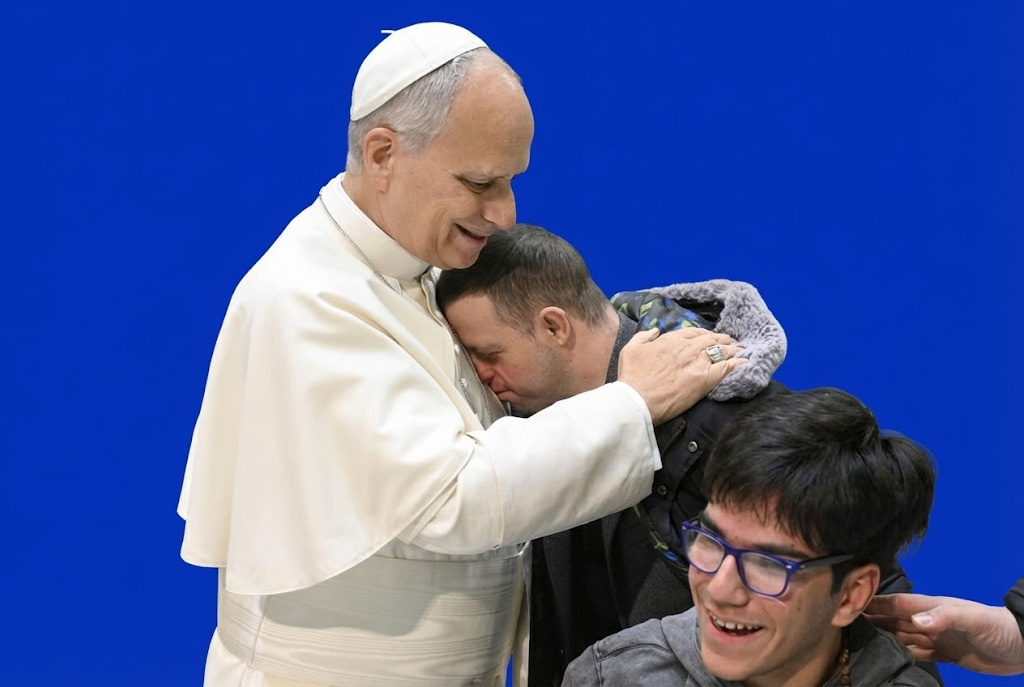
Pope Leo: Vatican II Is the Church’s “Guiding Star” as Cardinals Meet — Latin Mass Hopes Deferred
The new pope isn’t pivoting away from Vatican II. Upsetting traditionalists, Leo XIV launched a catechesis series extolling the Council and convened his first cardinals’ summit to push its reforms.
Thank you for reading! Letters from Leo is a reader-supported publication. If you find value in my work, please consider becoming a paid subscriber or making a one-time donation.
In the span of a few hours on January 7, Pope Leo XIV made his priorities unmistakably clear.
At his Wednesday general audience, the first of the new year, the Pope unveiled a cycle of teachings dedicated entirely to revisiting the Second Vatican Council and its documents. He told pilgrims this was a “precious opportunity” to “rediscover the beauty and importance” of Vatican II — not through “hearsay” or biased commentary, but by studying the Council texts themselves.
Leo emphasized that the Council’s magisterial teaching “still constitutes the guiding star of the Church’s journey today.”
He even cited Saint John Paul II’s famous words calling Vatican II “the great grace bestowed on the Church in the twentieth century,” and echoed Pope Benedict XVI’s insistence that its teachings remain strikingly relevant in our era.
For a Church often divided over the Council’s legacy, Pope Leo’s message was bold: Vatican II is non-negotiable — it’s the roadmap for the future.
The timing was no accident. Just days after closing the Holy Door to conclude the Jubilee Year, Leo effectively launched the agenda of his own pontificate.
That same afternoon, he convened 170 cardinals from around the world for an extraordinary consistory — the first such gathering of his papacy — and used it to reinforce his Vatican II vision.
In an opening address, the pope drew a direct line from the biblical imagery of Epiphany to the Council’s hopes for the Church.
Quoting Lumen Gentium, Vatican II’s constitution on the Church, he reminded the red-hatted prelates that “Christ is the light of the nations,” and that the Church’s mission is to bring Hhs light to all peoples.
Leo then highlighted a favorite theme of his recent predecessors: The Church must grow by attraction, not domination.
Reprising a line from Benedict XVI and later cherished by Pope Francis, Leo noted that the Church “does not engage in proselytism. Instead, she grows by “attraction”: just as Christ ‘draws all to himself’ by the power of his love, so the Church fulfills her mission by imitating the love of her Lord.”
In other words, evangelization flows from a Church that radiates unity, charity, and holiness — all core emphases of the Council. Leo’s point was implicit but pointed: a fragmented, inward-looking Church cannot credibly preach the Gospel.
The extraordinary consistory itself was run in a markedly synodal fashion. Pope Leo had the cardinals break into 20 small working groups — round tables in the Paul VI Audience Hall — much like the sessions of Pope Francis’s Synod on Synodality.
“I am here to listen,” he assured them, stressing that genuine collegial dialogue would help him govern the Church. The cardinals were asked to zero in on two discussion themes out of four that Leo had proposed in advance: the Church’s mission in today’s world; the Roman Curia’s service to local churches; synodality; and the liturgy. By day’s end, the choice was decisive.
Vatican spokesman Matteo Bruni announced that a “vast majority” of the groups voted to focus on mission and synodality, given the limited time available.
In practice, that meant two topics were left on the sidelines — curial reform, and notably, the contentious debate over the Traditional Latin Mass.
This outcome did not go unnoticed.
For weeks, some conservative Catholic circles had been openly lobbying and praying that Pope Leo would use this meeting to reverse or relax his predecessor’s restrictions on the pre-Vatican II Latin Mass.
Pope Francis had severely limited the old rite in 2021’s Traditionis Custodes, citing the need for unity, to the outrage of traditionalist groups, especially in the U.S.
Even Bishop Robert Barron — a prominent conservative in the U.S. — remarked on social media that he “understood that one of the topics” on the consistory agenda was the liturgy, signaling his hope that a resolution to the liturgy wars might be in the offing.
But those hopes were disappointed.
The Latin Mass question never made it to the floor. It wasn’t suppressed by any fiat; rather, it was quietly upstaged by the pope’s preferred priorities.
By choosing evangelization and synodality as their focus, the cardinals, in effect, left the old-rite debate for another day — if it happens at all.
As one Vatican observer noted, critics of Pope Francis had “held out hope that Leo XIV will relax restrictions on the Latin Mass,” but given Leo’s heavy emphasis on church unity and the Council’s reforms, he “might wait and see” before making any such changes.
In the meantime, the extraordinary consistory’s message to traditionalists was clear: no Latin Mass policy reset is on the immediate horizon.
Far from offering an olive branch to those nostalgic for the pre-1960s Church, Pope Leo instead doubled down on the course set by Vatican II and the popes who implemented it.
He affirmed that a “synodal” mode of governance — one of listening, broad consultation, and shared responsibility — is here to stay as the way forward for Catholicism.
For anyone hoping the “synodal Church” would be a short-lived experiment, Leo XIV’s actions speak otherwise.
Eight months into his pontificate, the first American pope is energetically picking up where Francis left off — championing Vatican II as the Church’s guiding star, and trusting that if the Church walks together in unity, Christ’s light will lead the way
Letters from Leo is open to anyone who wants to be informed and inspired by our pope — and to turn that inspiration into action that leaves America and the world more just, less cold, and more alive with hope.
If you’d like to invest in our mission during this new year, here are three ways you can help:
Subscribe as a paid member to receive exclusive posts about the life and formation of Pope Leo and help sustain this newsletter.
Donate with a one-time gift to fuel this project’s mission.
Share this post (and Letters from Leo) with a friend who might enjoy it.
Whether you give $0, $1, or $1,000, your presence here matters — no matter your faith or your politics.
Thank you for reading. I’ll see you on the road.


I am so excited to see the way Leo has done this. He has set the stage for getting broad support for Vatican II’s agenda in the global church. He is out maneuvering the naysayers in the US and getting to the important matters that the church faces.
I pray Pope Leo emphasizes that Vatican II is a continuity of all the previous councils. This is the only way we can bring the fruit of the council fathers. Anti-Vatican II try to negate the council as heresy or unnecessary. However pro-Vatican II speak as though this is the only council that is necessarily relevant to our times.
Both approaches are wrong, Vatican II is a great gift to the church, BUT it must interpreted and understood in continuity of the councils before Vat-II. Or else we live in a church of post 1960s and not the living Church that was, is, and is to come.