


Thank you for reading! Letters from Leo is a reader-supported publication. If you find value in my work, please consider becoming a paid subscriber or making a one-time donation.
Pope Leo XIV brought the year 2025 to a close on Wednesday, Dec. 31, with a striking prayer: that the city of Rome might become a truly welcoming place for foreigners and all fragile people, young and old.
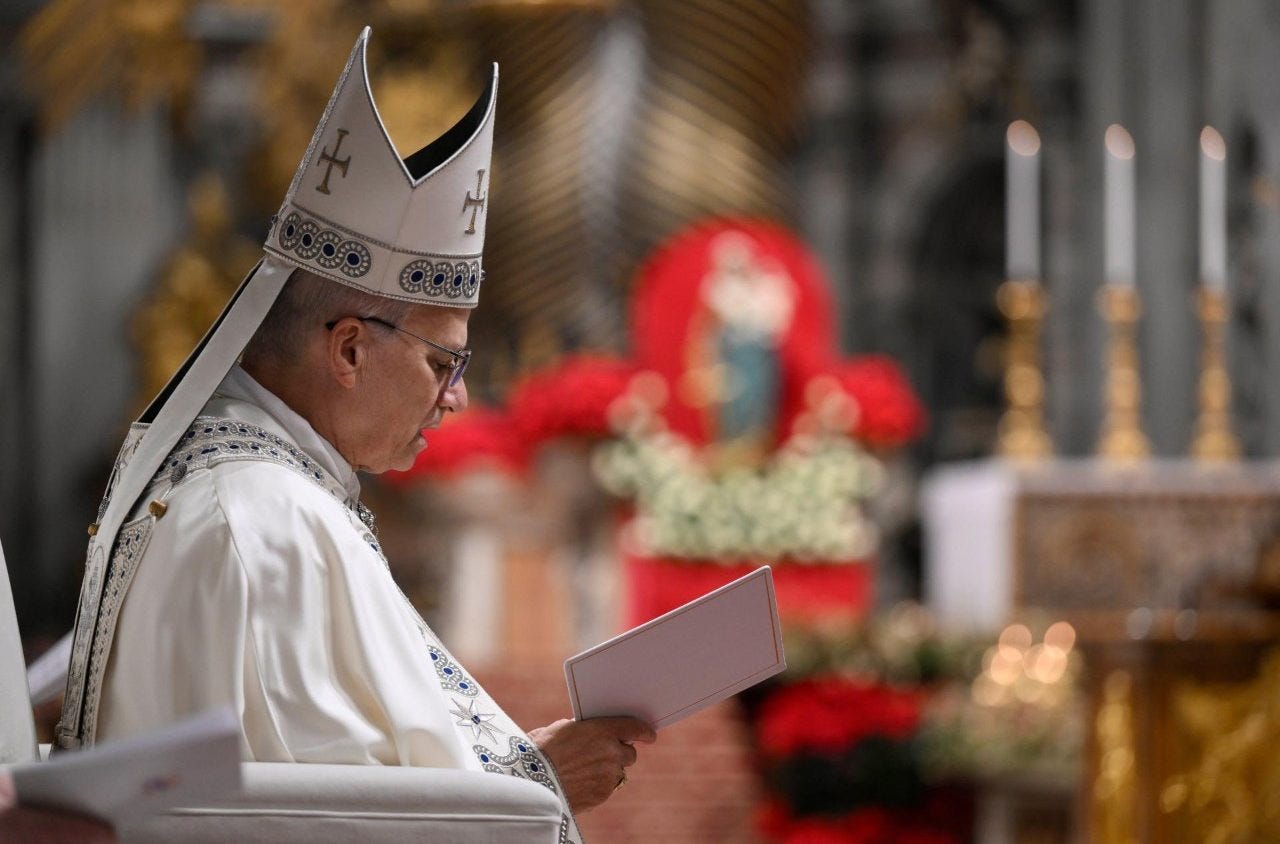
Presiding over a sunset Vespers service in St. Peter’s Basilica, the pope offered thanks for the graces of the Holy Year and directly invoked Rome’s civic leaders. “What can we wish for Rome?” Leo asked aloud.
“That it may be worthy of its little ones — of men and women who have come from afar hoping for a dignified life.”
In the front pews, Rome’s mayor and other dignitaries listened as the pope urged the Eternal City to live up to its legacy of mercy.
This moment unfolded as part of the traditional New Year’s Eve Te Deum service, in which the pontiff leads a hymn of praise and thanksgiving to God for the year’s blessings.
And 2025 had plenty to be thankful for: the Vatican reports that over 3.2 million pilgrims took part in papal liturgies, audiences, and Jubilee events during this Holy Year.
Many of those faithful passed through the Holy Door that Pope Francis opened last Christmas to begin the Jubilee — and Pope Leo, elected in May after Francis’s death, will solemnly close that Door on January 6th, ending the Jubilee of Hope.
Earlier that same day, at his final Wednesday audience of the year, Leo had already set a reflective tone. He invited Catholics worldwide to look back on 2025 with both gratitude and repentance, and to place the coming year in God’s hands.
I Love This Church. I Love This Country. And I Refuse to Give Up on Either.

As we begin 2026, I’m asking you to help build something sturdy enough to stand against cynicism, authoritarianism, and despair.
This “examination of conscience,” as he called it, was the spiritual prelude to the evening’s grand Te Deum. By tying the two events together, Leo signaled that welcoming the outsider and examining our own hearts are inseparable Christian duties.
As he noted, the Te Deum — Latin for “Thee, O God, we praise” — helps believers recognize God’s gifts and renew their hope for the future.
Confronting “Armed” Ideologies and False Religion
If the first part of Leo’s message was a plea for compassion, the second was a fierce challenge to the forces that thwart it.
In his New Year’s Eve homily, the Pope warned that not everyone’s “designs” for the world align with God’s mercy.
He lamented the rise of “strategies aimed at conquering markets, territories and spheres of influence. Armed strategies, cloaked in hypocritical discourse, ideological proclamations, and false religious motives.”
In short, Leo condemned the kind of cynical power-plays that masquerade as noble causes — whether it’s warlords invoking God, politicians exploiting patriotism, or any “weaponized” ideology that tramples the vulnerable.
This was a bold moral indictment delivered in the heart of Christendom, and Leo did not shy away from naming the spiritual antidote. He pointed to Mary, the Mother of God, celebrated on Jan. 1, as the exemplar of humble faith that overturns the mighty.
It’s Mary’s Magnificat vision — the “power of littleness” — that God uses to “scatter the plots of the proud” and “overthrow the mighty,” the pope said, while lifting up the lowly and filling the hungry with good things.
In Leo’s view, history isn’t ultimately shaped by tyrants grasping for power or economies chasing profit; it’s moved by the hopeful witness of ordinary “little ones” cooperating with God’s plan.
By juxtaposing these themes — welcoming the stranger and denouncing violent ideological crusades — Pope Leo XIV closed out his first year as pontiff with a clear moral narrative.
The Gospel, he insists, calls for open doors and open hearts, not walls built out of fear or selfish ambition.
The Jubilee Year has been, in Leo’s words, a “great sign of [God’s] plan of hope for humanity and the world.”
And fittingly, Leo highlighted that Rome itself has a special role in that hopeful plan — not because of imperial glory or worldly power, but because it is sanctified by martyrs and called to be “at the height of its little ones,” a city where the weakest are treasured.
As we enter 2026, Leo XIV’s parting exhortation challenges all of us to make a choice.
Here are the questions at stake:
