
Pope Leo XIV Condemns the “Imperialist Occupation of the World” in Holy Thursday Homilies
In two addresses at the Vatican, the pope invoked Óscar Romero, quoted Pope Francis on the duty of humble love, and called Christians to kneel alongside the oppressed.
Thank you for reading! Letters from Leo is a reader-supported publication. To receive new posts and support my work, consider becoming a free or paid subscriber.
Pope Leo XIV delivered two homilies on Holy Thursday in Rome — one at the morning Chrism Mass in St. Peter’s Basilica, one at the evening Mass of the Lord’s Supper at Saint John Lateran. Together they formed a sustained theological argument about the nature of power, the legacy of imperial violence, and the Christian obligation to kneel alongside the oppressed.
The morning homily addressed priests and bishops renewing their ordination promises. Leo grounded the Christian mission in Jesus’ own words from Isaiah — “He has sent me” — and made clear that this sending binds the Body of Christ “to the poor, to prisoners, to those groping in the dark and to those who are oppressed.”
He turned quickly to the Church’s own historical failures. Citing John Paul II’s acknowledgment that Christians “bear the burden of the errors and faults of those who have gone before us,” Leo drew a direct line between the colonial distortion of mission and today’s political realities. “Neither in the pastoral sphere nor in the social and political spheres can good come from abuse of power,” he said.
Leo then described how the cross itself upends imperial logic. “The imperialist occupation of the world is thus disrupted from within,” he preached. “The violence that until now has been the law is unmasked.” In Leo’s reading of the Passion, Jesus does not accommodate empire. The Messiah descends into the structures of domination and exposes them as fraud. The poor, imprisoned, rejected Christ brings what Leo called “a new creation” — but only by passing through the darkness of death first.
Anyone paying attention to American politics in 2026 will hear in these words a pointed challenge to the Trump administration’s escalating use of executive power against immigrants, dissidents, and the institutions designed to check authoritarian impulse. Leo spoke in the language of the Gospel, but the phrase “abuse of power” carries a concrete resonance when ICE is conducting deadly enforcement operations and the White House treats cruelty as a communications strategy.
Leo was also offering an alternative methodology for engaging the world. Authentic missionaries, he said, bear witness through “quiet, unobtrusive approaches, whose method is the sharing of life, selfless service, the renunciation of any calculated strategy, dialogue and respect.” An ambassador of peace works through encounter, through the slow and patient labor of being present to another human being.
He invoked the martyred Archbishop Óscar Romero, quoting Romero’s journal entry written a month before his assassination: “It is enough for me, to be happy and confident, to know with certainty that in him is my life and my death.” Romero was killed for siding with the poor against the empire that crushed them. By placing Romero at the center of a homily about mission, Leo signaled that the Church’s calling in this century is the same calling that got Romero killed in the last one — solidarity with the oppressed, regardless of cost.
Leo closed the Chrism Mass by calling the faithful to action: “In this dark hour of history, it has pleased God to send us to spread the fragrance of Christ where the stench of death reigns.”
On His Knees at Saint John Lateran
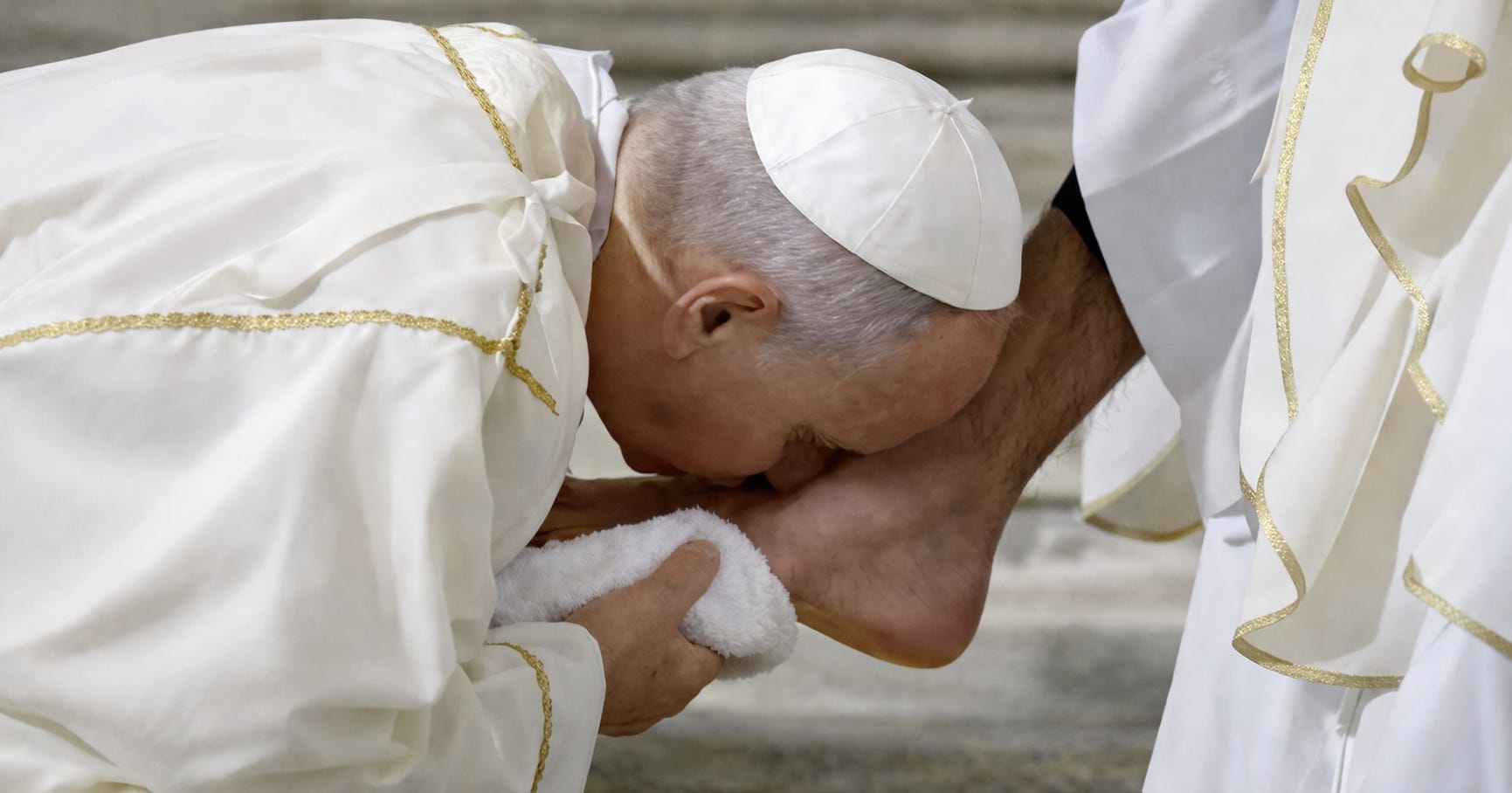
At the evening Mass, Leo shifted registers. The washing of the feet became the occasion for a meditation on what power looks like when God is the one holding the towel.
Leo began by unpacking the significance of timing. “He offers his example not when all are content and devoted to him,” Leo preached, “but on the night he was betrayed, in the darkness of incomprehension and violence.” Christ does not wait for ideal conditions to demonstrate love. He serves in the teeth of abandonment, at the precise moment when loyalty collapses.
From this, Leo drew a conclusion about the nature of divine love that strikes at the heart of how we understand mercy: “The Lord’s love precedes our own goodness or purity; he loves us first, and in that love, he forgives and restores us. His love is not a reward for our acceptance of his mercy; instead, he loves us, and therefore cleanses us, thereby enabling us to respond to his love.”
The implications of this theology run deep. If Christ’s love comes before our worthiness, then every system that conditions dignity on compliance — every deportation policy that says you must earn the right to exist in this country, every political framework that treats human beings as problems to be managed — stands in direct contradiction to the Gospel proclaimed on Holy Thursday.
Leo then turned to his predecessor. “As Pope Francis once remarked,” he said of the foot-washing, “this ‘is a duty which comes from my heart: I love it. I love this and I love to do it because that is what the Lord has taught me to do.’”
Leo was careful to frame this as more than sentiment. Francis, he said, “was not speaking of an abstract imperative, nor of a formal and empty command, but expressing his heartfelt obedience to the charity of Christ, which is both the source and the model of our own charity.” The example Jesus gives, Leo concluded, “cannot be imitated out of convenience, reluctance or hypocrisy, but only out of love.”
There is a thread running through both homilies that deserves attention. In the morning, Leo condemned the “desire for domination, entirely foreign to the way of Jesus Christ.” In the evening, he showed us what replaces domination — the physical act of kneeling, of touching another person’s feet, of doing the work that servants do. The theology of Holy Thursday is embodied theology. You cannot understand it from a lectern. You have to get on the ground.
Leo also addressed the way we misunderstand power itself. “We tend to consider ourselves powerful when we dominate, victorious when we destroy our equals, great when we are feared,” he said. Christ’s answer to that temptation is the basin and the towel — a God on his knees with a towel, washing the feet of men who will abandon him before sunrise.
Near the close of the homily, Leo connected the foot-washing to the ancient narrative of liberation from Egypt. “As humanity is brought to its knees by so many acts of brutality,” he said, “let us too kneel down as brothers and sisters alongside the oppressed. In this way, we seek to follow the Lord’s example, fulfilling what we have heard from the book of Exodus: ‘This day shall be a day of remembrance for you.’”
Leo drew the full arc of salvation history into the room at Saint John Lateran: “Indeed, the whole of biblical history converges in Jesus, the true Passover lamb. In him, the ancient figures find their fulfilment, for Christ the Savior accomplishes the Passover of humanity, opening for all the passage from sin to forgiveness, from death to eternal life: ‘This is my body which is for you. Do this in remembrance of me.’”
This is the theological vision Leo is articulating for the Church in 2026. The Exodus story pulses through every line of his Holy Thursday preaching. Jesus entered an occupied territory, submitted to the violence of empire, and broke its power from within — armed with a basin, a towel, and bread broken for the life of the world.
At a time when American Christians are being asked to bless the machinery of state violence, to accept the surveillance of houses of worship as security, and to mistake cruelty for strength, Pope Leo XIV offered a radically different vision on Holy Thursday. God kneels on Holy Thursday because kneeling is what love looks like when it refuses to be conscripted by power.
The tools of the Christian mission are embarrassingly simple — bread, wine, water, a towel, and the willingness to kneel. Leo’s charge to us on this Holy Thursday is to carry those tools into the dark places — to spread the fragrance of Christ where the stench of death reigns, and to disrupt the imperialist occupation of the world from within.
At Letters from Leo, we stand with Pope Leo XIV and the millions of Catholics around the world who heard in his Holy Thursday homilies an unmistakable call — to kneel alongside the oppressed, to reject the abuse of power in every sphere, and to carry the basin and towel into a world that worships domination.
In a season defined by state violence and moral cowardice, we remain rooted in a faith that sees the washing of feet as the truest expression of God’s power.
The Exodus story is alive. The Passover lamb walks among us. And the Christian mission — humble, unobtrusive, grounded in encounter — is the only force that has ever disrupted empire from within.
This is the fastest-growing Catholic community in the country because people are hungry for a faith that refuses to be conscripted by power.
They want courage rooted in the Gospel, analysis grounded in Catholic social teaching, and a community that takes the words of Pope Leo XIV seriously — even when those words challenge the powerful.
If you believe this movement matters — Catholics and people of goodwill standing for human dignity against the imperialist occupation of the world — I am asking you to join us.
If you’d like to invest in our mission, here are three ways you can help this Holy Week:
Subscribe as a paid member to receive exclusive posts about the life and formation of Pope Leo and help sustain this community.
Donate with a one-time gift to fuel this project’s mission.
Share this post (and Letters from Leo) with a friend who might enjoy it.
Paid subscribers get access to exclusive biographical deep-dives on Pope Leo’s Life & Formation, our ongoing Epstein-Bannon Investigation, and the full archive of the Lenten Reflection Series.
Whether you give $0, $1, or $1,000, your presence here matters — no matter your faith or your politics.
Thank you for reading. I’ll see you on the road.


Thank you, Chris, for this beautiful report on Leo and his homilies.
Thank you so very much. This has to inform all of our actions and our hearts. We must act out of service and love.