
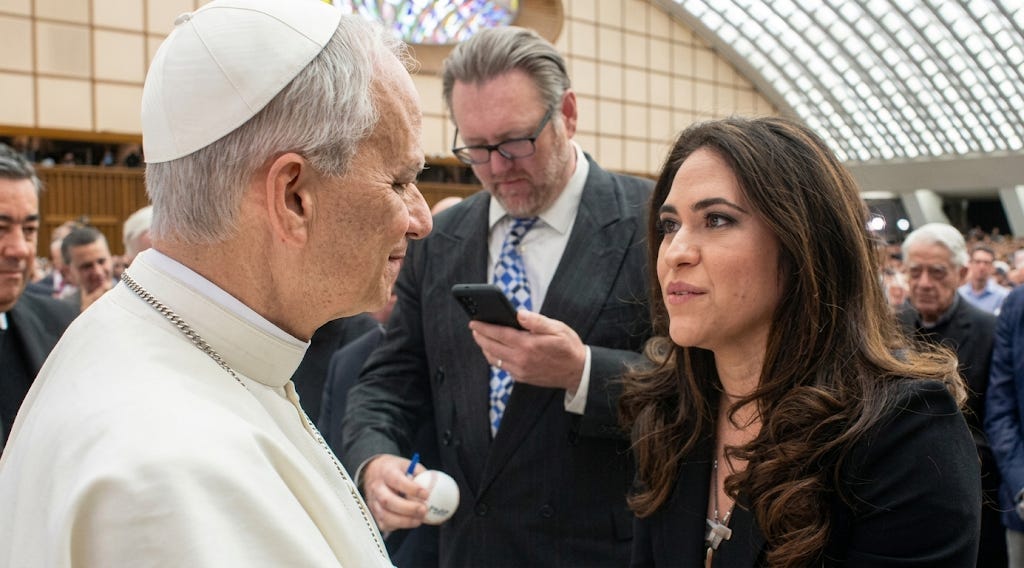
Pope Leo XIV Hands Vatican Communications to the Woman Who Pulled EWTN Back From the Brink
Montse Alvarado is the first laywoman ever to lead the Holy See’s media. She spent three years steering EWTN away from its war with Pope Francis — now she inherits the Vatican’s slow, scattered communications machine.
Thank you for reading! Letters from Leo is a reader-supported publication on Pope Leo XIV, the Catholic Church, and American politics. To receive new essays and support this work, consider becoming a free or paid subscriber.
On Tuesday, Pope Leo XIV named Maria Montserrat Alvarado — a Mexican-American known to nearly everyone as Montse — to lead the Dicastery for Communication.
She becomes the first woman ever to hold the post. When she takes over on November 1, she will oversee every outlet the Holy See runs: the press office, Vatican News, Vatican Radio, L’Osservatore Romano, the publishing house, and the whole apparatus that carries the pope’s voice to the world.
Here is the part that matters most — and the part that will surprise readers of this newsletter who have spent years wary of the network she comes from.
For the last three years, Montse Alvarado ran EWTN News. She spent those years pulling it toward the kind of honest journalism the Church actually needs.
That sentence deserves some explanation, because a lot of you have a long memory when it comes to EWTN, and for good reason.
Founded by Mother Angelica from a garage in Alabama, EWTN grew into the largest Catholic media organization in the world: eleven television channels, programming in multiple languages, more than 400 million households across 160 countries.
For much of the last decade, a loud faction of that programming — led by the commentator Raymond Arroyo — treated Pope Francis as an opponent to be managed rather than a shepherd to be served. Arroyo has continued that shtick into the Leo pontificate.
Francis noticed. In 2021, he told suggested that the network was doing “the work of the devil” in a Catholic outlet that claimed to love the Church while tearing down the man chosen to lead it.
That is the EWTN many of you remember. It is not the EWTN that Montse Alvarado hands off this fall.
Since she took over in 2023, she has worked — in the words of veteran Vatican correspondent Gerard O’Connell — to get the network to overcome its “contradictory positions toward the Vatican.” The change shows up where it counts most, in the bylines.
EWTN’s reporting is increasingly carried by a generation of millennial journalists who are good at the job, devoted to the facts, and faithful to the pope no matter who sits in the chair.
Look at Mark Irons. In February, Irons sat down with Cardinal Timothy Dolan for a long, tough, fair interview on EWTN News In Depth. He pressed the cardinal on JD Vance and drew out an admission on camera: Vance had apologized to Dolan for claiming the bishops support immigrants for the money. I covered that exchange when it aired.
Colm Flynn offers another example. Last week, Flynn interviewed Bishop Robert Barron and pressed him directly on his relationship with Donald Trump and his seat on the administration’s religious liberty commission. I wrote about that conversation just last night. The questions were respectful and relentless, which is precisely what a serious journalist owes a bishop.
The network’s long-form work has been just as strong. Flynn traveled to Buenos Aires to trace the early life of Jorge Mario Bergoglio, the boy who would become Pope Francis, in a documentary I learned a great deal from.
Jonathan Liedl’s hour-long report on Pope Leo’s two decades as a missionary and bishop in Peru taught me more about the Holy Father’s formation than almost anything else I have watched this year.
This is the journalist’s EWTN that Montse Alvarado built. Pope Leo hired the executive who rebuilt that newsroom, and that is the person the Vatican is getting.
And he hired her for a reason that goes well beyond EWTN.
The Vatican’s communications operation needs an overhaul. I say that with real affection for the people who work there, many of them devoted, talented, and trying hard inside a system that fights them. The machine itself is slow, often unresponsive, and at times it blunts the Holy Father’s ability to reach the people he is speaking to.
The clearest, most recent example arrived last week. Pope Leo XIV released his first encyclical, Magnifica Humanitas, a document aimed squarely at Silicon Valley and the moral stakes of artificial intelligence. The text was strong and the design was thoughtful.
The timing made no sense. The Vatican pushed it out at 2:30 in the morning Pacific time on Memorial Day, and I stress Pacific because this encyclical was written with Silicon Valley engineers in mind first.
The Church should not run its communications on an American calendar. But a document built especially for the builders of these machines deserved real thought about how to reach that community, and a holiday dawn when the Valley had logged off was the wrong moment to send it.
Then the Dicastery for Promoting Integral Human Development prepared five genuinely beautiful infographics explaining the encyclical chapter by chapter. You had to dig deep into the Dicastery’s website to find them. I found them by accident.

Below is a video of my attempt to pull these documents up on a phone, which is how more than 80 percent of people reach the Vatican website. Watch the endless pinching and zooming, the sideways scrolling, the taps that land nowhere — a file built for a desktop monitor collapsing into a wall of unreadable type on a screen the size of your palm. The shame of it is what sits on the other side of all that friction. This is some of the most careful thinking the Church has offered on technology and the dignity of the human person, and almost no one will wrestle through a broken mobile experience long enough to read a word of it.
So I spent a few minutes building a cleaner home for all of it — the official Vatican video, the five visual cards, the full English text, and an audiobook, formatted for the phone in your pocket. In the five days since, more than 500,000 people have visited that page.
One person made that in an afternoon. The Vatican has every resource in the world — staff, money, history, the attention of the entire globe — and it can do better than a holiday-weekend, middle-of-the-night release that buries its own best work.

This is exactly why Alvarado’s appointment is encouraging. She is an operations person before she is anything else. She knows how to run a large, multilingual newsroom because she just spent three years doing it, producing content in seven languages across television, print, radio, and digital.
The weakness in Vatican communications has never been faith or effort or talent. It is organization — the discipline to get the right message to the right people at the right hour. That is the gap she has spent her career filling.
Montse Alvarado represents the kind of leadership Vatican communications has needed for a long time. She took over a network at war with the papacy and is handing back one that takes the work of honest journalism seriously.
If she can do for the Holy See what she did for EWTN, the next chapter of this pontificate will finally reach the people it is meant for — clearly, quickly, and in their own languages.
At Letters from Leo, we believe the pope’s voice deserves to be carried clearly and faithfully, by journalists who serve the truth rather than a faction, and by a Church confident enough to tell its own story well.
This is the fastest-growing Catholic community in the country because people are hungry for something steadier than outrage and spin. They are looking for honest reporting, moral clarity, and a faith that meets the moment we are actually living in.
If you believe that work matters — Catholics and people of goodwill standing for human dignity and the integrity of the Church — I am asking you to join us.
If you’d like to invest in our mission, here are three ways you can help at this critical moment:
Subscribe as a paid member to receive exclusive posts about the life and formation of Pope Leo and help sustain this newsletter.
Donate with a one-time gift to fuel this project’s mission.
Share this post (and Letters from Leo) with a friend who might enjoy it.
Paid members make this possible. Your support sustains original reporting, our Epstein-Bannon Investigation, the biographical series on Pope Leo’s life and formation, our continuing coverage of how Pope Leo is taking on AI, and the Sunday Scripture Reflection Series.
Whether you give $0, $5, $50, $500, $1,000, or more, your presence here matters — no matter your faith or your politics.
Thank you for reading. I’ll see you on the road.


Thanks for the backstory regarding the Vatican, EWTN and the new Communications Director. She has a big challenge but production of the materials in recent years has been insightful. I am still very fond of Pope Francis, he was radical and compassionate. Pope Leo is just plain awesome.
Great news. EWTN apparently did some polling which indicated the vast majority of their audience was not college educated and had a tendency to be confused easily. Political operatives from the right exploited this for votes to punish the poor and EWTN was late to understand the irony. Their audience never recovered their high mark and still a place for the angry and confused.