
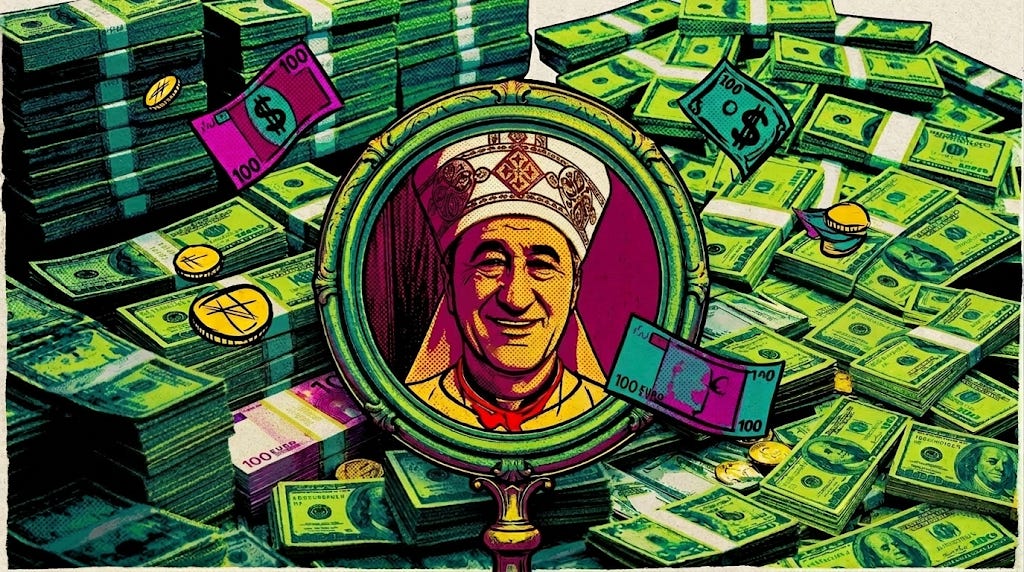
Pope Leo XIV Ousts Bishop Accused of Stealing $270,000 — Then Forces Out the Cardinal Who Tried to Shield Him
Bishop Emanuel Shaleta was arrested fleeing the country with cash in his luggage. Cardinal Louis Sako is gone too — and the timing is not a coincidence.
Thank you for reading! Letters from Leo is a reader-supported publication. To receive new posts and support my work, consider becoming a paid subscriber.
On March 5, law enforcement agents arrested a Catholic bishop at the San Diego International Airport as he prepared to board a flight to Germany. In his luggage: nearly $10,000 in cash — just below the federal reporting threshold. That detail alone tells you something about the planning involved.
The bishop was Emanuel Hana Shaleta, 69, leader of the Chaldean Catholic Eparchy of St. Peter the Apostle, a small but storied Eastern Rite Catholic community of Iraqi Christians spread across the western United States.
The San Diego County Sheriff’s Office charged him with 16 felonies — eight counts of embezzlement, eight counts of money laundering, and an aggravated white collar crime enhancement.
Prosecutors say he pocketed over $270,000 in monthly rental payments from a tenant of the church’s social hall, collecting them in cash and never sending them to the parish. When the discrepancy grew too large to hide, he allegedly wrote checks from a diocesan charity account — money set aside to help the poor — to cover his tracks.
Five days after the arrest, the Vatican announced that Pope Leo XIV had accepted Shaleta’s resignation. What the announcement also revealed: Leo had actually accepted the resignation back in February, quietly, before the arrest, deliberately delaying publication to avoid interfering with the police investigation.
That restraint mattered. It meant the Vatican cooperated with civil authorities rather than racing to manage its own optics. A different kind of pope — or a different kind of institution — might have tried to get ahead of the story. Leo held back so the criminal process could work.
But the story doesn’t end with Shaleta.
In the same Vatican bulletin that announced Shaleta’s removal, the Holy See revealed that Leo had also accepted the resignation of Cardinal Louis Raphael Sako, the 76-year-old patriarch of the global Chaldean Catholic Church, who had led the Church’s Baghdad-based headquarters since 2013.
Sako insisted in a public statement that he resigned of his own free will, that “no one asked me to do so,” and that he wanted to spend his remaining years in “prayer, writing, and simple service.”
That explanation strains credulity, given what The Pillar reported. According to the outlet, Sako knew about the Vatican’s investigation into Shaleta well before it concluded.
After Shaleta submitted his diocesan resignation in late January, Sako began polling Chaldean bishops about transferring him to a senior administrative post at the patriarchate in Baghdad — not removing him from ministry, but moving him to a more prestigious position within Sako’s own sphere.
The Vatican’s Dicastery for Eastern Churches had already received the investigation’s findings in late 2025. Sako knew those findings were serious. He pushed for the transfer anyway.
Whatever one calls that — protection, patronage, institutional self-preservation — it is not justice. And the timing of both resignations appearing in the same Vatican bulletin strongly suggests Leo saw it the same way.
The Chaldean Catholic community deserves particular attention in this story. These are Christians whose families survived the collapse of Iraq, the rise of ISIS, and generations of displacement that have scattered them from Baghdad to Detroit to El Cajon.
The St. Peter Chaldean Catholic Cathedral sits in a working-class suburb east of San Diego, the spiritual home of a community that rebuilt itself in exile. The people who dropped cash in the collection plate — the people whose charity funds Shaleta allegedly raided — are not wealthy.
They are survivors. The alleged theft was not an abstraction. It was a betrayal of people who had already lost almost everything.
Accountability in the Church has historically been slow, opaque, and dependent on who was protecting whom. For years — decades — the operating logic of Catholic leadership was that institutional survival mattered more than truth. The abuse scandals exposed how catastrophically that logic fails the faithful.
Leo is operating from a different set of assumptions.
He moved deliberately on Shaleta: accepting the resignation before the arrest, holding the announcement until civil authorities had their case, naming a temporary administrator. He accepted the findings of the Vatican’s own investigation rather than shelving them.
And when the patriarch of the Chaldean Church attempted to redirect a credibly accused bishop toward a position of greater authority, Leo apparently chose not to permit that outcome either.
None of this means the institutional problem is solved. The priests of Shaleta’s own eparchy released a statement of solidarity with him after his arrest. Shaleta himself told his congregation from the pulpit that he had never “abused any penny of the church money.”
His defense attorney calls the allegations false. The criminal case is still ahead — a preliminary hearing is scheduled for April 27.
But what happened this week was still significant.
Two leaders of the same Eastern Church, gone in the same Vatican bulletin. The pope who replaced them is Robert Prevost, an Augustinian friar who spent decades as a missionary bishop in Peru, who knows what it looks like when a bishop stops serving his people and starts serving himself.
The Chaldean faithful of El Cajon deserved better from their shepherd. Leo XIV, at minimum, appears to have agreed.
At Letters from Leo, we stand with the Chaldean Catholics of El Cajon and every community of faith that has watched its trust violated by the people entrusted to lead it.
The demand for accountability in the Church isn’t a liberal agenda or a conservative one — it flows directly from the Gospel command that those who hold authority must serve, not exploit, the people placed in their care.
At Letters from Leo, we are building something the American Church deserves and needs: a movement of Catholics and people of goodwill who refuse to let fear, cynicism, or power determine what the Church becomes.
This story is exactly why that movement exists.
The people who make it possible are the ones reading right now. This community is the fastest-growing Catholic movement in the country because the hunger for moral clarity — for a faith that acts, not just talks — has never been greater.
If you’d like to invest in our mission, here are three ways you can help this Lenten season:
Subscribe as a paid member to receive exclusive posts about the life and formation of Pope Leo and help sustain this newsletter.
Donate with a one-time gift to fuel this project’s mission.
Share this post (and Letters from Leo) with a friend who might enjoy it.
Paid subscribers get exclusive access to our ongoing biographical series on Pope Leo’s life and formation and the Lenten Reflection Series. Whether you give $0, $1, or $1,000, your presence here matters — no matter your faith or your politics.
Thank you for reading. I’ll see you on the road.


Bravo Pope Leo. Our church needs more decisive ledership. And fewer scandals.
How long til MAGA Bishop Robert Barron gets his comeuppance?