
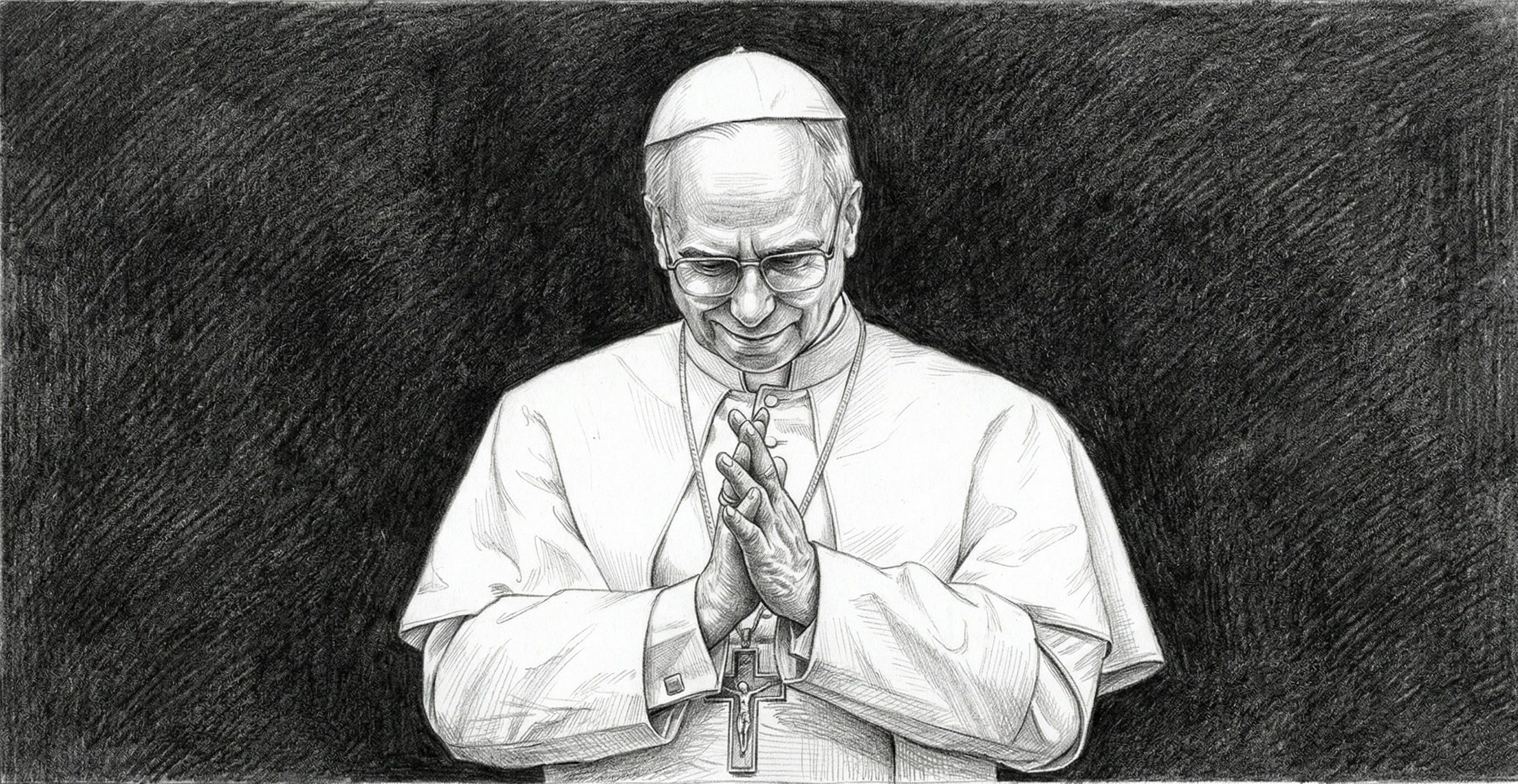
Pope Leo XIV Says Aerial Bombings Should Be Banned Forever
The first American pope rebukes the American president's war — and Trump says he doesn't want a ceasefire.
Thank you for reading! Letters from Leo is a reader-supported publication. To receive new posts and support my work, consider becoming a free or paid subscriber.
On Monday, Pope Leo XIV stood before a room full of Italian airline executives and called for the permanent abolition of aerial bombing.
“After the tragic experiences of the 20th century, aerial bombings should have been banned forever,” the pope said. “Yet they still exist … this is not progress; it is regression!”
The setting was unusual. The audience was a group of airline employees, gathered for what might have been a routine papal greeting. But Pope Leo XIV turned the occasion into a pointed moral address. “No one should have to fear that threats of death and destruction might come from the sky,” he told them.
The timing was uncanny. The U.S.-Israeli military campaign against Iran has now entered its fourth week.
Strikes that began on February 28 have escalated into a sustained air war, with Tehran retaliating against American and Israeli bases across the region. Civilians are dying. A Maronite priest was killed in an Israeli bombing.
The pope himself has expressed “profound sorrow” over the deaths of “many innocent people, including many children.”
Pope Leo did not name the conflict directly on Monday. He did not have to. The bombs falling on Iran and across the Middle East are speaking loudly enough. And the pope has already spent weeks building an unmistakable case.
On March 1, during the Angelus, he called for the “thunderous sound of bombs” to stop and for guns to “fall silent.” This past weekend, he called the war “a scandal to the whole human family” and urged leaders to “seek solutions without weapons.”
What makes Monday’s statement different is its permanence. The pope was not simply calling for a ceasefire in a particular conflict. He was making a sweeping moral claim about the nature of aerial warfare itself.
The twentieth century gave us Dresden, Hiroshima, Guernica, and the firebombing of Tokyo. These were supposed to be the lessons that ended the practice. Pope Leo’s words carry the weight of that history. He is saying the human race had a chance to learn, and we failed.
Trump’s Refusal
President Trump’s response arrived before the pope’s Monday address, but it applies with grim precision. Asked about Leo’s earlier calls for a ceasefire, Trump was blunt: “We can talk, but I don’t want a ceasefire.”
Trump’s reasoning was purely strategic. Iran’s military capacity, he argued, had been “effectively dismantled.” Its navy, air power, radar systems, and anti-aircraft infrastructure were gone. A ceasefire would surrender the advantage. The calculus was transactional, bloodless in its language, even as the blood kept flowing.
This is the fracture that defines this moment. The first American pope is begging the American president to stop bombing a country, and the American president says no. The leader of the Catholic Church invokes the moral catastrophe of the twentieth century’s air wars, and the leader of the free world responds with a cost-benefit analysis.
The Moral Weight
Catholic teaching on war has always operated within the framework of just war theory, which demands proportionality, distinction between combatants and civilians, and a reasonable chance of success in pursuit of a just cause. Indiscriminate aerial bombing fails these tests almost by definition. Bombs dropped from the sky cannot distinguish a soldier from a child. The twentieth century proved this at enormous cost.
Pope Leo stands in a long line here.
Pope Benedict XV called World War I “the suicide of civilized Europe.” Pius XII pleaded for an end to the bombardment of cities during World War II. John XXIII, in Pacem in Terris, declared that war could no longer be an instrument of justice in the nuclear age. John Paul II vocally objected to the Iraq War. Francis spent his pontificate warning that a “piecemeal Third World War” was already underway.
Pope Leo’s contribution is direct and specific. He is not speaking in abstractions about the tragedy of war. He is calling for a concrete prohibition. Aerial bombings, he says, should be banned. The word “banned” carries legal, institutional, and moral force. The pope is calling for a new norm in international law, rooted in the hard evidence of what happens when explosives fall from the sky onto populated areas.
And he is making this claim as an American citizen. That fact gives his words a weight that Francis’s antiwar statements, powerful as they were, could never carry in Washington. When a pope from Buenos Aires criticizes American military action, it is easy for the White House to dismiss. When a pope from the United States does the same, the dismissal rings hollow.
What Comes Next
The war in Iran is not slowing down. Trump has shown no interest in the pope’s appeals. The daily reports from the region grow worse. Pope Leo knows all of this. His statement on Monday was not naive. He has spent his entire priesthood in places shaped by violence and poverty, first in Peru and then in the institutional trenches of the Vatican. He understands power.
But he also understands that moral claims exist outside the logic of military advantage. The pope’s job is to say what is true even when the powerful refuse to listen. On Monday, he told the truth: that dropping bombs on human beings from the sky is a regression, a failure, a scandal. The twentieth century should have settled this. The twenty-first century has not.
Thank you for reading. I’ll see you on the road.
At Letters from Leo, we stand with Pope Leo XIV and the millions of Catholics around the world who believe that war is never a video game, that human life is never a strategic calculation, and that the moral authority of any nation crumbles when it treats the killing of civilians as an acceptable cost of doing business.
In the fourth week of this bombing campaign, with a Maronite priest dead and children buried in rubble, we refuse to accept the logic that says military advantage justifies silence. We remain rooted in a faith that holds every human life sacred and every indiscriminate bomb as an offense against that holiness.
This is the fastest-growing Catholic community in the country because people are hungry for moral clarity in a moment saturated with propaganda and spin. They want the truth about what their government is doing in their name, and they want it grounded in something deeper than partisan talking points.
If you believe this movement matters — Catholics and people of goodwill standing for human dignity against the machinery of indiscriminate war — I am asking you to join us.
If you’d like to invest in our mission, here are three ways you can help this Lenten season:
Subscribe as a paid member to receive exclusive posts about the life and formation of Pope Leo and help sustain this newsletter.
Donate with a one-time gift to fuel this project’s mission.
Share this post (and Letters from Leo) with a friend who might enjoy it.
Paid subscribers get access to our exclusive biographical series on Pope Leo’s Life & Formation, our ongoing Epstein-Bannon Investigation, and our full archive.
Whether you give $0, $5, $50, or $500, your presence here matters — no matter your faith or your politics.
Thank you for reading. I’ll see you on the road.


My heart breaks to think humanity suffered already through so many wars, the lessons of their futility, the lessons of their desecration, the lessons of the indiscriminate wiping out of innocents, that we are a quarter way through the 21st century and choose to regress to amoral acquisitive inhumanity. Pope Leo is a light. This light is important. As are all people. May it bring focus, snd relief to the many hidden innocents suffering. Too many are suffering in secret under rule of these soul-less deal-makers.
Bombs are quite precise, and often used to destroy industry that supplies weapons and soldiers, saving lives overall if used correctly. I don't really follow the logic behind why they shouldn't be used in a just war.