
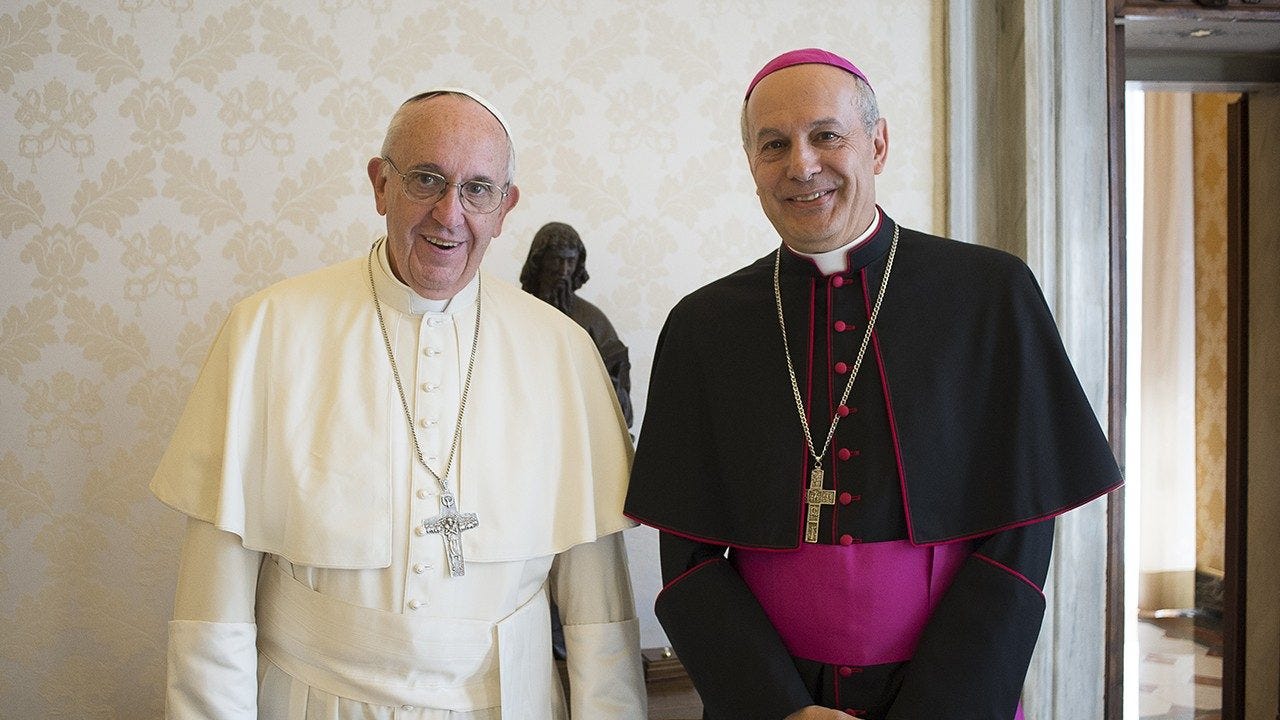
Pope Leo XIV Sends His Best Diplomat to America
Archbishop Gabriele Caccia — the Vatican's veteran envoy to Duterte's Philippines and the United Nations — is now headed to Washington at the most turbulent moment in modern Vatican-U.S. relations.
Thank you for reading! Letters from Leo is a reader-supported publication. If you find value in my work, please consider becoming a paid subscriber or making a one-time donation.
On Saturday, Pope Leo XIV made one of the most consequential appointments of his young papacy. He named Archbishop Gabriele Giordano Caccia — a 68-year-old Italian career diplomat from Milan — as the new apostolic nuncio to the United States, replacing the retiring Cardinal Christophe Pierre, who held the post for nearly a decade across three presidents and two popes.
The appointment may not make front-page headlines in most American newspapers. But make no mistake — this is one of the most significant decisions Pope Leo XIV has made since his election last May.
The Vatican’s ambassador to the United States doesn’t just attend state dinners and convey papal messages. He recommends to the pope which American priests should become bishops, shaping the leadership of a Church that serves 72 million Catholics.
And in a moment when the relationship between the Holy See and the White House is under extraordinary strain, the man Pope Leo chose to send tells us everything about how the pope sees this moment.
He’s sending his best.
A Diplomat Forged in Crisis
Caccia is not a culture warrior. He is not a political operative. He is a man who has spent 35 years in the Vatican’s diplomatic service, navigating some of the most volatile corridors of global power — and he has done it with a steady hand, a quiet resolve, and a gift for finding common ground where others see only scorched earth.
Consider where he has served. After joining the Holy See’s diplomatic corps in 1991, Caccia was posted to Tanzania, then spent nearly a decade inside the Vatican’s powerful Secretariat of State — the engine room of papal diplomacy.
Pope Benedict XVI sent him to Lebanon in 2009, a country riven by sectarian conflict and regional proxy wars. He navigated that minefield with enough skill that Pope Francis tapped him in 2017 for one of the most sensitive postings in Asia: the Philippines.
What Caccia found in Manila was a country in the grip of President Rodrigo Duterte’s brutal “war on drugs” — a campaign that led to thousands of extrajudicial killings and mass incarcerations, most of them targeting the poorest and most vulnerable Filipinos.
The Philippine Catholic hierarchy — representing the largest Catholic population in Asia — was in open conflict with Duterte, who routinely attacked bishops and priests in profanity-laden public speeches and once called God “stupid.”
In the middle of this chaos, Caccia did what the best Vatican diplomats do: he listened, he mediated, and he kept channels open. He tamped down tensions between local bishops and the Duterte government without abandoning the Church’s moral witness.
He was neither silent nor reckless. He was strategic. And when he left Manila in 2019, the Filipino government awarded him the Grand Cross of the Order of Sikatuna — its highest diplomatic honor — a remarkable tribute to a man who represented a Church that Duterte openly despised.
That experience matters now more than you might think.
The United Nations and the Art of Principled Engagement
From Manila, Caccia moved to New York to serve as the Holy See’s permanent observer to the United Nations — a post he has held since 2019.
At the U.N., Caccia became the Vatican’s voice on some of the defining issues of our era: climate change, migration, nuclear disarmament, and conflict resolution. He championed multilateral dialogue at a time when the very concept of multilateralism was under siege.
This is the context that makes Caccia’s appointment so revealing. For the past several years, we have watched the Trump administration systematically undermine the institutions and norms of international diplomacy.
The president has floated acquiring Greenland by force, threatened to annex the Panama Canal, and — as of this week — joined Israel in a military campaign against Iran that Cardinal Pietro Parolin, the pope’s top deputy, has said undermines international law.
The administration has treated allies like adversaries and strongmen like friends. It has hollowed out the State Department, withdrawn from international agreements, and governed with a disdain for the diplomatic traditions that have kept fragile peace for decades.
Caccia has watched all of this from his perch at the United Nations. He has seen the consequences of American unilateralism ripple through the international order. And now Pope Leo is sending him from the U.N. — the heart of the multilateral system — directly to Washington, the capital of the government most aggressively trying to dismantle it.
What Caccia Will Face
The new nuncio arrives in Washington at one of the most turbulent moments in the modern relationship between the Vatican and the United States. Pope Leo XIV — the first American pope — has openly described the Trump administration’s immigration crackdown as “inhuman.”
The Vatican has strongly criticized U.S.-Israeli military strikes on Iran. Catholic churches have been targeted by ICE raids. And the administration has shown no hesitation in publicly feuding with the Church that counts more members in this country than any other.
Caccia’s job will be, in many ways, the same job he had in Duterte’s Philippines — only the stakes are higher.
He must represent the moral priorities of the Holy See at a White House that views those priorities with suspicion, if not open hostility. He must advocate for the rights of immigrants, the pursuit of peace, and the dignity of every human person — all positions that put the Vatican directly at odds with the current administration’s governing philosophy.
But Caccia must also do something more delicate: he must keep the diplomatic channel open. The Vatican learned long ago that moral witness without diplomatic engagement is just shouting into the wind.
The Church’s power lies in its ability to speak truth to power while remaining at the table. Caccia’s entire career has been preparation for exactly this kind of work — maintaining principled engagement with governments the Church finds morally troubling.
And then there is the other half of the job, the one that receives less attention but may matter even more for the long arc of American Catholicism. As nuncio, Caccia will recommend to Pope Leo which American priests should be elevated to the episcopacy.
In other words, he will help shape the next generation of Catholic bishops in the United States — the men who will lead the Church long after the current political storms have passed. This is how papal appointments ripple through decades. The bishops Caccia helps select will still be serving when most of us have forgotten the headlines of this week.
Pope Leo’s Message
As Massimo Faggioli, who teaches ecclesiology at the Loyola Institute at Trinity College Dublin, put it: “This is an extremely heavy and important appointment because right now you really don’t know what will happen in the United States.”
Exactly right. And that uncertainty is precisely why Pope Leo chose a man who has spent his career navigating uncertainty — in Tanzania, in Lebanon, in Duterte’s Philippines, and at the United Nations.
Caccia is not a provocateur. He is not a partisan. He is a diplomat in the deepest sense of the word — a man who believes that dialogue is not weakness and that principled engagement can move hearts that bluster and threats cannot.
In appointing Caccia, Pope Leo XIV is telling us something about how he intends to engage the most powerful country on earth — his home country — in the years ahead. He is not retreating from moral clarity.
He is not surrendering to political pressure. But he is choosing engagement over isolation, strategy over spectacle, and the long game over the daily news cycle.
In an era when so many leaders have abandoned the patient work of diplomacy for the cheap thrill of confrontation, that choice itself is a kind of prophecy.
At Letters from Leo, we stand with the millions of American Catholics — and countless others of goodwill — who believe that diplomacy, dialogue, and the relentless pursuit of peace are not signs of weakness but the highest expressions of moral courage.
In an era poisoned by cruelty and division, we remain rooted in a faith that refuses to flinch before injustice or bow to the idols of fear and authoritarianism.
This is the fastest-growing Catholic community in the country because people are hungry for something deeper than rage and cynicism.
They’re looking for courage, for truth, for love made visible in action — and right now, as the relationship between the Vatican and the White House enters uncharted waters, that hunger has never been more urgent.
If you’re ready to build a country — and a Church — that chooses dialogue over domination and moral witness over political convenience, then I’m asking for you to join us.
If you’d like to invest in our mission, here are three ways you can help this Lenten season:
Subscribe as a paid member to receive exclusive posts about the life and formation of Pope Leo and help sustain this newsletter.
Donate with a one-time gift to fuel this project’s mission.
Share this post (and Letters from Leo) with a friend who might enjoy it.
Paid subscribers receive full access to the biographical series on Pope Leo’s life and formation and exclusive investigations — including how Epstein and Bannon plotted to take down Pope Francis, Epstein’s disturbing emails about the pope, and the full network of conspirators behind the scheme.
Whether you give $0, $1, or $1,000, your presence here matters — no matter your faith or your politics.
Thank you for reading. I’ll see you on the road.


Just wanted to let you know that I am very much enjoying your Substack. Your posts are so relevant to the current geo-political nightmare we are all living through & I enjoy learning more about Pope Leo & his viewpoints. I'm not Catholic although I was educated by nuns in a Catholic school. I am intrigued by the history of the church & am always interested in learning more. Thank you for your work.
Archbishop Caccia sounds like the perfect choice for this important position.
Let us welcome and support him in this critically important task and role.