
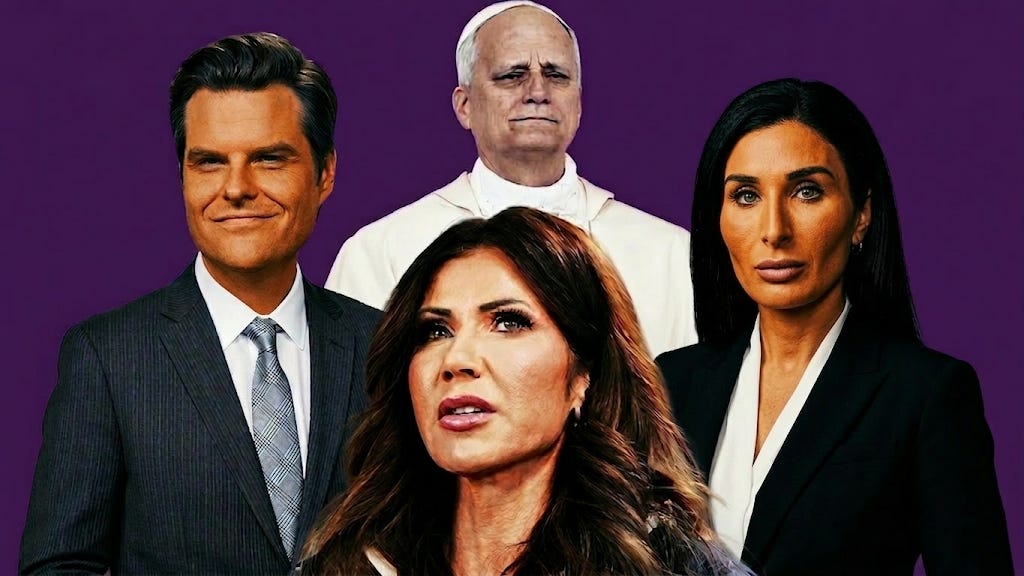
Pope Leo XIV Takes On Mar-a-Lago Face, Looksmaxxing, and America’s “Cult of the Body”
A sweeping Vatican document approved by the pope warns that the obsession with surgical perfection is an attempt to escape what it means to be human.
Thank you for reading! Letters from Leo is a reader-supported publication. To receive new posts and support my work, consider becoming a free or paid subscriber.
In Washington, D.C., plastic surgeons report a surge in requests for what the industry now calls “Mar-a-Lago face” — the sculpted, frozen, perpetually thirty-five-year-old look that has become a uniform among Trump’s inner circle.
Severe jaws, razor-sharp cheekbones, lips that would make Mick Jagger blush. Axios reported the trend accelerating as Trump loyalists flooded the capital, bringing Palm Beach aesthetics with them. The look has become so recognizable that it functions as a political signal — a way of announcing, through your face, which team you play for.
Now the Vatican has weighed in. And the pope is not amused.
In a sweeping 48-page document titled Quo Vadis, Humanitas? — “Where Are You Going, Humanity?” — the Vatican’s International Theological Commission, with Pope Leo XIV’s explicit approval, has issued its sharpest critique yet of the cosmetic surgery culture that has consumed American public life.
The commission warns of a widespread “cult of the body,” marked by what it calls “the frantic pursuit of a perfect figure, one that always stays fit, youthful, and beautiful.”
The Vatican’s diagnosis cuts deeper than aesthetics. The theologians identify a painful paradox at the heart of the beauty-industrial complex: “The ideal body is exalted, sought after and cultivated, while the real body is not truly loved, being a source of limitations, fatigue, aging.”
Read that again. The real body is not truly loved.
The document goes further, describing trends that “reduce the body to biological material to be enhanced, transformed, and reshaped at will, with the dream of achieving living conditions that avoid pain, aging, and death.”
For the commission, the obsession with surgical perfection represents something theologically urgent: the attempt to escape what it means to be human.
The Internet Had Thoughts
The reaction online was immediate and largely delighted. Users on X zeroed in on the absurdity of the pope wading into the beauty wars. “Asking Pope Leo what he thinks about preventative botox done tastefully,” wrote one user, quote-tweeting the New York Post’s coverage.
The post racked up hundreds of engagements. On The View, Joy Behar quipped that perhaps it was best not to invite the pope and the Kardashians to the same party.
But beneath the jokes lies a serious cultural collision. The Vatican has identified a phenomenon that extends far beyond any individual’s decision to get Botox.
The document connects the Mar-a-Lago aesthetic to a broader philosophical crisis — the same crisis that has produced the “looksmaxxing” movement among young men, the explosion of weight-loss drugs taken for cosmetic rather than medical reasons, and the normalization of surgical intervention as a prerequisite for public life.
From Face Lifts to Cyborgs
The commission didn’t stop at cosmetic surgery. Quo Vadis, Humanitas? takes aim at the entire spectrum of technologies that promise to remake the human person — from performance-enhancing drugs to neural implants to artificial intelligence systems that, in the commission’s words, risk creating “a world governed by machines” where the living God is replaced by a “virtual God.”
On AI specifically, the document questions the use of algorithms “when deciding whether or not to provide medical care, granting loans, or mortgages, or providing insurance, or when preparing criminal cases in court, or when deciding on military strikes.”
As I wrote about earlier this week, Pope Leo has already moved to restrict AI in the Church’s own worship life, banning AI-generated homilies and warning priests against replacing pastoral presence with digital convenience.
The sharpest theological language in the document is reserved for transhumanism — the movement that believes science should eliminate aging, disease, and death. The commission calls it “the existential expression of a presumption that is both naive and arrogant.”
Posthumanism, the related belief that humans should merge with machines, fares even worse: “an existential expression of escape from reality, which stems from a radical devaluation of humanity.”
A Gospel for People Who Are Aging
What makes this document powerful is where it lands. After cataloguing the ways technology and vanity conspire to make people ashamed of their own bodies, the commission offers an alternative that is startlingly simple. Life, it says, is a vocation — a gift received, shared, and returned to God. The body is not raw material to be optimized. The body is a gift to be inhabited.
“Man is not an atom lost in a random universe,” the document declares, “but is a creature of God, to whom He wished to give an immortal soul and whom He has always loved.”
In a culture where the president’s closest allies signal loyalty through matching cheekbones, where young men inject themselves with unregulated peptides to maximize their jawlines, and where aging is treated as a failure of self-discipline rather than a dimension of human experience, the Vatican’s message lands with unexpected force. Your wrinkles are not a deficiency.
Your aging body is not a problem to be solved. God made you mortal, and that mortality is where the encounter with grace begins.
The document insists that “the future of humanity is not decided in bioengineering laboratories, but in the ability to navigate the tensions of the present.” Pope Leo signed off on those words. Given everything this pope has said about dignity, poverty, and the idols of power, the message could not be more consistent with his papacy so far.
Mar-a-Lago face is a symptom. The disease is a civilization that no longer believes the human person — fragile, mortal, aging — is enough.
Pope Leo, once again, is offering a different vision. One where the body you were given is worthy of love exactly as it is.
At Letters from Leo, we are tracking every dimension of this pontificate — from Pope Leo’s moral confrontations with the Trump administration to his theological vision for a Church that refuses to flinch before the idols of wealth, power, and vanity.
In a culture that tells you your body is a product to be optimized and your worth is measured by your appearance, this community insists on something deeper: that every human person is a gift, not a project.
This is the fastest-growing Catholic community in the country because people are hungry for moral clarity in an age of cosmetic everything — cosmetic politics, cosmetic faith, cosmetic faces.
They want truth that goes beneath the surface. Right now, as the Vatican challenges the entire beauty-industrial complex, that hunger has never been more urgent.
If you believe this movement matters — Catholics and people of goodwill standing for human dignity against a culture that commodifies the body — I am asking you to join us.
If you’d like to invest in our mission, here are three ways you can help this Lenten season:
Subscribe as a paid member to receive exclusive posts about the life and formation of Pope Leo and help sustain this newsletter.
Donate with a one-time gift to fuel this project’s mission.
Share this post (and Letters from Leo) with a friend who might enjoy it.
Paid subscribers get access to our in-depth biographical series on Pope Leo’s life and formation, our ongoing Epstein-Bannon investigation, and the daily Lenten Reflection Series.
Whether you give $0, $8, $80, or $800, your presence here matters — no matter your faith or your politics.
Thank you for reading. I’ll see you on the road.


My laugh lines have been earned as well as the grief of loved ones lost. My nose and double chin are hereditary and I see my beloved ancestors in the mirror.
It’s nice to see the clergy from the Vatican noticing the sick culture we have. I have a 14 year old granddaughter and the pressure to look beautiful is real. She’s already asking for skin care products! That’s insane. I follow women’s sports and I have noticed in the past few years the players play with full makeup. Who starts this pressure for women?