
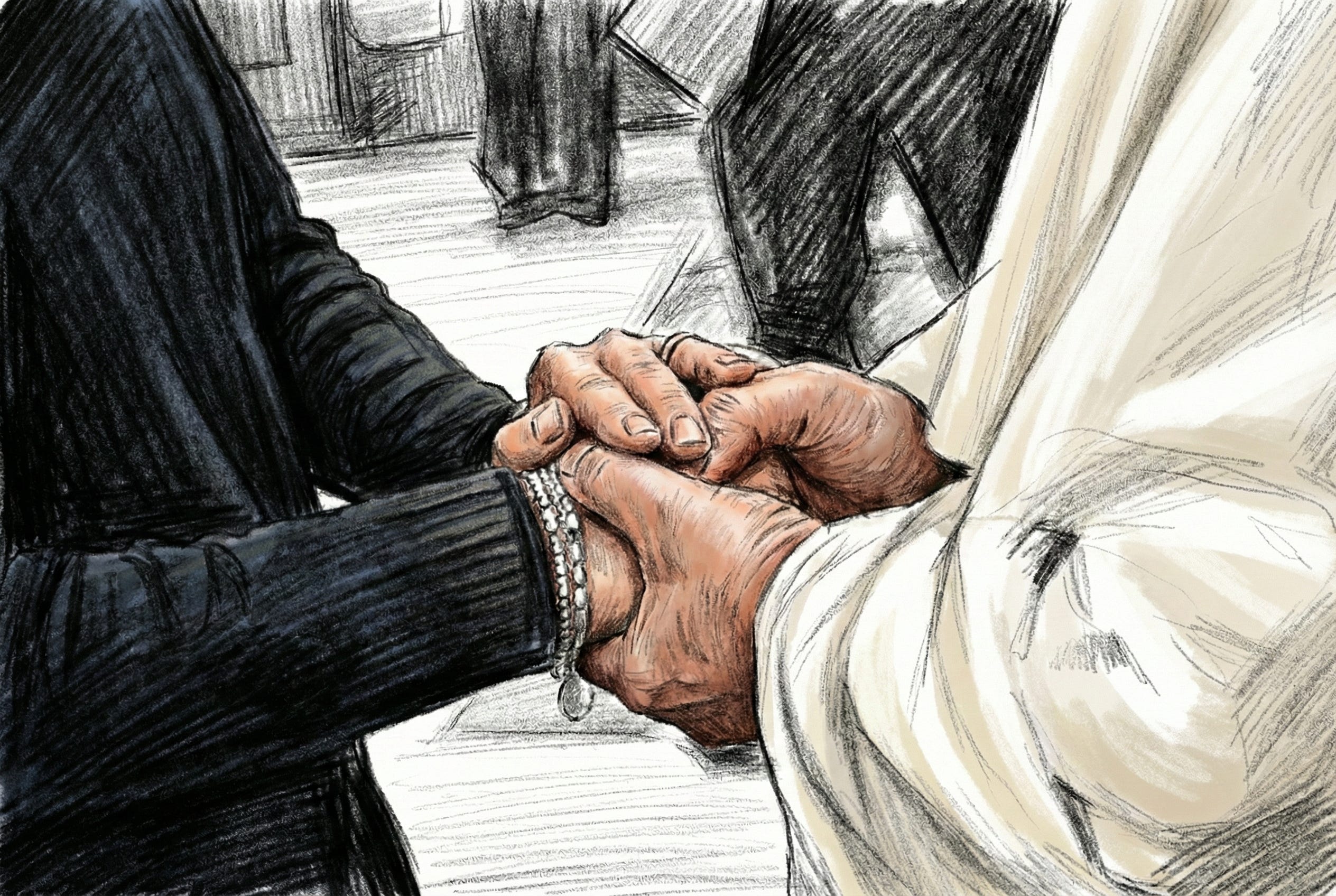
Pope Leo XIV Tears Up Comforting Families of Swiss Bar Fire Victims
The first American pope, visibly moved, embraced parents mourning an unspeakable New Year’s tragedy and offered them the Church’s full compassion — and a message of faith that even in this darkness.
Thank you for reading! Letters from Leo is a reader-supported publication. If you find value in my work, please consider becoming a paid subscriber or making a one-time donation.
On Thursday morning, two weeks after the Alpine New Year’s Eve blaze that killed 40 people and injured 116 — most of them teenagers and young adults — Pope Leo welcomed about twenty of their bereaved relatives to a quiet hall in the Vatican.
The mood was heavy with grief. As mothers and fathers clutched photos of their lost children, the pope immediately set aside his prepared remarks to speak from the heart.
“When I learned you wanted this audience, I immediately said ‘yes’,” he told them, his voice already trembling. He explained that he “wanted at least to share a moment” with them in their immense pain and “test of faith”.
At times, Pope Leo himself welled up with tears as he listened to their stories. He sat close to the families, “deeply moved” and even “shocked” by the magnitude of their suffering. In that intimate circle of sorrow, the pope offered gentle embraces and consoling words of affection and hope.
An Alpine Celebration Turned Tragedy
The disaster that brought these families to Rome struck without warning in the early hours of New Year’s Day. Dozens of young people — friends celebrating at Le Constellation, a popular basement bar in the Swiss resort of Crans-Montana — became trapped when a sudden fire and explosion tore through the club.
Investigators believe sparklers on champagne bottles ignited flammable soundproofing foam in the ceiling, turning the packed holiday party into an inferno. In minutes, the joyous ski-town festivities gave way to panic and horror.
By the time firefighters doused the flames, 40 people were dead and over 110 injured, many with disfiguring burns. Switzerland was stunned; authorities called it one of the most tragic events in the nation’s recent history.
Adding to the heartbreak, most victims were incredibly young — between 13 and 25 years old — including several Italian teens on holiday. Grieving residents of Crans-Montana packed local churches in the days after, marching by candlelight to honor the dead and pray for the injured. As one Swiss bishop put it, the whole community’s heart was “pierced” by this catastrophe.
Even from afar, Pope Leo responded immediately. Within hours of the fire, he sent a telegram mourning the lives lost and praying that God would “welcome the deceased into his light” while strengthening those left behind.
At his Sunday Angelus, the pope publicly renewed his “closeness to those suffering” and lifted up prayers for the “young people who died, for the injured, and for their families.” He even turned a meeting with Vatican youth on January 10 into a moment of solidarity, urging students in Rome to pray for their “peers” who perished and reminding them that “life is so precious”.
Throughout, Leo XIV made one thing clear: this tragedy, though distant, was “an open wound” not just for Switzerland or Italy but for the whole Church. Thus he readily agreed to the survivors’ request to see him in person, seeing it as a pastoral priority.
Faith in a Night of Suffering
Sitting face-to-face with the grieving families on Jan. 15, Pope Leo did not offer easy answers — he acknowledged the limits of human words in the face of such agony. “I cannot explain why you and your loved ones have been asked to face such a trial,” he admitted honestly. Instead, he joined them in the burning question that haunts every grieving heart: “Why, Lord?”
The pope gently pointed them to Christ’s own cry of abandonment on the cross. Even Jesus, he recalled, voiced that searing “My God, why have you forsaken me?” when engulfed in pain. “Perhaps there is only one word that is adequate” in this darkness, Leo suggested — that word of Christ on the Cross, which God the Father answered after “three days of silence” by raising Jesus from the dead.
With compassion in his voice and tears in his eyes, Pope Leo urged the families to hold onto that Paschal hope. “Your hope is not in vain, because Christ is truly risen!” he proclaimed, echoing the earliest Christian witness.
The Holy Father assured them that nothing — not even death — can separate their loved ones from the love of Christ.
“Be assured of his closeness and his tenderness,” Leo said of Jesus. “He is not distant from what you are experiencing; on the contrary, He shares it and carries it with you.”
In that moment, it was as if the pope himself were carrying a piece of their cross, shoulder to shoulder with each parent. He emphasized that the entire Church is praying and grieving “with you and for you” — they are not alone in this valley of tears.
Pope Leo also pointed the families toward Mary, the Mother of Sorrows, as a source of comfort. Just as Mary’s heart was “pierced” at the foot of her Son’s cross, he noted, she now stands alongside every parent shedding painful tears. “Entrust your tears to her without reserve,” the pope encouraged, “and seek in her the maternal comfort” that only a grieving mother can give.
Mary knows the awful silence of Holy Saturday, but she also witnessed the dawn of resurrection. With her maternal help, “like her, you will know how to wait patiently for a new day to dawn; and you will rediscover joy,” Leo XIV promised.
It was a remarkable image: the Vicar of Christ in tears encouraging these families to cling to the Blessed Mother as their refuge in this nightmare.
Before concluding the encounter, Pope Leo XIV invited everyone in the room to pray together. Hand in hand with the pope, the families joined in an Our Father and a Hail Mary, invoking the very hope he had spoken of. Finally, Leo raised his right hand and gently imparted his Apostolic Blessing over these wounded moms and dads, their injured children still in hospitals, and the souls of those who had perished.
“May the peace and comfort of faith always be with you,” he said softly, making the sign of the cross over the group. It was a tender, profoundly human moment of shared grief and faith — a moment that left even the pope himself quietly wiping his eyes.
Walking with the Wounded
Pope Leo’s tearful solidarity did not erase the families’ pain, but it clearly touched a chord. In giving them time and an open heart, Leo XIV showed what it means for the Church to “mourn with those who mourn.”
This private audience was only the latest instance of his now-familiar pastoral closeness. In his young pontificate, Leo has made a point of standing with victims of tragedy — whether meeting refugees who lost everything to war, embracing abuse survivors, or praying at the site of a deadly explosion. Time and again he has demonstrated that no suffering is too distant for the pope’s embrace.
The families from Crans-Montana, for their part, left the Vatican carrying both the weight of grief and a newfound glimmer of hope. From Rome they went on to meet Italian government officials who have demanded justice and a full accounting for the disaster. A criminal investigation is underway in Switzerland; negligence by the club’s owners is suspected, and arrests have been made.
Indeed, beyond the headlines of court cases and safety reforms, Pope Leo’s encounter offered something uniquely transcendent. He didn’t offer bureaucratic solutions; he offered presence, prayer, and the promise of Christian hope.
By weeping with these families and pointing them toward Christ’s victory over death, Leo reminded the world that faith can illuminate even the darkest night of suffering.
In that small meeting room, amid tears and embraces, the Gospel came alive: “The light shines in the darkness, and the darkness has not overcome it.”
Last year, something unexpected happened. The Advent Reflection Series became one of the most widely read and shared parts of Letters from Leo.
Many of you wrote to say those reflections helped steady your hearts during a difficult year — one marked by division, anxiety, and genuine moral uncertainty.
Because of that response, I’ve decided to make these Mass reflections a permanent part of this work in 2026.
These Sunday reflections will be available to all paid subscribers as a small but sincere way of saying thank you for making Letters from Leo possible.
Here is this week’s reflection.
Paid subscribers will also have access to the Q&A mailbag opening this week, where you can ask me anything about American politics, Catholicism, Donald Trump, Pope Leo, JD Vance — or my own faith, biography, and life.
Letters from Leo is open to anyone who wants to be informed and inspired by our pope — and to turn that inspiration into action that leaves America and the world more just, less cold, and more alive with hope.
If you’d like to invest in our mission during this new year, here are three ways you can help:
Subscribe as a paid member to receive exclusive posts about the life and formation of Pope Leo and help sustain this newsletter.
Donate with a one-time gift to fuel this project’s mission.
Share this post (and Letters from Leo) with a friend who might enjoy it.
Whether you give $0, $1, or $1,000, your presence here matters — no matter your faith or your politics.
Thank you for reading. I’ll see you on the road.


God made Pope Leo for this moment in time.
I will be in Rome in March. Does Pope Leo lead the Mass each week? I want to attend. He is so awesome. Phyllis