
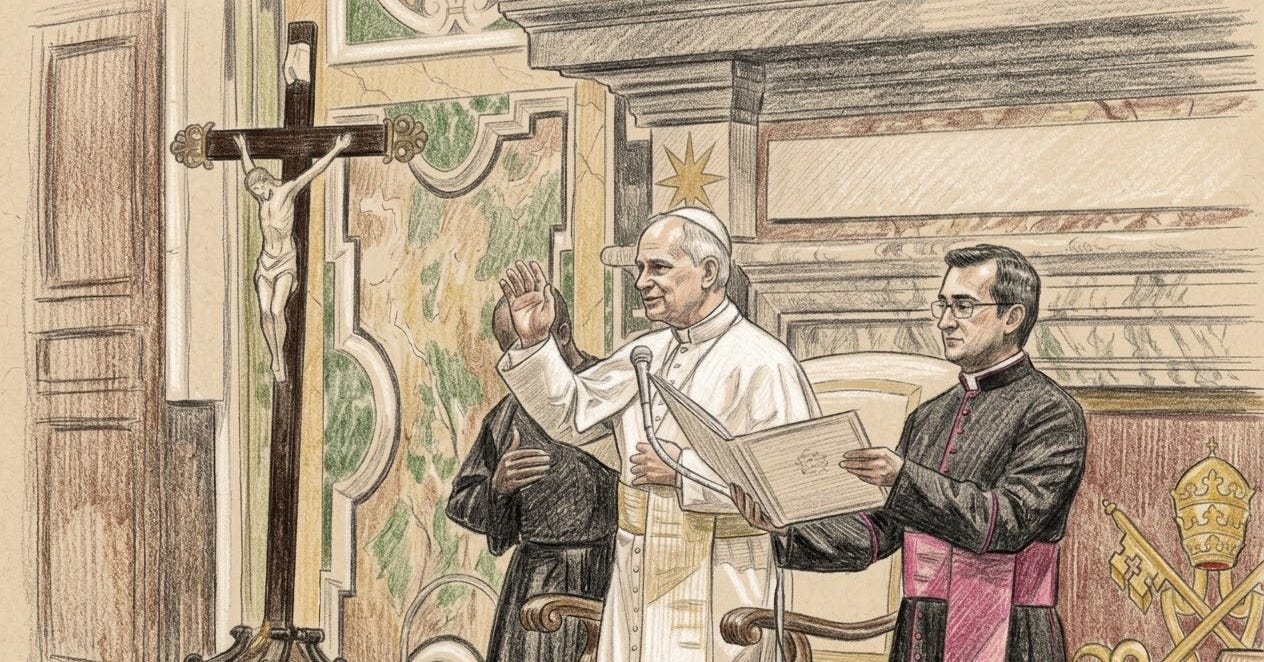
Pope Leo XIV Warns Media Against Becoming War Propagandists
After Cupich called the White House's Iran war video “sickening,” the pope echoed his language in a pointed address to broadcasters — as the FCC threatens networks for honest coverage of Iran.
Thank you for reading! Letters from Leo is a reader-supported publication. If you find value in my work, please consider becoming a paid subscriber or making a one-time donation.
On Monday morning, while the Trump administration threatened to strip broadcast licenses from networks covering the Iran war too honestly, Pope Leo XIV stood before a room of Italian journalists and delivered a quiet, unmistakable rebuke of every government — including his own country’s — that treats the killing of human beings as content.
“Always, but especially in the dramatic circumstances of war such as those we are experiencing,” the pope told broadcasters from Italy’s TG2 television news program, “information must guard against the risk of turning into propaganda.”
He urged reporters to “show the suffering that war always brings to populations, to show the face of war, and to tell it through the eyes of the victims so that it does not turn into a video game.”
That last phrase — a video game — carried an unmistakable target. Leo never mentioned the United States by name.
Just ten days earlier, Chicago Cardinal Blase Cupich — Pope Leo XIV’s closest American ally — issued one of the sharpest public rebukes a sitting American cardinal has directed at a wartime White House in modern memory.
Cupich took aim at “Justice the American Way,” a video posted to the official White House X account that spliced Hollywood action sequences with real footage of U.S. and Israeli strikes on Iran. The video racked up tens of millions of views. Cupich called it what it was.
“A real war with real death and real suffering being treated like it’s a video game,” Cupich said in a statement titled “A Call to Conscience.” “It’s sickening.”
Cupich went further. “Journalists now use the term ‘gamifying’ the war to describe this dynamic,” he said.
“What a profound moral failure, for gamifying strips away the humanity of real people.” He added: “We lose our humanity when we are thrilled by the destructive power of our military.”
Cupich had met with Leo in Rome three days before releasing the statement. In an interview with The Washington Post, he declined to share the details of that private conversation, but said U.S. bishops were not “getting directions from the Holy Father in some secret way or backdoor way.”
Leo, he explained, was more broadly directing bishops to “take responsibility for what’s happening in their country.”
The pope’s language on Monday suggests that responsibility runs both ways. Leo addressed the journalists with the same moral directness Cupich brought to the White House video — yet applied it to the press itself.
The task of journalists “in verifying the news so as not to become a megaphone for power,” Leo said, “becomes even more urgent and delicate — and indeed, essential.”
The Pope’s Message Arrives at a Dangerous Moment for the American Press
Leo’s call to honest reporting comes as the American media landscape faces an extraordinary threat.
FCC Chairman Brendan Carr warned last week that television and radio broadcasters could lose their licenses if they aired what he called “hoaxes and news distortions” about the Iran conflict.
President Trump, who accused major outlets of wanting “us to lose the war,” responded approvingly. CBS — whose parent company’s new owners have already installed a bias ombudsman under pressure from the administration — sits at the center of this storm.
Shortly after the TG2 audience, Leo posted the core of his message on X: “In the dramatic circumstances of war, information must guard against the risk of turning into propaganda. It is every journalist’s duty to verify the news, so as not to become a megaphone for power. They must show the suffering that war always brings to populations.”
The pope’s remark landed in a context where an American administration is punishing unfavorable war coverage with regulatory threats while producing its own content designed to thrill rather than inform.
Leo has built toward this moment over the past few weeks.
On March 8, he told pilgrims at the Angelus that news from Iran had caused him “deep dismay.” On Sunday, he escalated dramatically, directly addressing “those responsible for this conflict” and demanding they “cease fire so that avenues for dialogue may be reopened.”
Monday added a new dimension: the pope was no longer only calling for peace but telling the people who cover the war how to do it honestly.
The Pope’s Allies Throw The Hardest Punches
What makes Leo’s approach distinctive is its architecture. As the National Catholic Reporter has documented, Leo has leaned heavily on proxies to deliver the Church’s most pointed moral critiques of the war.
Cupich calls the White House video “sickening.” Cardinal Robert McElroy, the archbishop of Washington, has argued publicly that the war fails to meet the Catholic Church’s traditional criteria for a just war.
The Vatican’s own Secretary of State, Cardinal Pietro Parolin, has been more explicit than the pope himself.
Leo, meanwhile, positions himself above the fray — a unifier, a bridge builder, a man who speaks in principles rather than partisan accusation. The strategy reverts to a deep papal tradition: let the national churches lead in confronting their own governments while the pope establishes the moral horizon.
But Monday’s message to the TG2 journalists showed that Leo is willing to sharpen his own blade when the moment demands it.
Telling reporters not to turn war into a video game — the very phrase Cupich used to condemn the White House — amounts to a papal endorsement of the cardinal’s critique, delivered with just enough diplomatic remove to maintain plausible neutrality.
No one in the Vatican press office will confirm that connection. They don’t need to. The pope quoted his own cardinal’s language from the front page of every Catholic news outlet in the world. The signal was clear.
What the Gospel Demands of Those Who Report on War
Catholic teaching has long held that truth-telling is a precondition of justice. The Church’s commitment to the dignity of the human person extends to the language we use for suffering — and to the graphics, soundtracks, and engagement metrics we use to bury it.
Over a thousand Iranian civilians have died since February 28. A girls’ school was bombed, killing as many as 160 people. The cardinal archbishop of Tehran was evacuated. And the White House posted a hype video.
Pope Leo XIV looked at a room full of journalists on Monday and said, in effect: you are the last line of defense. Show the human face of this war, because no one else will. The powerful want to turn you into their megaphone — your moral obligation is to resist.
“No technological innovation can replace creativity, critical discernment, and freedom of thought,” Leo told the TG2 broadcasters.
In an age when the FCC chairman threatens licenses for honest reporting, and the White House turns airstrikes into action-movie trailers, those words carry the weight of prophecy.
At Letters from Leo, we stand with Pope Leo XIV and the millions of American Catholics — and countless others of goodwill — who believe that war is not a game, that human life is not content, and that the moral authority of the United States cannot survive leaders who treat the deaths of children and soldiers as engagement metrics.
In an era poisoned by cruelty and cynicism, we remain rooted in a faith that refuses to flinch before injustice or bow to the idols of fear and authoritarianism.
This is the fastest-growing Catholic community in the country because people are hungry for something deeper than rage and propaganda. They’re looking for courage, for truth, for love made visible in action — and right now, as our government wages a war it won’t let reporters cover honestly, that hunger has never been more urgent.
If you believe this movement matters — Catholics and people of goodwill standing for human dignity against the machinery of war and censorship — I am asking you to join us.
If you’d like to invest in our mission, here are three ways you can help this Lenten season:
Subscribe as a paid member to receive exclusive posts about the life and formation of Pope Leo and help sustain this newsletter.
Donate with a one-time gift to fuel this project’s mission.
Share this post (and Letters from Leo) with a friend who might enjoy it.
Paid subscribers have access to our ongoing series on Pope Leo’s Life & Formation, the Epstein-Bannon Investigation, and our Lenten Reflection Series — plus the Q&A mailbag, where you can ask me anything about American politics, Catholicism, Donald Trump, Pope Leo, JD Vance — or my own faith, biography, and life.
Whether you give $0, $1, or $1,000, your presence here matters — no matter your faith or your politics.
Thank you for reading. I’ll see you on the road.


I haven’t seen the video of gaming the war and don’t plan to watch it. Turning a war into a video game is disguisting and sick. I guess sadly this is our society.