

“Put an End to It” — Pope Leo XIV’s Secretary of State Tells Trump to End Iran War
Cardinal Parolin tells Trump to end the war. Pizzaballa calls it sinful. Three American cardinals reject it outright. The two Catholic frontrunners for 2028 have a problem.

Thank you for reading! Letters from Leo is a reader-supported publication. If you find value in my work, please consider becoming a paid subscriber or making a one-time donation.
March Madness is here. I’m running the first-ever Letters from Leo NCAA Tournament Bracket Pool. We have both men’s and women’s bracket competitions. $26 entry fee a piece. $500 to the winner — $750 if you pick a Catholic school to win it all. $1,000 if you pick Villanova. Sign up here before 11:45 AM ET Thursday.

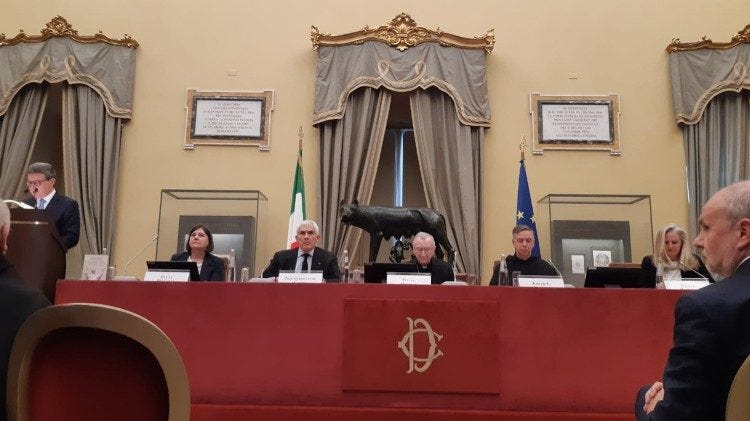
On Wednesday, Cardinal Pietro Parolin — the Vatican’s Secretary of State and Pope Leo XIV’s most senior diplomat — was asked at a book presentation in Rome what message he would deliver to President Donald Trump. His answer was blunt: “Put an end to it as soon as possible, because the real danger is that an escalation is just around the corner.”
To Israel, Parolin had a separate plea: leave Lebanon alone.
The Cardinal made these remarks during the presentation of a new book about the pope, Leo XIV: Who Do You Say I Am? I Am a Son of Saint Augustine, at the Italian Chamber of Deputies. The setting was interesting. Parolin spoke at a venue associated with secular governance and delivered a message aimed squarely at secular power. And the message could not have been more direct: the war spreading across the Middle East must stop.
Parolin’s statement landed three days after Pope Leo XIV himself addressed thousands in St. Peter’s Square with the most forceful public demand of his papacy on the conflict.
“On behalf of the Christians of the Middle East, and of all women and men of good will, I appeal to those responsible for this conflict: cease fire!” he said on March 15, adding that “violence can never lead to the justice, stability and peace for which the people are waiting.”
The pope also singled out Lebanon, calling for “lasting solutions to the serious ongoing crisis for the common good of all Lebanese people” — a direct response to Israel’s ground invasion of its northern neighbor, launched in early March and now threatening to become the largest Israeli incursion into Lebanon since 2006.
Two days later, Palestinian President Mahmoud Abbas called the pope to discuss what the Vatican described as “alarming developments in the conflict in the Middle East and the living conditions of the Palestinian people.”
A Unified Catholic Front
What makes this moment so striking is the breadth of the Catholic response. The Church has spoken on the war in the Middle East with a clarity and coordination unprecedented in modern American Catholic life.
In January, Cardinals Blase Cupich, Robert McElroy, and Joseph Tobin issued a rare joint statement measuring U.S. foreign policy against the principles Pope Leo XIV had laid out before the diplomatic corps.
“We renounce war as an instrument for narrow national interests,” they wrote, “and proclaim that military action must be seen only as a last resort in extreme situations, not a normal instrument of national policy.” Cupich, the Archbishop of Chicago, was unsparing: “As pastors entrusted with the teaching of our people, we cannot stand by while decisions are made that condemn millions to lives trapped permanently at the edge of existence.”
Cardinal Pierbattista Pizzaballa, the Latin Patriarch of Jerusalem who oversees the Catholic communities closest to the carnage, has gone further still.
In a recent webinar, Pizzaballa declared that using God’s name to justify this or any war is “the gravest sin we can commit at this time.” He was equally explicit about where God stands: “If God is present in this war, he is among those who are dying, who are suffering, who are in pain, who are oppressed in various ways, throughout the Middle East.”
The patriarch has also detailed what the war has inflicted on the ground: two million people displaced in Gaza, 80 percent of the Strip destroyed with no reconstruction begun, 36 hospitals only partially functional, and even basic antibiotics running out.
In the West Bank, he reported settler attacks against Palestinians, including Christians, on an almost daily basis. Pizzaballa has also dismissed the U.S.-led Board of Peace as “a colonialist operation: others deciding for the Palestinians.”
The pope, his Secretary of State, the three most prominent American cardinals, and the patriarch responsible for Catholic life in the Holy Land have all delivered the same verdict: this war must end.
Two Baptized Catholics, One Uncomfortable Question
Which brings us to the two men most likely to seek the Republican presidential nomination in 2028 — both of whom are baptized Catholics.
Vice President JD Vance converted to Catholicism in 2019. Secretary of State Marco Rubio has attended Mass at Church of the Little Flower in Coral Gables, Florida, for years.
Together, they represent the two leading figures in Trump’s orbit jockeying for position in the next presidential cycle, and the Iran war has sharpened the rivalry between them.
Rubio has emerged as one of the war’s most prominent public defenders, arguing that only a large-scale air campaign can suppress Tehran’s military capabilities. Trump has lavished praise on him, reportedly asking donors at a Mar-a-Lago event which of the two men he should back in 2028 — and the room cheered louder for Rubio.
Vance, meanwhile, built his political identity on opposition to overseas military entanglements. Yet as it became clear Trump favored military action, Vance shifted, advocating for a fast and decisive strike. The former Marine who once preached restraint found himself aligned with an expanding war that his own Church now calls a moral failure.
Catholic teaching on war is unambiguous. The Catechism requires that armed conflict meet strict conditions: the damage inflicted by the aggressor must be lasting, grave, and certain; all other means of ending it must be impractical or ineffective; there must be serious prospects of success; and the use of arms must not produce evils graver than the evil to be eliminated.
The three American cardinals framed their January statement explicitly around these criteria. Pizzaballa has described the suffering in Gaza as a catastrophe that mocks any claim of proportionality. Parolin, the pope’s top diplomat, now pleads publicly for the whole thing to end.
Vance and Rubio will have to reckon with the fact that the Church into which they were baptized has spoken with a unified voice — and that voice condemns the policies they champion.
A Catholic cannot attend Mass on Sunday and architect the expansion of a war that his patriarch calls sinful on Monday without that contradiction becoming visible to everyone watching. The 2028 campaign trail will run directly through this tension, and the Catholic voters who delivered decisive margins in 2024 will be paying attention.
Pope Leo XIV, the first American pope, has made peace his signature cause since the day he was elected. Parolin’s message on Wednesday was a continuation of that mission, sharpened by the urgency of a conflict that now threatens Lebanon, the broader Middle East, and the ancient Christian communities that have endured there for two millennia.
The Church has offered its verdict on this war. Vance and Rubio can hear it clearly enough. The real question is whether they will keep running from their own faith all the way to the White House.
At Letters from Leo, we stand with Cardinal Parolin, Cardinal Pizzaballa, Cardinals Cupich, McElroy, and Tobin — and with the millions of Catholics and people of goodwill around the world who believe that war must never become a normal instrument of national policy, and that the lives being destroyed across the Middle East are sacred.
In an era where Catholic politicians invoke their faith on the campaign trail and then abandon its moral demands when the bombs start falling, we remain rooted in the conviction that the Gospel speaks to power — especially when power refuses to listen.
This is the fastest-growing Catholic community in the country because people are hungry for something deeper than talking points and political spin.
They are looking for courage, for truth, for a faith that does not flinch when the first American pope says “cease fire” and the vice president of the United States looks the other way.
If you believe this movement matters — Catholics and people of goodwill standing for human dignity against an escalating war that our own Church calls sinful — I am asking you to join us.
If you’d like to invest in our mission, here are three ways you can help this Lenten season:
Subscribe as a paid member to receive exclusive posts about the life and formation of Pope Leo and help sustain this community.
Donate with a one-time gift to fuel this project’s mission.
Share this post (and Letters from Leo) with a friend who might enjoy it.
Paid subscribers have access to our ongoing biographical series on Pope Leo’s life and formation, the Epstein-Bannon investigation, and the Lenten Reflection Series — daily meditations walking through this sacred season together.
Whether you give $0, $1, or $1,000, your presence here matters — no matter your faith or your politics.
Thank you for reading. I’ll see you on the road.
Trump doesn't understand the concept of sin.
Why are bishops around the country not instructing parishes around the country to hold vigils, holy hours, and rosaries for peace? We all need to make a concerted effort spiritually as well as physically to bring about peace.