
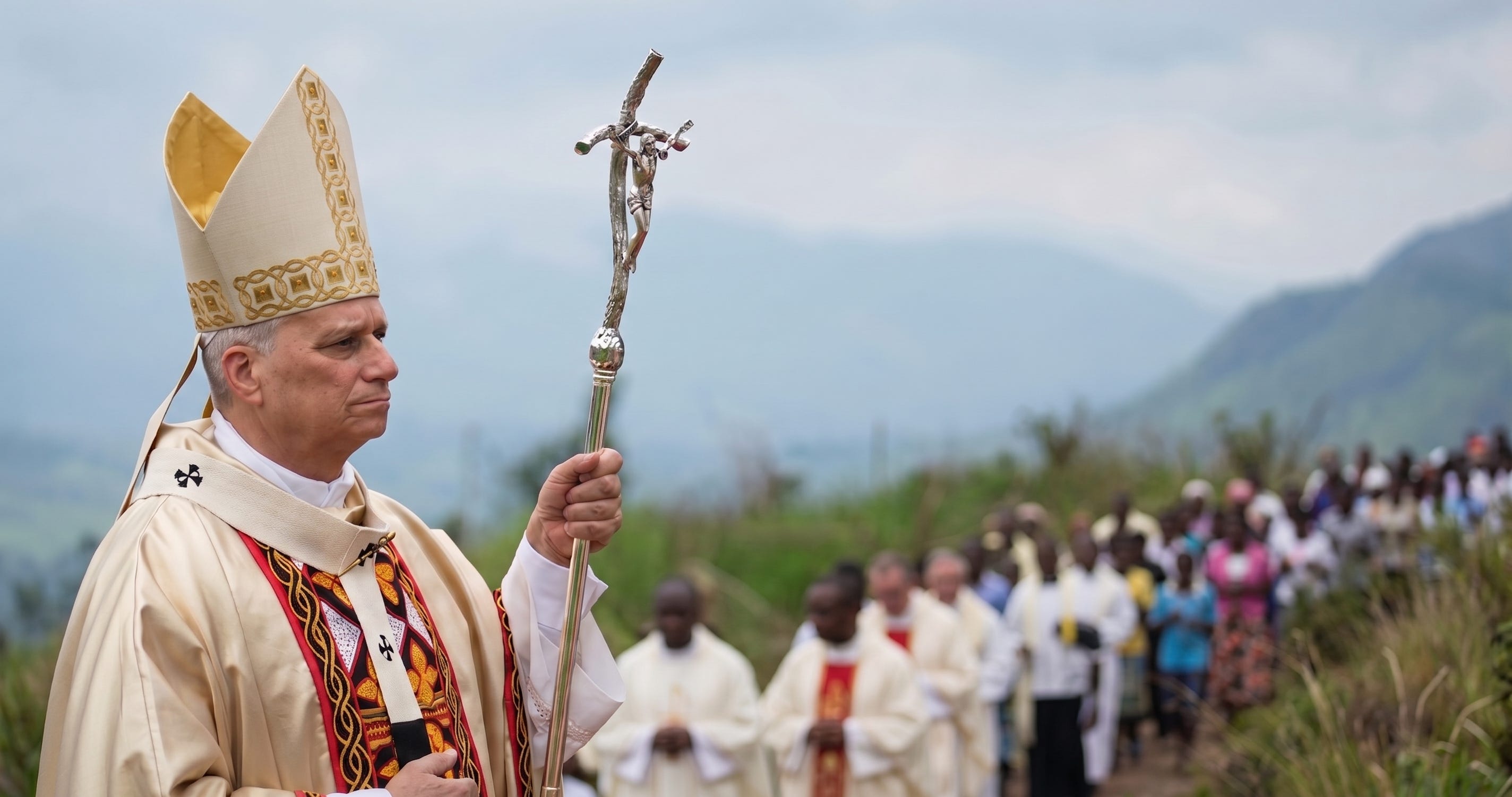
“Ravaged by a Handful of Tyrants” — Pope Leo XIV in Cameroon
Leo spoke from Bamenda, epicenter of a war that has killed 6,000 Cameroonians. The Trump administration’s attacks on the Church continue unabated.
Thank you for reading! Letters from Leo is a reader-supported publication. To receive new posts and support this movement, consider becoming a free or paid subscriber.
Before you read on, join 50,000 Americans and sign our letter to President Trump demanding that he apologize for attacking Pope Leo XIV. We’ll deliver it to the president via JD Vance.
Pope Leo XIV stood in Saint Joseph’s Cathedral in Bamenda, Cameroon, on Thursday and declared that “the world is being ravaged by a handful of tyrants, yet it is held together by a multitude of supportive brothers and sisters.”
The cathedral sits on land donated by the Mankon people, in the heart of a separatist conflict that has killed more than 6,000 Cameroonians and displaced over 600,000 since 2017.
The crisis began when English-speaking Cameroonians — marginalized for decades after a 1961 U.N.-backed merger with the French-speaking majority — launched a rebellion that humanitarian organizations now call one of the most neglected on Earth.
Separatist fighters announced a ceasefire for the pope’s visit, and jubilant crowds clogged the roads into the city, blowing horns and dancing, overjoyed that a pope had come this far to witness their suffering.
Leo’s words in that cathedral carried well beyond Central Africa.
“The masters of war pretend not to know that it takes only a moment to destroy,” he said, “yet often a lifetime is not enough to rebuild.”
He condemned leaders who “rob your land of its resources” and “generally invest much of the profit in weapons, thus perpetuating an endless cycle of destabilisation and death” — “a world turned upside down, an exploitation of God’s creation that must be denounced and rejected by every honest conscience.”
The pope called for a “decisive change of course” away from conflict and exploitation. “Woe to those who manipulate religion and the very name of God for their own military, economic, and political gain,” he said, “dragging that which is sacred into darkness and filth.”
Leo directed these remarks at participants in a Cameroonian peace meeting that included a Mankon traditional chief, a Presbyterian moderator, an imam, and a Catholic nun. He named no American official, and his address carried no reference to any foreign government.
The timing, though, speaks for itself. Leo arrived in Africa days after President Trump attacked him as “weak on crime” and “terrible for Foreign Policy,” claiming that “if I wasn’t in the White House, Leo wouldn’t be in the Vatican.”
The confrontation followed Leo’s public judgment that Trump’s threat to annihilate Iranian civilization was “truly unacceptable.”
Leo responded that he had “no fear of the Trump administration” and would continue preaching the Gospel.
Read Leo’s warning about those who drag “that which is sacred into darkness and filth,” and consider what happened at the Pentagon one day before his Bamenda address. Defense Secretary Pete Hegseth stood at a prayer service and recited what he presented as a reflection of Ezekiel 25:17.
The words were lifted nearly verbatim from Quentin Tarantino’s Pulp Fiction — the revenge monologue that Samuel L. Jackson’s hitman delivers before executing a man. Hegseth read the fictionalized scripture to bless combat search-and-rescue crews flying missions over Iran.
Weeks earlier, he had urged Americans to pray for “overwhelming violence” against enemies, while Leo used the same holy day to call on those with weapons to lay them down.
The Catholic Church has a long memory for confrontations between temporal power and moral authority. In 390 A.D., Ambrose of Milan refused communion to Emperor Theodosius after the emperor ordered the massacre of 7,000 civilians in Thessalonica.
Ambrose wrote that no imperial title could sanctify the killing of innocents and demanded public penance. Theodosius — ruler of the Roman Empire at its territorial height — knelt.
That episode established a principle Catholic teaching has carried forward for sixteen centuries: political power answers to a moral law it did not write and cannot rewrite.
Leo has drawn on that tradition throughout this crisis, insisting that Christians cannot side with those who launch bombs and calling the global appetite for war an “imperialist occupation of the world.”
From a cathedral in a conflict zone that the world has all but forgotten, the first American pope called this age what it is — an age of tyrants.
He placed his confidence in the brothers and sisters holding the world together against the violence raining down from above, and he warned that those who use God’s name to sanctify that violence will answer for it.
The rest belongs to the tyrants and whatever remains of their consciences.
At Letters from Leo, we stand with Pope Leo XIV and the Catholic faithful around the world who refuse to let God’s name be dragged into the service of war, exploitation, and political vanity.
From Bamenda to Washington, the question Leo raised in that cathedral is the same one Ambrose of Milan posed to an emperor sixteen centuries ago: Will those who wield power answer to the moral law, or will they pretend it does not apply to them?
This is the fastest-growing Catholic community in the country because people are hungry for a faith that confronts tyranny rather than baptizing it.
They want the truth that names the actors, follows the evidence, and insists on the dignity of every human life — from the forgotten villages of Cameroon to the neighborhoods targeted by ICE raids back home.
If you believe this movement matters — Catholics and people of goodwill standing for human dignity against the tyranny Leo named today — I am asking you to join us.
If you’d like to invest in our mission, here are three ways you can help this Easter season:
Subscribe as a paid member to receive exclusive posts about the life and formation of Pope Leo and help sustain this community.
Donate with a one-time gift to fuel this project’s mission.
Share this post (and Letters from Leo) with a friend who might enjoy it.
Paid members receive exclusive access to our ongoing biographical series on Pope Leo’s Life & Formation, our investigative coverage of The Epstein-Bannon Investigation, and the best of our full archive.
Whether you give $0, 5, $50, $500, or more, your presence here matters — no matter your faith or your politics.
Thank you for reading. I’ll see you on the road.


What struck me about this piece is that it frames the issue not just as political, but moral—about what happens when power becomes disconnected from accountability and from the people it affects.
It also raises a question about the role of ordinary citizens in moments like this. Many people can see what’s happening, but there’s rarely a clear, shared way for them to make their values and priorities visible before decisions are made in their name.
That gap seems important. When public priorities remain scattered or invisible, even strong moral clarity can struggle to translate into meaningful influence.
I’ve been working on a small volunteer platform called One Voice One Vote – Count and Deliver aimed at addressing that—giving people a structured way to document and surface shared priorities so they’re visible earlier and harder to ignore.
If helpful, I’ve shared more here: https://countanddeliver.org
Pieces like this highlight the moral stakes. They also point toward the need for structures that help people act on that clarity collectively.
I've joined this newsletter even though I am Episcopalian, and not particularly religious, in fact. But as an American who possesses moral clarity and who is distraught by the tyranny (especially when they use the lazy, cheap, ugly cop-out of religion to try to defend the indefensible) I welcome the leadership of anyone who is in a position to assert the soft, but critical power of moral clarity. I have deep respect for Pope Leo, and for the voices being raised around the country and the world in support of his message and work.