
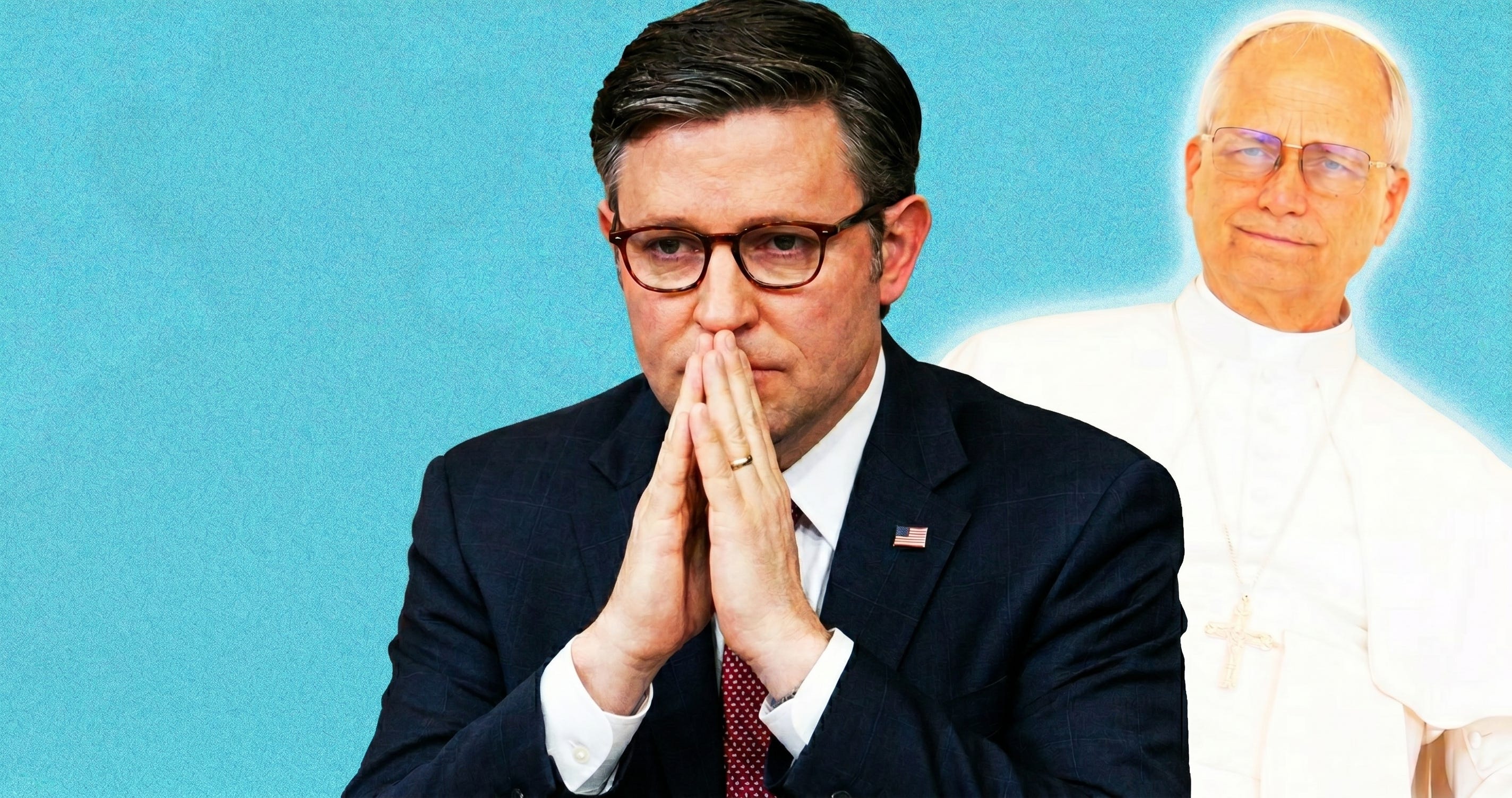
“Something Called the Just War Doctrine” — Speaker Johnson Lectures Pope Leo XIV on Augustine
The Speaker, an evangelical with no theological training, told Pope Leo XIV he misunderstands the doctrine his patron saint invented while the pope walked through the ruins of Augustine’s cathedral.
Thank you for reading! Letters from Leo is a reader-supported publication. To receive new posts and support this movement, consider becoming a free or paid subscriber.
Before you read on, join 50,000 Americans and sign our letter to President Trump demanding that he apologize for attacking Pope Leo XIV. We’ll deliver it to the president via JD Vance.
Speaker Mike Johnson stood at a House Republican press conference on Wednesday and offered Pope Leo XIV a theology lesson. “It is a very well-settled matter of Christian theology,” Johnson told reporters. “It’s something called the ‘just war doctrine.’”
He was responding to Pope Leo’s declaration that Jesus “does not listen to the prayers of those who wage war, but rejects them.” Johnson, a Southern Baptist with a business degree from LSU and a law degree he parlayed into running a law school that never enrolled a single student, felt the need to correct the pope on a point of Catholic theology.
The pope he was correcting is an Augustinian friar. Pope Leo XIV entered seminary at fourteen, spent eighteen years in continuous theological formation, earned his doctorate at the Pontifical University of St. Thomas Aquinas in Rome, and served twelve years as the worldwide head of the Order of Saint Augustine.
His patron saint — the namesake of his religious order, the figure whose writings shaped his vocation, whose thought he studied in his doctoral dissertation — is Augustine of Hippo.
Augustine invented the Catholic just war doctrine in the fourth century.
The same week Johnson offered his lesson from a podium in Washington, Pope Leo was walking through the archaeological ruins of Augustine’s cathedral in Hippo, Algeria.
He laid a wreath of flowers where Augustine preached sixteen centuries ago, planted an olive tree as a symbol of peace, and celebrated Mass at the Basilica of St. Augustine while a choir sang hymns in Latin, Berber, and Arabic drawn from Augustine’s own texts.
This is the second time Johnson has publicly lectured Pope Leo on theology.
In February, the Speaker published a 1,700-word essay on X laying out what he called “the biblical case for border security,” arguing that mercy toward migrants is an individual obligation but never a governmental one. He cited Romans 13 to claim that nations “bearing the sword” fulfill God’s will through enforcement.
The pattern has become unmistakable: Johnson keeps picking theological fights with a man who has spent his entire adult life inside the tradition Johnson claims to understand.
Johnson was not alone on Tuesday.
Rep. Troy Nehls of Texas told reporters the pope should “keep his nose in the church’s business and stay out of the political arena.”
Nehls — who was fired from a Texas police department for nineteen violations in a single year and later stripped of a Combat Infantryman Badge the Army confirmed he was never eligible to wear — offered no theological reasoning for his position.
Rep. Carlos Giménez of Florida, asked whether he sided with the pope or the president, answered that he was “for the pope for spiritual things and for the president for political things.”
It was the MAGA version of telling Pope Leo XIV to “shut up and pray.”
Their entire framework assumes Catholic teaching on war and peace is a spiritual abstraction rather than a concrete demand on the state.
Augustine wrote City of God to demolish exactly that assumption. Catholic social teaching does not recognize a wall between the spiritual and the political — the dignity of the human person makes claims on every institution, from governments to congresses to the men and women who lead them.
Vice President JD Vance, a Catholic convert who chose Augustine as his confirmation patron saint, made a similar argument this week — questioning whether the pope understood just war theory just hours after Pope Leo honored the man who created it.
The U.S. bishops’ doctrine chairman, Bishop James Massa, responded with a clarification on just war theory that I covered earlier today: a war can only be just as a defense against active aggression, and only after every effort at peace has been exhausted.
Augustine did develop the just war framework. He wrote it amid the collapse of the Roman Empire, and he never treated it as a permission slip.
War, for Augustine, can only be an act of grief undertaken to protect the innocent and restore order. The man who spent twelve years leading Augustine’s religious order as its Prior General — who prayed at his tomb, walked the ground where he preached, studied his writings in Latin as a seminarian in Rome — grasps the tradition that Johnson referenced on Tuesday.
Nothing in Johnson’s background, from a business degree to a law school with zero students, suggests he has engaged with it at any depth.
A political movement that needs religious cover for a war in Iran is attempting to conscript a sixteen-hundred-year-old Catholic doctrine into service, and the people doing the conscripting cannot name its conditions or its limits. Pope Leo can.
He has spent his life studying them. The gap between theological literacy and political performance has never been wider, and it is visible to anyone paying attention — including the twenty-one percent of the American electorate that is Catholic.
At Letters from Leo, we stand with Pope Leo XIV and the Catholic intellectual tradition against those who would strip its deepest teachings down to political talking points.
When a Speaker of the House tells the spiritual heir of Saint Augustine that he does not understand Augustine, something more dangerous than ignorance is at work.
A faith is being hollowed out for political convenience, and the people doing the hollowing have no idea what they are discarding.
In a country where the powerful now lecture the pope on his own tradition, the need for a Catholic community that refuses to be silent has never been more urgent.
Letters from Leo is that community — the fastest-growing Catholic movement in the country, built by readers who believe that faith demands more than sloganeering and that the Gospel makes claims the powerful cannot ignore.
If you believe this movement matters — Catholics and people of goodwill standing for the integrity of the faith against those who would weaponize it — I am asking you to join us.
If you’d like to invest in our mission, here are three ways you can help this Easter season:
Subscribe as a paid member to receive exclusive posts about the life and formation of Pope Leo and help sustain this community.
Donate with a one-time gift to fuel this project’s mission.
Share this post (and Letters from Leo) with a friend who might enjoy it.
Paid subscribers get exclusive access to the ongoing biographical series Pope Leo’s Life & Formation, deep investigative work like The Epstein-Bannon Investigation, and the best of our full archive.
Whether you give $0, 5, $50, $500, or more, your presence here matters — no matter your faith or your politics.
Thank you for reading. I’ll see you on the road.


I don’t care if he thinks himself a Catholic convert, none of these people are at all serious. Anyone who’s ever read the Bible or tried to understand Jesus words would know, they’re using it for votes and power, period. When I heard Trump say he was anti abortion the first time, I knew he had found his way in for getting all the Christians’ votes.
JD has changed his name, his political perspective, his biography, and his faith more than once. He is a seeker after something: is it God? is it meaning? is it a niche in an authoritarian political hierarchy? is it money? is it some kind of balm or peace to make up for his humiliations and losses and sense of incompleteness and shame? Who even knows? Certainly not JD himself, who will, one suspects, invent himself all over again, and more than once, before he is done.
He is to be pitied. He is not to be taken seriously, however, as he is not a serious man so much as he is a broken and rather desperate child; an unformed soul, a soul in chaos.