
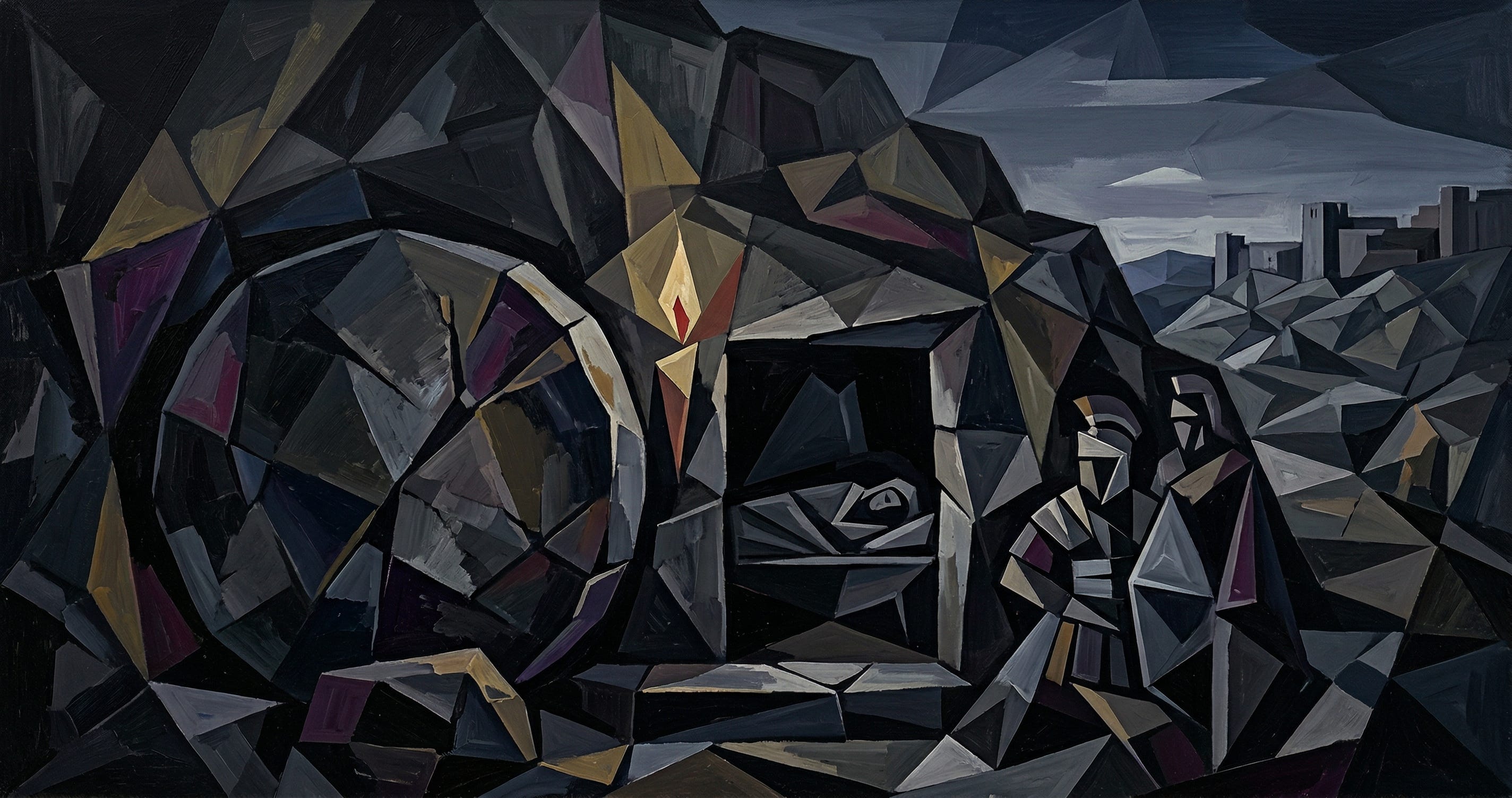
Something Strange is Happening
Holy Saturday is the only day of the year without liturgy, without readings, without even the Eucharist. The ancient homily prayed today asks us to sit in that silence and trust in God’s redemption.
Dear friends,
Letters from Leo is publishing daily Lenten reflections through Easter. This series has been exclusively available to paid subscribers, but as a token of gratitude, the remainder of the series will be free this weekend.
Each meditation explores what it means to follow Jesus more faithfully — not as partisans first, but as Christians whose consciences are shaped by the Cross.
It’s Holy Week, which means these are the most important reflections of the year, and it’s not too late to join.
New yearly subscribers and one-time donors of $80 or more receive a free copy of Christopher Lamb’s revelatory new book on Pope Leo XIV — and the extended deadline to claim yours is Sunday at midnight PT.
These reflections are personal writing: vulnerable, searching, and grounded in the conviction that repentance, renewal, and resolve are not abstract concepts but daily choices.
If they’ve meant something to you this Lent, I hope you’ll consider making a one-time gift to support our work.
I invite you to walk with us in these final days of the most sacred week of the year.
PS — I created a Spotify playlist for your Sacred Triduum reflection this weekend. It comes directly from recommendations made by this community. I hope it helps as you prepare for Easter Sunday.
“Something strange is happening.” — An Ancient Homily for Holy Saturday
For the only day of the year, there are no liturgical readings today. No Mass nor reception of the Eucharist. The tabernacle is empty, its door swung open. The altar has been stripped bare. The holy water fonts are dry. This is the only day of the entire liturgical year when the Church offers nothing — no sacrament, no scripture proclaimed aloud, and no liturgy at all.
Just silence.
Something strange is happening.
That phrase opens the ancient homily that priests and religious prayed this morning in the Liturgy of the Hours, a text attributed to the early centuries of the Church and often associated with the tradition of St. Augustine.
“Something strange is happening — there is a great silence on earth today, a great silence and stillness. The whole earth keeps silence because the King is asleep.”
The King is asleep. God is dead and buried, and the whole cosmos holds its breath.
The homily describes Christ descending to the realm of the dead, not as a defeated man but as a liberator. He finds Adam in the darkness and takes him by the hand. “Awake, O sleeper, and arise from the dead, and Christ shall give you light.”
The Lord enters death not to condemn but to rescue. Every soul held captive in that darkness walks free because he walked in first.
But we do not live inside that homily yet. We live in the silence before it.
Fr. James Martin has written that most of our lives are spent in Holy Saturday — “not in the unbearable pain of Good Friday, or the unlimited joy of Easter Sunday, but somewhere in between, waiting, hoping, wanting.”
He is right, and the observation cuts deeper than it first appears. Holy Saturday is the paradigm of human experience. We spend most of our days in the in-between.
The diagnosis has arrived but the results have not. The relationship ended months ago, and the healing still feels far off. Something precious was lost, and no explanation has surfaced. We sit with job uncertainty, with loneliness, with test results that have not come back yet, with a country that feels more broken every morning.
The great question is how we wait.
The most frequently repeated command in all of scripture — more than “love one another,” more than “repent” — is “be not afraid.”
The phrase appears hundreds of times across the Old and New Testaments. God, it seems, knows what we are most inclined to do when the silence descends: we panic and despair. We fill the emptiness with noise.
And so, again and again, through prophets and angels and his own incarnate voice, he says the same thing.
Do not be afraid.
The Greek word for faith is pistis. We tend to translate it as belief, as intellectual assent to a set of propositions. But that misses the heart of it.
Pistis means trust. It means confidence in someone whose faithfulness you have staked your life on.
Faith, in the biblical sense, is what happens when you sit in the dark and refuse to let go of the hand you cannot see.
Today invites us into that trust. Not the easy kind that arrives on Easter morning, when the tomb is empty, and the alleluias are ringing, and the story has resolved.
Something harder is being asked of us — the trust of the disciples crouched in a locked room, unable to see what comes next. The stone is still in place. And we are asked to believe anyway.
I will confess: I struggle with this kind of trust. My instinct in the silence is to fill it, to plan my way out, to manufacture certainty where none exists.
I suspect I am not alone in this. We live in a culture that treats waiting as a failure and silence as something to be solved.
But the Church, in her wisdom, gives us a whole day of nothing.
She refuses to rush past the tomb or skip ahead to the resurrection. Instead, she holds the grief of Friday and the hope of Sunday in the same breath, without resolving the tension. The biggest antidote to fear is stillness — the willingness to remain in the discomfort of not knowing and trust that hope is alive, whether we see it or not.
All of us sit in the pain of our brokenness today. We carry our own failures and the world’s corruption, suffering that has no explanation, doubts that visit even the most faithful, a heaviness that settles when the losses pile too high.
But being a Christian means knowing the story does not end at the tomb. We know our redemption is at hand.
Hope arises through suffering. It emerges most brightly in deprivation and darkness because it offers a vision that reaches beyond what is immediately at hand.
You can see it in the person who suffered intense loss and kept moving, in the one who stepped forward to love another with no promise of a return.
It shows up in the prayer of someone who doubts the existence of God and prays anyway. It sustains the person who endures suffering for the sake of another and finds unexpected strength in the act.
Part of me wonders if it was hope that powered Jesus’s resurrection from the grave, but all of me knows it is hope that fuels human redemption in people and communities every day.
Because Easter redemption is not first and foremost a historical event. It is a living reality that allows beauty to be born anew every day amidst the storms of history.
The ancient homily ends with Christ promising Adam not a return to the garden but something greater — a throne in heaven. The promise of Holy Saturday is that the silence is not empty. God is at work in the darkness. He always has been.
So today, wait. Sit in silence. Let the empty tabernacle speak. Be not afraid. The stone will move. It always does.
If you enjoyed this essay and would like to support this work with a one-time gift, it makes a real difference.
Thank you for reading. I’ll see you on the road.


Tu autem, domine, miserere nobis quoniam misericordiam tuam maneat in aeterum. deo gratias.
Thank you so much for the Spotify playlist, Christopher, it's truly inspiring and perfect for today ❣️🙏🏻🌷