
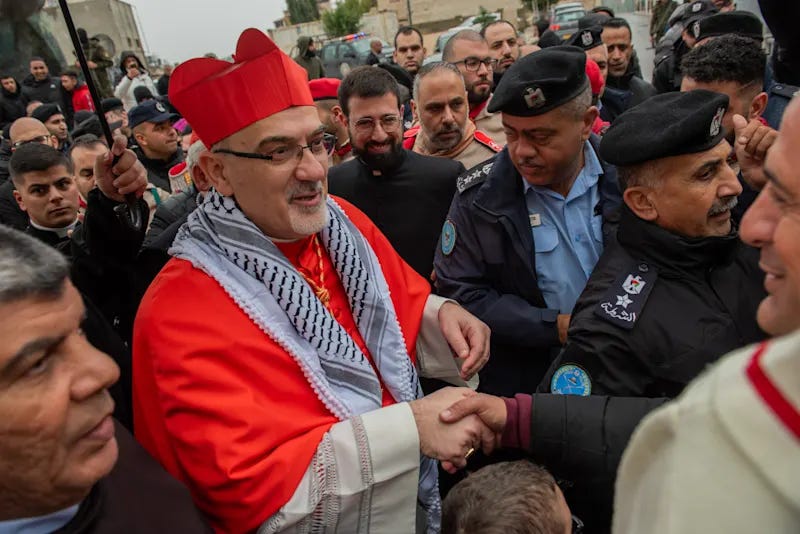
“The Gravest Sin” — Pope Leo XIV’s Middle East Envoy Rebukes Hegseth for Invoking God in Iran War
The Latin Patriarch of Jerusalem — who has walked the rubble of Gaza — responded to the Secretary of War’s Crusade theology with the sharpest rebuke from the Catholic Church yet.
Thank you for reading! Letters from Leo is a reader-supported publication. If you find value in my work, please consider becoming a paid subscriber or making a one-time donation.
March Madness is here. I’m running the first-ever Letters from Leo NCAA Tournament Bracket Pool. $26 entry fee. $500 to the winner — $750 if you pick a Catholic school to win it all. $1,000 if you pick Villanova. Sign up here before 11:45 AM ET Thursday.
Last Tuesday, Pete Hegseth stepped to the Pentagon podium and told reporters that the day ahead would be “yet again our most intense day of strikes inside Iran.” Then he bowed his head and read from Scripture.
“Blessed be the Lord, my rock, who trains my hands for war and my fingers for battle,” the Secretary of War intoned, drawing from Psalm 144. He concluded with his own prayer:
“May the Lord grant unyielding strength and refuge to our warriors, unbreakable protection to them and our homeland, and total victory over those who seek to harm them. Amen.”
Hegseth has made this a pattern.
In an interview with CBS News, he told viewers that “the providence of our almighty God” was protecting American troops in the war against Iran.
The invocations fit neatly alongside his 2020 book, titled American Crusade: Our Fight to Stay Free, in which he wrote that the United States faces a “crusade moment” echoing the 11th-century Christian invasion of the Holy Land.
His Jerusalem Cross tattoo — the symbol of the Crusades — once got him disinvited from a military unit’s detail to President Biden. Now it adorns the arm of the man running the U.S. military.
The man perhaps best positioned to respond to all of this is Cardinal Pierbattista Pizzaballa, the Latin Patriarch of Jerusalem — who lives in the Holy Land, ministers to a community caught between Israeli bombs and Hamas control, and has spent decades watching what happens when leaders wrap their wars in the name of God.
On Sunday, speaking at a webinar hosted by the International Oasis Foundation on the war consuming the Middle East, Pizzaballa was asked directly about Hegseth’s conduct. He didn’t equivocate.
“The abuse and manipulation of God’s name to justify this and any other war is the gravest sin we can commit at this time,” Pizzaballa said. “War is first and foremost political and has very material interests, like most wars. We must do everything we can to leave no room for this pseudo-religious language, which speaks not of God, but of ourselves.”
He continued: “As believers, we need to say that no, there are no new crusades. If God is present in this war, he is among those who are dying, who are suffering, who are in pain, who are oppressed in various ways, throughout the Middle East.”
Pizzaballa’s rebuttal carries a weight that few voices in the world can match. He is not a Vatican official issuing a statement from Rome.
He is a Franciscan cardinal who has walked the rubble of Gaza. He attended Christmas Mass in Bethlehem while Israeli tanks surrounded it.
After an Israeli tank shell struck the only Catholic church in Gaza last July, he traveled to the war zone to comfort his flock.
When Trump unveiled his Gaza Peace Board — a scheme Pizzaballa publicly condemned as a “colonialist operation” — Pope Leo XIV backed his cardinal’s judgment and refused to participate. The Vatican Secretary of State said simply: “The Vatican will not participate in the Board of Peace for Gaza.”
Pizzaballa’s critique of Hegseth’s theology echoed immediately among Christians with actual skin in the game.
What makes Hegseth’s posture so theologically reckless is precisely what Pizzaballa identified: it doesn’t speak of God.
It speaks of the speaker. Invoking divine blessing on a military campaign — one that has already killed more than 1,200 Iranians, including children — and reciting the Psalms of David as if American bombs are the fulfillment of biblical prophecy is not piety. It is the oldest trick in the book of power: borrowing the authority of heaven to launder the interests of earth.
The Catholic tradition has spent centuries wrestling with the moral conditions under which war can ever be justified.
Augustine developed the framework. Aquinas refined it. Every pope from Leo XIII to Leo XIV has affirmed it. The Church’s doctrine on war and peace does not offer a blank check to governments that sprinkle Scripture over their press briefings.
It demands that war be a genuine last resort, that violence not exceed the threat, that the innocent be protected — and that diplomacy be exhausted before a single bomb falls. Hegseth’s version of Christianity dispenses with all of that and replaces it with a theology of total victory, armed with Crusade imagery and a tattoo that belongs in a history book.
Pizzaballa didn’t stop at Hegseth. He used the webinar to say something that has gone almost entirely unnoticed in American media: Gaza has been forgotten.
The war on Iran, he warned, has swallowed the world’s attention — and behind that smoke screen, a humanitarian catastrophe grinds on.
According to Vatican News, Pizzaballa reported that 2 million Palestinians remain displaced, deprived of everything. Eighty percent of the Gaza Strip is still destroyed, with no reconstruction begun. Of the 36 hospitals in the Strip, none are fully operational — medicines are lacking, including basic antibiotics.
People are, in the cardinal’s own words, “literally living in the sewers.” He noted with evident frustration that even Trump’s Board of Peace “has not yet understood what it should do,” with the conflict locked in a vicious circle: Hamas won’t surrender its weapons until Israel withdraws; Israel won’t withdraw until Hamas surrenders its weapons.
“The images cannot convey the smells,” Pizzaballa said.
A man who has knelt on the floor of Holy Family Parish in Gaza City while bombs fell nearby does not speak those words as a figure of speech.
Pope Leo XIV has stood with his Latin Patriarch at every turn. When Pizzaballa called Trump’s Peace Board a colonialist venture, Leo backed him.
When the war on Iran began and a diplomatic channel through Oman had just produced nuclear concessions from Tehran, Leo called the strikes as a moral catastrophe.
He has called the blending of religious language with military aggression exactly what Pizzaballa called it — a manipulation of faith, a lie told in God’s name.
Hegseth’s Crusade theology has real victims. They live in Gaza’s sewers. They shelter in tents on the grounds of Holy Family Parish. They pray in Christmas Lutheran Church in Bethlehem, blocks from the birthplace of the Prince of Peace, watching as men in Washington borrow his name to bless their bombs.
Cardinal Pizzaballa said what the moment required: the gravest sin is invoking God to justify what God would never sanctify. The people of the Middle East — Christian, Muslim, Jewish — are the ones paying the price for that sin. And the Church’s job, as Pizzaballa put it plainly, is to say so.
At Letters from Leo, we stand with Cardinal Pizzaballa and the millions of Christians — Catholic, Lutheran, Orthodox, and others of goodwill — who believe that God is found among the suffering, not among those claiming divine cover for war.
When the Secretary of War reads Psalm 144 at a briefing to announce the “most intense day of strikes” against a country where children go to school, the Church’s obligation is clarity, not diplomacy.
This community exists because people are hungry for something more substantive than the Christian nationalism being sold from the Pentagon podium.
They want the actual Gospel — the one that says blessed are the peacemakers, the one that places God among those who are dying rather than those who are doing the killing. That hunger has never been more urgent than right now.
If you believe this movement matters — Catholics and people of conscience standing with the Church’s authentic moral voice against the weaponization of faith — I am asking you to join us.
If you’d like to invest in our mission, here are three ways you can help this Lenten season:
Subscribe as a paid member to receive exclusive posts about the life and formation of Pope Leo and help sustain this newsletter.
Donate with a one-time gift to fuel this project’s mission.
Share this post with a friend who needs to hear it.
Paid subscribers receive full access to the biographical series on Pope Leo’s life and formation, exclusive investigations — including how Epstein and Bannon plotted to take down Pope Francis — and the full Lenten Reflection Series.
Whether you give $0, $1, or $1,000, your presence here matters — no matter your faith or your politics.
Thank you for reading. I’ll see you on the road.


I think Pope Leo would chide you for not including a women’s bracket. I love and appreciate your work, but I’m honestly disappointed here. It seems minor in light of all of the awful things going on right now, but the systematic diminishment of the importance of women is not unrelated to all of the bad things going on right now.
The commandment to not take the Lord’s name in vain prohibits the very action Hegseth is taking: attaching God’s name to things not of God. Wars of aggression are not of God