
The Ground Is Shaking
The resurrection began with an earthquake. From the White House to St. Peter’s Square, two earthquakes taught me that this faith demands movement.
Dear friends,
Letters from Leo has been publishing a daily Scripture reflection series throughout Lent. This series has been exclusively available to paid subscribers, but as a token of gratitude, the reflections throughout the Triduum have been available to all.
Each meditation explores what it means to follow Jesus more faithfully — not as partisans first, but as Christians whose consciences are shaped by the Cross.
And yes, it’s Easter Sunday, but it’s not too late to join us on this journey.
New yearly subscribers and one-time donors of $80 or more receive a free copy of Christopher Lamb’s revelatory new book on Pope Leo XIV — and the extended deadline to claim yours is tonight at midnight PT.
These reflections are personal writing: vulnerable, searching, and grounded in the conviction that repentance, renewal, and resolve are not abstract concepts but daily choices.
If they’ve meant something to you this Lent, I hope you’ll consider making a one-time gift to support our work.
I invite you to walk with us on the most sacred day of the year.
PS — I created a Spotify playlist for your Easter Octave reflection. It comes directly from recommendations made by this community. I hope it helps as you rest in the peace of Easter.
I have experienced two earthquakes in my life.
The first was in 2011.
I was working in the Obama White House when a 5.8 magnitude tremor out of Virginia hit Washington. The building shook. People scattered into the hallways. For a few seconds, nobody knew what was happening, and in those seconds, everything that had mattered five minutes earlier — the meeting on my calendar, the memo on my desk, the email I was drafting — vanished. The only thing left was the ground beneath my feet, and it was moving.
The second earthquake was man-made. On May 8, 2025, I stood in the loggia overlooking St. Peter’s Square among 150,000 people when the bells of the basilica began to ring, and the white smoke curled into the Roman sky as the former Cardinal Robert Francis Prevost was elected Pope Leo XIV — the first American pope.
I felt the earth move beneath me. The roar of that crowd carried a physical force that rattled through my chest and into my bones.
Both taught me the same lesson.
An earthquake is never a domesticated event. The ground jolts your body into action before your brain catches up. It focuses the mind and strips away everything that does not matter, narrowing you down to what does. You do not think during an earthquake. You move.
Scripture tells us that the resurrection of Jesus Christ began with an earthquake.
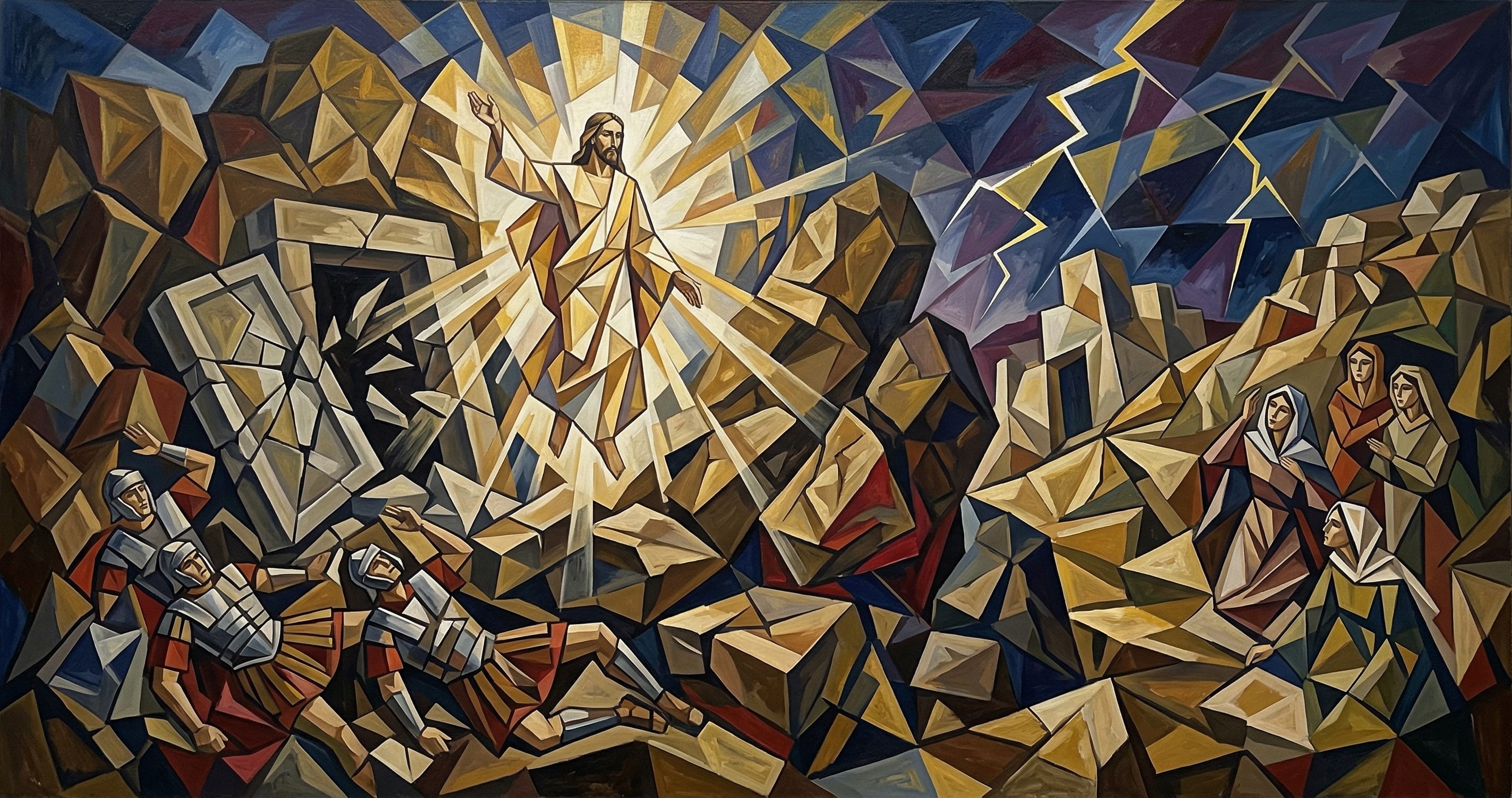
Matthew writes that on the first day of the week, as Mary Magdalene and the other Mary went to the tomb, “there was a great earthquake, for an angel of the Lord descended from heaven, rolled away the stone, and sat on it.”
The Greek word is seismos — the same root as seismic. God did not whisper the resurrection into being. He shook the earth to announce it.
The resurrection of Jesus Christ from the dead is not a theoretical fairy tale. This is a flesh-and-bone experience in the here and now. The ground moved as the stone rolled away. The guards fell like dead men, and the women ran towards the tomb.
Notice how the disciples react across every Gospel account. Excitement jumps off the page — and so does fear. There’s movement, speed, and a lot of running.
In John’s account, Mary Magdalene races to tell Peter and the beloved disciple, and then they sprint to the tomb — the younger one outrunning the older.
In Luke, the two disciples on the road to Emmaus recognize the risen Christ in the breaking of bread and get up that very hour to walk seven miles back to Jerusalem in the dark. Nobody sits still after encountering the risen Lord.
Pope Leo XIV, in his Easter Vigil homily last night, spoke of those first witnesses at the tomb.
The women, he said, saw “the power of God’s love, stronger than any force of evil” in the earthquake and the angel seated on the overturned stone. He is right. That power knocked Roman soldiers off their feet and sent women running through the streets of Jerusalem at dawn. It still shakes us today, if we let it.
The early Church understood this. The excitement of those first Christians bordered on audacity.
Paul’s taunt in his letter to the Corinthians captures what the resurrection earthquake unleashed in them: “O death, where is your sting? O hell, where is your victory!”
No one talks that way about a philosophical claim. Paul’s body had been seized by something so real, so overpowering, that death itself had become small.
Peter went to his own cross in Rome under Nero — not for an abstraction, but because he had met the risen Jesus in his flesh, and nothing could make him unsay what he had seen.
As we reflected throughout this Lenten series — from the promise Peter could not keep to the silence that costs us everything — we have been walking toward this day. Lent stripped us down, and the cross broke us open. Now the earthquake of Easter morning puts us back together — though differently than we were before.
The entire arc of the Jesus story compels his followers to make haste.
From conception to resurrection, urgency is woven into this faith. Mary made haste to visit Elizabeth when she learned she was carrying the Son of God. The shepherds rushed to Bethlehem. Mary Magdalene ran from the empty tomb. The Emmaus disciples walked seven miles in the dark to share what they had witnessed. Speed belongs to the Gospel because the news it carries cannot wait.
That charge belongs to us now. The growing temptation to reduce Christianity to a polite religion of ethics and platitudes — a faith without movement, without risk, without the bodily experience of being shaken — must be rejected.
As Pope Francis once warned, there are Christians whose lives seem like Lent without Easter. The empty tomb refuses us that comfort.
This is why the ancient hymn O Filii et Filiae — O Sons and Daughters — compels me every Easter. It is my favorite moment of the entire Triduum. Written by a Franciscan friar in the fifteenth century, each stanza builds toward the same single word: Alleluia.
The story of the empty tomb, the angel, Thomas’s doubt, his confession of faith — every verse, no matter its subject, ends in that eruption of uncontainable praise.
When it rings out through the church on Easter morning, you feel it in your chest the way I felt the crowd in St. Peter’s Square. Not as an idea, but as a force that moves through your body and demands you do something about it.
This Easter invites Christians to again to re-center our faith on the person of Jesus and his resurrection from the dead.
We mustn’t forget the story of our people: that God pitched a tent among us and shared our human lot in Jesus Christ.
To the poor, Jesus proclaimed the good news of salvation, to prisoners, freedom, and to those in sorrow, joy. In his death, our death was destroyed, and in his resurrection, our lives were restored.
And that we might live no longer for ourselves, he gave us a Holy Spirit to serve others and to renew the face the earth. In spite of our continual failings as individuals and as a society, God has never grown tired of loving us.
This Easter story isn’t simply for us, but also for the transformation of our families, our communities, our Church, our country and the entire world. The resurrection of Jesus Christ from the dead gives us a chance to reimagine and reconstruct human life and society once again.
It allows us to become collaborators in God’s great dreams for a world where everyone is welcomed, loved, and forgiven, and where every man, woman, and child experiences the salvation that Christ won for us in his death and resurrection.
Jesus Christ is risen from the dead! This is our faith, and this is the faith of the Church.
Two millennia later, and it is still good news indeed.
If you enjoyed this essay and would like to support this work with a one-time gift, it makes a real difference.
Thank you for reading. I’ll see you on the road.


The Resurrection narratives are the most bold and powerful stories ever written. They are not of human origins but an act of Divine triumph over human willfulness. Even though one may question their historical veracity and they do, in fact, Matthew’s narrative records the first century claim that the body was stolen and not raised.
Now on the next day, the day after the preparation, the chief priests and the Pharisees gathered together with Pilate,
Matthew-27:62
🩷🩷🩷🩷