
The Nuns Who Built Catholic America Are Living in a Lutheran Care Home
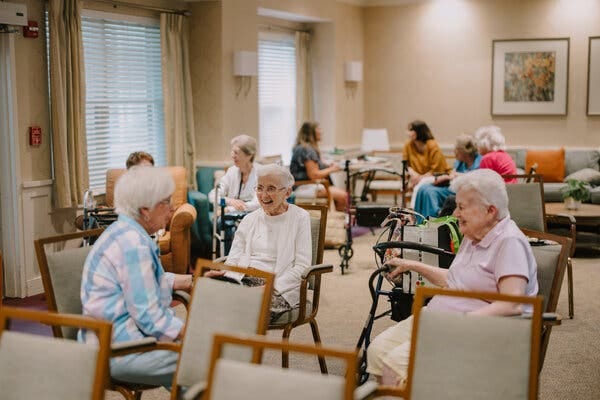
About eighty nuns make up more than a third of the residents at Wartburg in Mount Vernon, New York. Their final years are giving the Church one more lesson in gratitude, care, and Christian witness.

Sister Mary Stephen Healey is ninety-six, has had both knees replaced, and still gets up to dance. Happy hour at the Wartburg home in Mount Vernon, New York, comes every Friday at two o’clock. She leans on her walker and sways through “Save the Last Dance for Me.”
For fifty-nine years, the Catholic nun ran a school before retiring last year. Even still, she drives back three days a week over two crowded highways to teach Spanish.
I think it’s absolutely amazing that Sister Mary Stephen Healey, even at ninety-six, can joyfully live her vocation and continually continue to serve her community. It reminds me that a vocation lasts longer than a career and that our talents never cease to serve God, even in old age. It gives me great gratitude that she is still serving the people of God until her very last breath.

Healey’s story appeared in Thursday’s New York Times.
Here’s the kicker to me: Wartburg is owned and run by the Lutherans, founded in 1866 as a farm school and residence for Civil War orphans on 34 acres in Westchester County, just north of New York City.
About eighty Catholic sisters live there now, making up more than a third of its residents.
The sad reason why is that their congregations can no longer afford to house them.
“In 10 years, children will not know what a nun is,” Sister Stephen told the Times.
“They’ll be gone.”
The women behind the numbers
The United States counted more than 180,000 Catholic nuns in the mid-1960s. Roughly 35,000 remain today. Their average age has surpassed eighty.
In all of 2025, across the entire United States, seventy-four women professed perpetual vows, according to Georgetown’s Center for Applied Research in the Apostolate.
Eighty-two percent of American religious institutes had no perpetual professions at all.
Many people view the decline of religious sisters over the past fifty years as a failure. I don’t see it that way. I think it shows that women can serve the people of God, the Church, in a variety of ways, both as single women and as married women.
Of course, we want thriving religious communities, but religious communities don’t exist for their own sake. Their purpose is the salvation of souls and service to laypeople. Never forget that more than ninety-nine percent of this Church is lay, and that is for a reason.
Simply put, the women religious of the United States both built this Church and built this country. The Second Vatican Council makes it so clear that the Church, first and foremost, is not a building but the people of God.
The faith we inherit today, the faith we pass down to our children, comes directly from these women, and we owe them tangible support, personal prayers, and, finally, immense gratitude.
We tend to get caught up in numbers alone when we talk about Catholic schools and hospitals: the number of people served, the number of attendees, the number of Medicare and Medicaid dollars billed. Obviously, these institutions go so far beyond the numbers. So many of us can look back on our lives and be grateful to God that these sisters created institutions that formed us in the faith, healed us, and cared for us in times of need.
What Pope Leo told the sisters
On Wednesday, one day before Leland’s story appeared, Pope Leo XIV sent a video message to Orlando, where the Leadership Conference of Women Religious was marking its seventieth anniversary.
He thanked the sisters for their work in education and their care for the poor. “The Church needs you and all of the diversity and richness of the forms of consecration and ministry that you represent,” he said, “for with your vitality and the witness of a life centered on Jesus, you can contribute to waking up the world.”
Two things struck me about Pope Leo’s message. The first was the backlash from conservative figures online who mocked the LCWR for being elderly and not wearing religious habits. In our Church, we honor the elderly for their years and for their decades of service to God’s people.
Second, Pope Leo XIV gets it. His message fits the Church’s larger commitment to synodality. Women religious were among its first practitioners in their own communities, in the communities they serve, and in the secular world writ large. Despite their advanced ages, Pope Leo sees these women religious as a means of securing the future needs of the Church.
A debt that money cannot settle
Only four percent of American religious communities report being adequately funded for retirement, according to the bishops’ National Religious Retirement Office. The average religious receives $9,090 a year in Social Security, less than half the benefit paid to an average lay recipient, because these women spent their working lives in schools and hospitals that offered small stipends.
Care for one senior sister costs about $56,600 each year and reaches $96,000 when skilled nursing is required. The national collection raised $28.1 million in 2024, while care for aging religious cost more than a billion dollars.
We owe these sisters our gratitude and our resources. No woman religious who has served God should die in discomfort or poverty. They gave so much to us in our youth and throughout our lives, and we owe them our resources in their final years. There is no better investment in end-of-life care for God’s people. These women deserve it, and we should not hold back.
The Second Vatican Council makes it so clear that the Church exists both in an ecumenical capacity and an interfaith capacity. I think it’s a great testament to that vision that this Lutheran community is coming to the aid of these Catholic sisters. Jesus says his prayer is that they may all be one, and this is an embodiment of that dream. Christianity serves itself by going outside of itself, which adds to our faith, so we work with people of all stripes and we take help from people of all stripes to build the kingdom of God.
Thank you, sisters
Luke’s Gospel teaches that much will be expected from those who have been given much. We receive the gift that these sisters have given us with open hands so that we can share back with them and others. After giving them our resources and our prayers in these later years, the best thing we can do to honor their legacy is to serve the people to whom they gave their lives: the poor, the migrant, and the excluded.
American sisters have been the public conscience of this Church through particular acts of courage. Five hundred marched through Atlanta last summer for migrants and racial justice.

Sisters and priests in Texas placed their bodies between ICE agents and families. A ninety-one-year-old sister confronted JD Vance, and this July ICE arrested a sister walking to Mass.

Our talents never fail to serve God even to our dying breath. I think it encourages us to never think, even as we age, even as we are weak, even as we’re tired, that there isn’t some way that we can channel the love of God and give it to the world.
Wartburg gives us an answer, or at least the beginning of one. The sisters moved into a Lutheran care home and made themselves useful all over again. David Gentner, the home’s president, described them to Leland as vital, educated, and service-oriented.
Sister Mary Martin Delahanty, eighty-seven, taught and ran schools until she was eighty-one. Now she takes drink orders at happy hour and visits residents who are too frail to come downstairs. During “Ring of Fire,” Sister Mary Alice O’Brien, eighty-one, danced beside a man in a wheelchair and held his hand so he could move too.
At eighty-seven, they are still doing what they began at twenty-five. I wrote recently that Christians never retire from love. These women have supplied the footnotes.
“It’s not what’s in the glass that’s important,” Sister Jane said after one happy hour, where the only wine was red. “It’s what’s in the spirit that we share.”
Thank you, sisters. You gave the Church a human face, and we will need your courage for everything that comes next.
At Letters from Leo, we want to honor the sisters with our prayers, our resources, and service to the people they taught us to notice. If you believe that work matters, I am asking you to join us.
They are the living proof that a life is measured by what it gives away. In a country that has learned to treat the old as a line item and the poor as an inconvenience, these women have spent sixty and seventy years insisting that every single person is worth the trouble.
This is the fastest-growing Catholic community in the country because people are hungry for that kind of witness, and because they can feel it slipping away. Someone has to carry what the sisters carried.
If you believe this movement matters — Catholics and people of goodwill standing for human dignity in a moment when cruelty is policy — I am asking you to join us.
If you’d like to invest in our mission, here are three ways you can help:
Subscribe as a paid member to receive exclusive posts about the life and formation of Pope Leo and help sustain this community.
Donate with a one-time gift to fuel this project’s mission.
Share this post and Letters from Leo with a friend who might find hope in the sisters’ witness.
Paid members receive the ongoing biographical series on Pope Leo’s life and formation, along with our Epstein-Bannon investigation and the Sunday Scripture Reflection Series.
Whether you give $0, $5, $50, $500, $1,000, or more, your presence here matters — no matter your faith or your politics.
Thank you for reading. I’ll see you on the road.


The elderly nuns gave their lives to teaching and nursing. Unlike priests they took vows of poverty, and were not rewarded with any pension program from their hospitals or diocese.
Thank you, sisters, and Christopher, for bring this to us. I will upgrade when I can.